
Beacon Biosignals advances wearable EEG for sleep mapping with FDA-cleared Waveband
Beacon Biosignals is building AI-driven tools to interpret brain activity during sleep, combining clinical- and FDA-cleared hardware with analytics to extract objective EEG biomarkers from real-world data. The company positions its approach as a scalable alternative to lab-based polysomnography and a way to improve how clinicians and sponsors measure outcomes, making a focused case for wearable EEG for sleep mapping in clinical care and drug development [1][3].
Company background and funding that enabled scale
Founded in Boston in 2019, Beacon Biosignals set out to unlock EEG data with AI for neurology, psychiatry, and sleep medicine use cases [1]. The company raised a $27 million Series A in 2021 to expand its neurologist network, refine AI-augmented safety and reporting workflows, and deepen biomarker development [1]. It later upsized its Series B to over $97 million, bringing total funding above $132 million. Backers include Innoviva, GV, S32, Catalio, and General Catalyst, signaling investor confidence in EEG-based digital biomarkers as decision tools for drug development and clinical care [2][3].
Waveband (Dreem 3S rebrand): a wearable, FDA-cleared EEG for multi-night studies
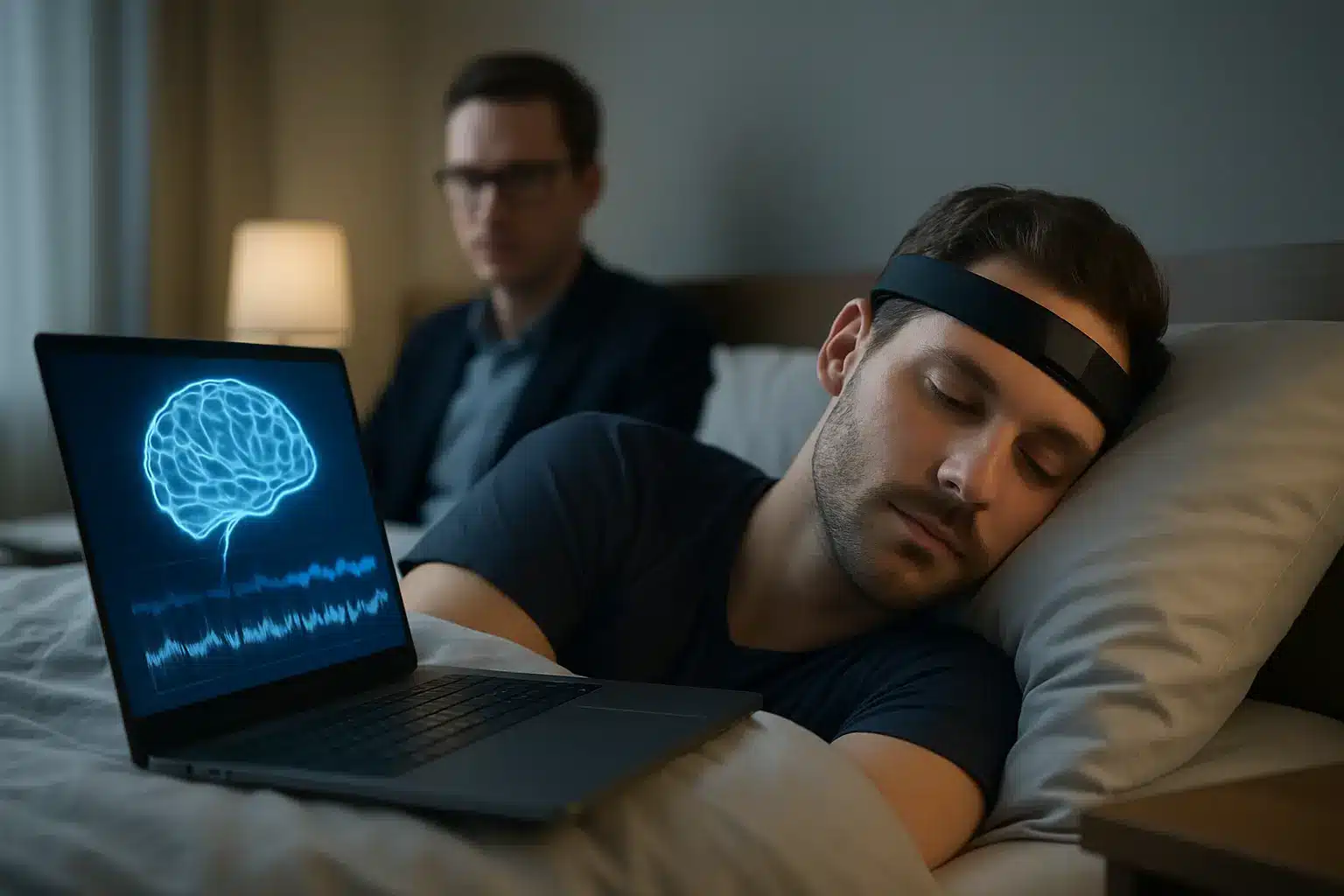
Beacon’s FDA 510(k)-cleared Dreem 3S EEG headband, rebranded as the Waveband EEG headband, is used in clinical trials to capture multi-night sleep and brain data outside the lab [3]. The company frames this at-home capture as a practical answer to sleep labs that are costly, low-throughput, and often subjectively scored. By shifting data collection into real-world settings, Beacon aims to boost throughput while standardizing the measurement process [1][3]. For context on the regulatory pathway for such devices, see the FDA 510(k) program (external).
Why wearable EEG for sleep mapping matters now
Traditional sleep evaluations rely on in-lab polysomnography that can be slow and hard to scale. Beacon’s model centers on at-home EEG for clinical trials and clinical care, providing multi-night recordings paired with analytics that offer consistent evaluation and standardized reporting across large cohorts [1][3]. This shift is designed to support high-throughput study designs and more frequent assessments, improving how teams track sleep architecture over time [1][3].
AI and analytics: converting raw EEG into standardized biomarkers
Beacon’s platform uses a curated, expert-labeled EEG database to train AI that automates sleep staging and detects subtle events such as microarousals or epileptiform activity. The resulting EEG sleep biomarkers give clinicians and biopharma sponsors quantitative readouts of brain activity to improve diagnosis, stratify patients, and measure treatment effects in real-world and at-home contexts [1][3]. The company highlights AI sleep staging, microevent detection, and treatment-response profiling as core capabilities designed to scale and standardize sleep analytics [1][3].
Use cases: neurology, psychiatry, sleep medicine, and drug development
Beacon targets neurology, psychiatry, and sleep medicine with digital biomarkers for sleep that can serve as objective endpoints and safety signals. The company’s partners use these tools to quantify brain function, evaluate therapies, and analyze how neuroactive compounds alter sleep architecture. Beacon also points to relevance for emerging psychedelics and other neuropsychiatric drug programs, where objective, brain-based outcome measures can support development and regulatory evaluation [1][3].
Operational advantages: scaling studies and integrating into trials
The company’s high-throughput infrastructure is built to standardize reporting and support AI-augmented safety workflows. Combined with the Waveband device, Beacon’s approach seeks to enable multi-night, decentralized data collection and consistent analytics across cohorts. For trial sponsors and clinicians, the aim is faster, more reliable insights from at-home EEG for clinical trials compared with traditional lab-bound workflows [1][3]. For ongoing context on the broader AI landscape in healthcare, see our coverage in the AI news section.
Practical takeaways for teams evaluating solutions
- For clinical teams: Consider how standardized, quantitative EEG sleep biomarkers could align with diagnostic and patient management workflows, especially where multi-night data can reduce variability [1][3].
- For sponsors: Evaluate whether AI-augmented sleep staging and real-world data collection can improve endpoint sensitivity and operational efficiency in pivotal or exploratory studies [1][3].
- For strategy and procurement: Factor the FDA 510(k)-cleared status of the Waveband EEG headband and Beacon’s focus on scalable analytics when comparing instrumentation and data platforms [3].
As funding and platform development continue, Beacon’s thesis is clear: pair clinically validated wearable hardware with analytics tuned for large cohorts, then deliver objective, brain-based measures that help clinicians and drug developers move faster with greater confidence [1][2][3].
Sources
[1] What is Brief History of Beacon Biosignals Company? – businessmodelcanvastemplate.com
https://businessmodelcanvastemplate.com/blogs/brief-history/beacon-biosignals-brief-history
[2] Beacon Biosignals Upsizes Series B Financing to Over $97 Million
https://www.bakersfield.com/ap/news/beacon-biosignals-upsizes-series-b-financing-to-over-97-million/article_4fe3848c-f5ab-5ea6-a221-1b117837c5a1.html
[3] Beacon Biosignals Upsizes Series B Financing to Over $97 Million – Beacon Biosignals
https://beacon.bio/news/beacon-biosignals-upsizes-series-b-to-over-97-million
