
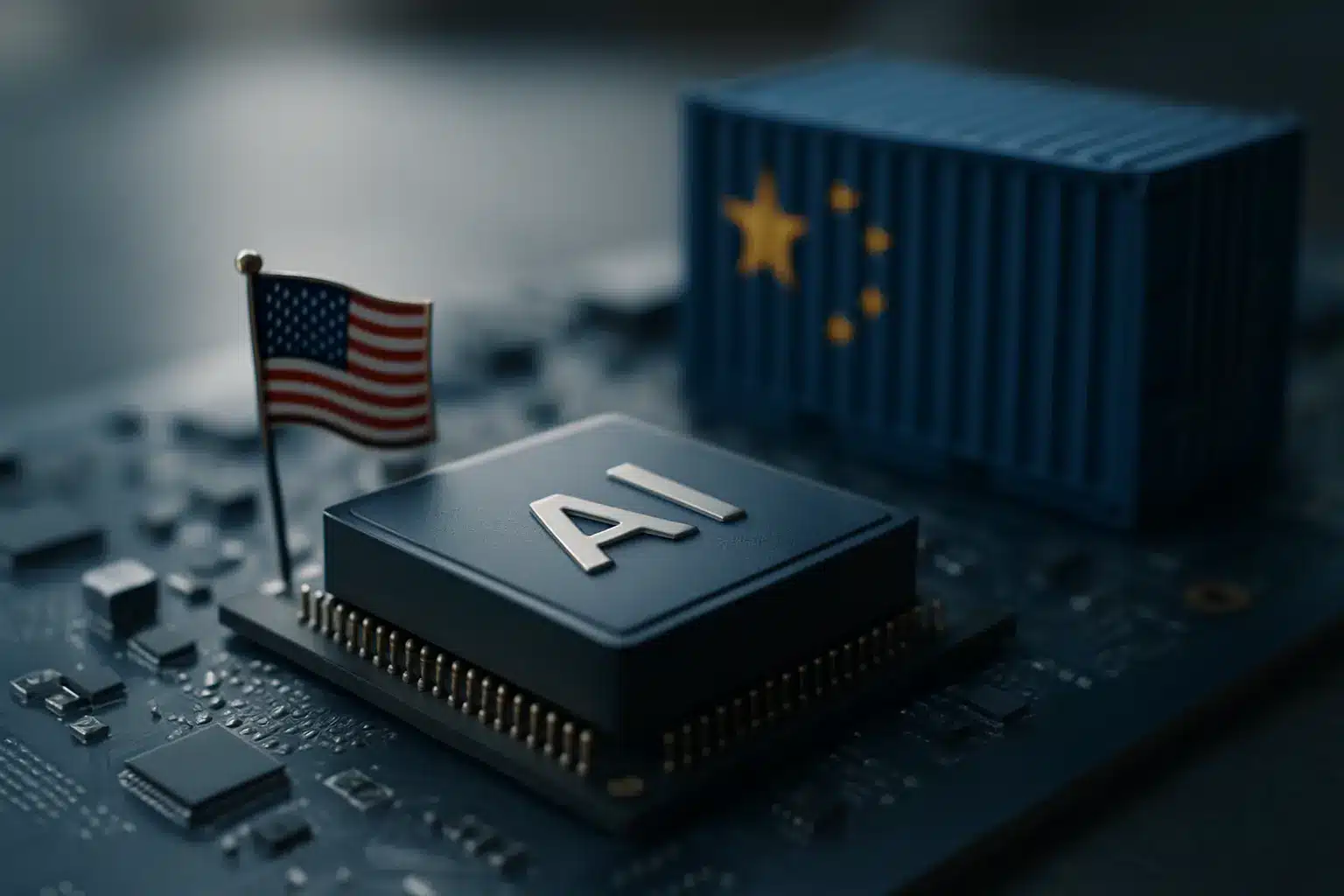
U.S. high-tech export controls on China: What they mean for tech, AI hardware, and supply chains
The U.S. is recalibrating its China strategy around targeted technology restrictions that directly affect chips, AI-enabling hardware, and cross-border investment. The shift to U.S. high-tech export controls on China matters because it aims to slow Beijing’s access to frontier capabilities while reshaping incentives for innovation and supply-chain planning across the global tech sector [1][2].
1) Executive summary: What business leaders need to know
Washington has moved from broad tariffs to targeted export controls focused on advanced and dual-use technologies, reframing trade policy as economic security strategy [1]. For operators in semiconductors and AI infrastructure, constraints on high-performance components affect sourcing, timelines, and compliance plans. Chinese firms face headwinds accessing frontier technologies and respond by exploring indigenous alternatives and import substitution, which can rewire demand and competitive dynamics [2]. Market watchers also look to U.S.–China diplomacy for signs of stability and clearer rules on tech and AI engagement [3].
2) The policy shift: From tariffs to targeted export controls
Analysts describe a structural change away from broad tariffs toward targeted measures designed to protect national security and slow Chinese technological upgrading [1]. In this framing, Trump-era and Trump-linked approaches sit inside a larger economic-security agenda that prioritizes critical technology leadership and risk management over generalized trade barriers [1].
U.S. high-tech export controls on China: what they aim to do
Controls now center on limiting access to advanced semiconductors, AI-enabling hardware, and other dual-use technologies with military and strategic relevance [1]. The goal is to constrain the speed and scope of Chinese upgrading at the technological frontier while channeling allied capacity toward resilient supply chains [1]. For reference on scope and definitions, see the U.S. Commerce Department’s Bureau of Industry and Security BIS overview (external).
4) Evidence from Chinese high-tech firms: innovation impacts and adaptation
Firm-level research finds that U.S. export controls restrict Chinese high-tech companies’ access to frontier technologies, which can hinder innovation outcomes [2]. At the same time, some firms pursue substitution or indigenous development to adapt, suggesting a mix of constraint and reorientation rather than a uniform halt of activity [2]. The interaction between limits on inputs and adaptive responses will shape competitive trajectories in segments like chips and AI-related components over time [2].
5) Business implications: supply chains, R&D decisions, and market risk
The immediate operational effect is pressure on procurement and design choices where high-performance components are implicated. Companies evaluating how export controls reshape AI hardware supply chains will need to revisit vendor lists, delivery assumptions, and compliance workflows [1]. For multinationals with China exposure, diversification moves and careful sequencing of R&D, manufacturing, and go-to-market plans can reduce disruption risk. Demand signals may shift as Chinese firms weigh local alternatives, which could change volume forecasts and product roadmaps [2]. Businesses also continue to watch U.S.–China engagements for predictable governance that supports long-horizon investment decisions [3]. For implementation references and practitioner tooling, explore AI tools and playbooks.
6) Policy coordination and the broader economic-security toolkit
The geoeconomics view highlights coordination among the U.S. and partners such as Japan on critical technologies and supply-chain resilience, using instruments that include export controls and investment screening [1]. This broader toolkit aims to align standards, reduce choke-point exposure, and manage cross-border financial and technology flows linked to sensitive capabilities [1]. For companies, that means monitoring parallel rulemaking across jurisdictions, especially where investment screening US China measures could affect capital allocation and partnerships [1].
7) Actionable guidance for firms
- Map product and supplier dependencies tied to advanced or dual-use technologies, with special attention to semiconductor export controls and AI-enabling hardware [1].
- Build scenario plans that capture supply interruptions, licensing outcomes, and design pivots toward compliant components [1][2].
- Reassess R&D and manufacturing footprints for exposure to restricted items and potential substitution pathways [2].
- Strengthen compliance programs to track evolving rules across allied markets and align procurement with the latest classifications [1].
- Engage industry groups and policymakers to seek predictability in rulemaking and to surface operational realities from the field [3].
8) Conclusion: strategic takeaways and forward-looking risks
U.S. high-tech export controls on China are now central to economic-security policy rather than a secondary trade tool [1]. Evidence points to constrained access to frontier tech for Chinese firms, alongside signs of adaptive innovation and substitution efforts that could alter competitive baselines over time [2]. Allied coordination and complementary tools like investment screening will add layers of governance that companies must design around [1]. As diplomatic visits and policy announcements unfold, executives should watch for stability signals that clarify compliance paths and reduce planning volatility in semiconductors, AI hardware, and adjacent supply chains [3]. For firms with material exposure, treating U.S. high-tech export controls on China as a durable planning assumption, not a temporary shock, is now the prudent course [1][2].
Sources
[1] Will Trump’s tech policies propel U.S. success against China?|News from the Institute of Geoeconomics(IOG)
https://instituteofgeoeconomics.org/en/research/2025080101/
[2] The impact of the U.S. export controls on Chinese firms’ innovation: Evidence from Chinese high-tech firms
https://www.sciencedirect.com/science/article/abs/pii/S1057521924004423
[3] Trump’s China visit watched in US for signs of stability
https://www.scmp.com/news/us/article/3353195/trumps-china-visit-watched-us-signs-stability-and-tangible-wins
