
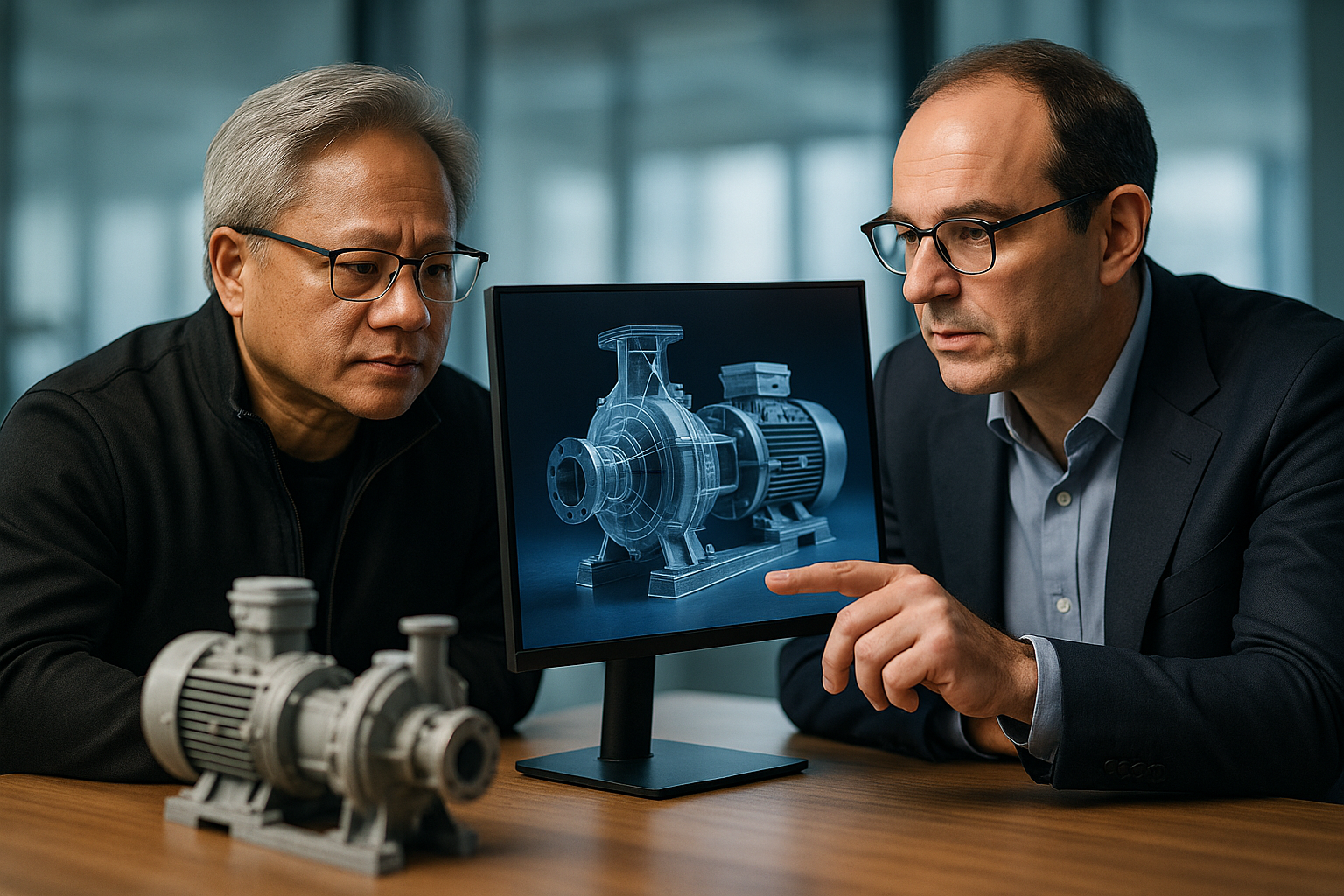
NVIDIA and Dassault Partner on an Industrial Virtual Twin Platform
At 3DEXPERIENCE World in Houston, NVIDIA CEO Jensen Huang and Dassault Systèmes CEO Pascal Daloz unveiled a long‑term collaboration to build an industrial virtual twin platform that unifies high‑fidelity modeling, accelerated computing, and generative biology. The companies framed their approach as “Industry World Models” that serve as physics‑ and science‑grounded systems of record for industrial AI—shifting away from isolated, probabilistic tools toward continuously validated virtual representations of products, factories, and biological systems [1][2][3].
Quick summary: NVIDIA and Dassault announce a shared vision
The NVIDIA Dassault partnership combines Dassault’s Virtual Twin technologies across design, simulation, manufacturing, and life sciences with NVIDIA’s CUDA‑X, Omniverse physical AI, and generative biology stack. The goal: near‑instant, physically accurate outcome predictions and autonomous, software‑defined operations across engineering, production, and R&D, with cloud delivery via the 3DEXPERIENCE platform and OUTSCALE [1][2][3][4][5]. For official details, see the NVIDIA press release (external) [2].
What is an Industry World Model and why it matters
Industry World Models are high‑fidelity virtual twins grounded in validated physics and science that enterprises can use as a trusted system of record for planning, optimization, and operations. By anchoring generative AI in verified simulations and industrial knowledge, organizations can move from probabilistic guesses to model‑based decision‑making that spans concept, design, manufacturing, and in‑field performance [1][2][3]. This approach is designed to improve continuity, reduce iteration costs, and enable continuous updates as real‑world data flows back into the twin [1][2][5].
Why an industrial virtual twin platform now
Dassault’s MODSIM methodology and SIMULIA Virtual Twin Physics Behavior will run on NVIDIA GPUs with CUDA‑X and AI physics libraries to accelerate simulations and provide rapid, physically accurate predictions across the product lifecycle. Coupling these models with Omniverse physical AI and DELMIA enables orchestration of autonomous, reconfigurable factories—particularly valuable amid supply chain disruption and cost pressures. In life sciences, Dassault’s BIOVIA integrates with NVIDIA BioNeMo to speed discovery in drugs and advanced materials using generative and simulation‑based methods, all delivered via 3DEXPERIENCE cloud and OUTSCALE [1][2][3][4][5].
Key platform components explained
- Omniverse physical AI: NVIDIA’s environment for connecting and simulating industrial data and workflows, here integrated with DELMIA to drive autonomous, software‑defined, reconfigurable plants [1][2][4].
- CUDA‑X and AI physics libraries: GPU‑accelerated stacks that boost SIMULIA’s Virtual Twin Physics Behavior for near‑instant, physically accurate outcome predictions [1][2][3].
- SIMULIA virtual twin physics: High‑fidelity, physics‑grounded simulation capabilities that inform model‑based decisions from design through manufacturing [1][2][3].
- DELMIA manufacturing twin: Digital models of production systems linked with Omniverse to orchestrate resilient, autonomous factory operations [1][2][4].
- BIOVIA BioNeMo integration: A combined generative and simulation‑based approach to accelerate molecules and materials discovery in life sciences and advanced materials R&D [1][2][3].
Use cases across engineering, manufacturing, and life sciences
- Engineering: MODSIM‑based workflows and SIMULIA Virtual Twin Physics Behavior running on NVIDIA GPUs deliver fast, accurate simulations to steer design choices, reducing iteration time and enabling continuous decisions across the lifecycle [1][2][3].
- Manufacturing: DELMIA manufacturing twins coupled with Omniverse physical AI support autonomous, software‑defined factories that can be rapidly reconfigured—an advantage for small and midsize manufacturers seeking resilience and cost efficiency, including packaged offerings under 3D UNIVERSES [1][2][4].
- Life sciences and materials: Integrating BIOVIA with NVIDIA BioNeMo accelerates the search for new drugs and advanced materials via generative models grounded by simulation, tightening discovery cycles [1][2][3].
Business impact: ROI, resilience, and operational continuity
By grounding generative capabilities in physics‑based virtual twins, organizations can reduce prototyping costs, increase uptime through predictive adjustments, and improve supply chain resilience via reconfigurable production. Dassault’s 3D UNIVERSES targets SMB needs with packaged virtual twin and AI capabilities to drive maintenance, quality, and operational efficiency, creating a practical on‑ramp for smaller teams to realize benefits sooner [1][2][4][5].
Deployment and delivery: 3DEXPERIENCE cloud, OUTSCALE, and AI factories
Dassault’s 3DEXPERIENCE platform and OUTSCALE will host AI factories and 3D Universes, delivering virtual twins, industrial AI services, and AI assistants via the cloud. This model centralizes deployment, governance, and updates while providing global access to validated models and continuous improvement pipelines—key for scaling across product lines and sites [1][2][4][5].
Adoption checklist for decision‑makers
- Define a pilot around a contained product, line, or discovery problem with measurable KPIs.
- Assess data readiness and simulation coverage (CAD/PLM, process models, lab data).
- Specify GPU capacity or cloud requirements for CUDA‑X‑accelerated workloads.
- Form a cross‑functional team spanning engineering, operations, and R&D.
- Plan for continuous validation loops feeding real‑world data into the twin [1][2][3][4][5].
For practical implementation approaches and ROI frameworks, explore our AI tools and playbooks.
Risks, validation, and governance
Trusted outcomes require rigorous model validation and continuous updates. Because Industry World Models claim grounding in physics and science rather than purely probabilistic outputs, governance should emphasize verification workflows, versioning, and auditability—especially in regulated domains like life sciences [1][2][3]. Cloud delivery via 3DEXPERIENCE and OUTSCALE concentrates model management and security controls to support enterprise‑grade oversight [1][2][4][5].
Bottom line: what organizations should watch next
Signals of maturity will include expanded integrations across MODSIM, SIMULIA, DELMIA, and BIOVIA; reference deployments of autonomous, reconfigurable plants; and case studies showing accelerated discovery with BioNeMo. As the NVIDIA Dassault partnership rolls out, expect more packaged offerings like 3D UNIVERSES aimed at SMB adoption, along with broader availability of cloud‑hosted AI factories on 3DEXPERIENCE and OUTSCALE [1][2][4][5].
Sources
[1] Dassault Systèmes and NVIDIA Partner to Build Industrial …
https://www.linkedin.com/pulse/dassault-syst%C3%A8mes-nvidia-partner-build-industrial-ai-platform-powering-zifle
[2] Dassault Systèmes and NVIDIA Partner to Build Industrial AI …
http://nvidianews.nvidia.com/news/dassault-systemes-nvidia-industrial-ai
[3] Dassault Systèmes & NVIDIA CEOs: Defining the Future of AI
https://businesschief.com/news/inside-dassault-systemes-nvidia-ceos-ai-announcement
[4] Industrial AI for Smart Manufacturing
https://www.3ds.com/insights/3d-universes/lean-adaptable-operations
[5] Agile Manufacturing with Virtual Twins
https://www.3ds.com/cloud/agile-manufacturing
