
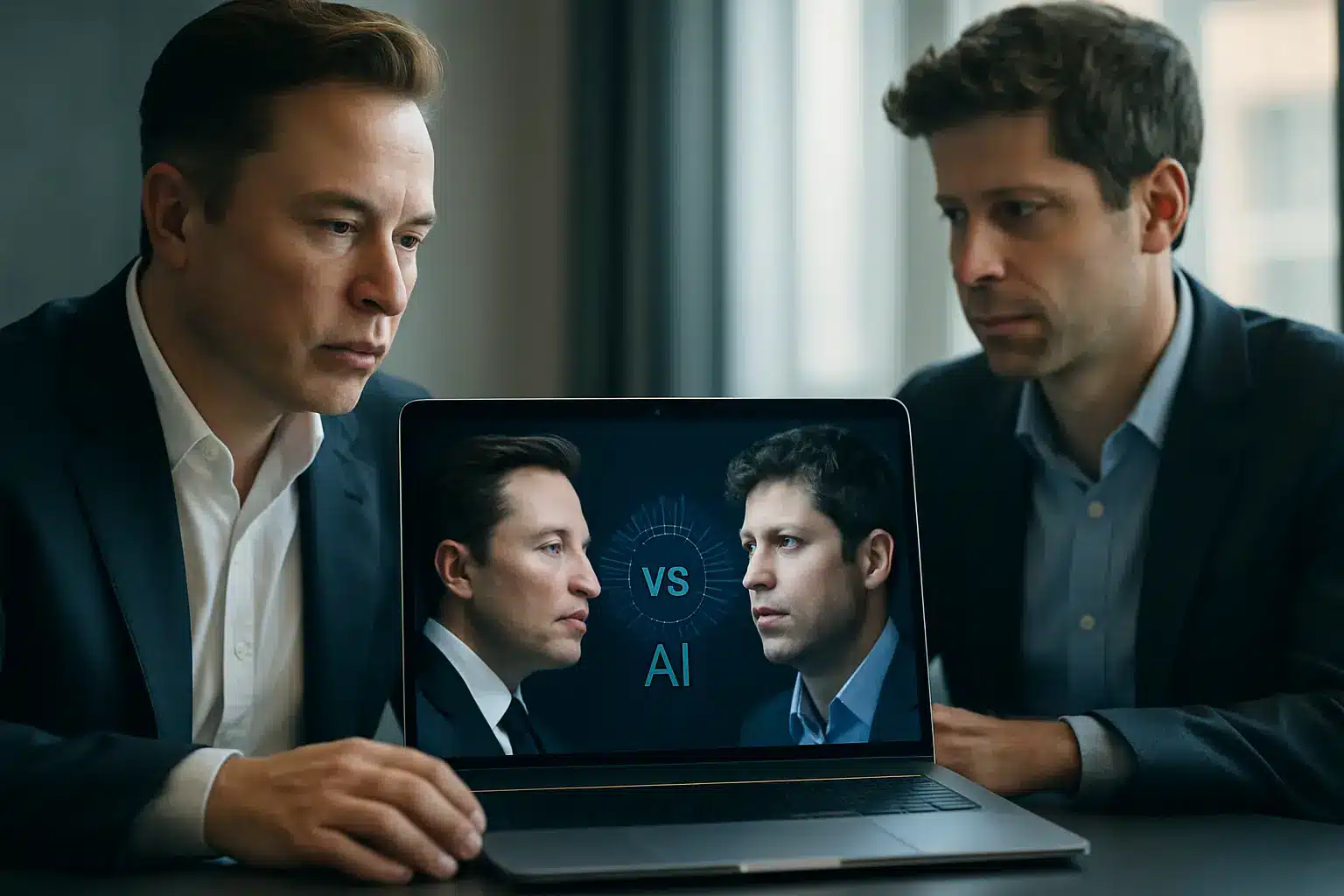
Musk v. Altman trial AI governance implications: what business leaders need to know
The legal showdown between Elon Musk and OpenAI leaders Sam Altman and Greg Brockman has moved from filings to the courtroom, with stakes that stretch far beyond one company. At issue are claims that OpenAI abandoned its public-benefit mission by shifting to a capped-profit structure, tying itself closely to Microsoft, and pursuing commercial scale. That frame makes the Musk v. Altman trial AI governance implications a live question for boards, investors, and enterprise customers deciding how to evaluate frontier AI partners [1][2][3].
What the filings and exhibits revealed
Discovery has surfaced a detailed paper trail from OpenAI’s earliest days. Exhibits show Musk drafted key portions of the founding mission and insisted on a nonprofit structure to guide development of powerful AI systems [2][3]. The records also highlight how early OpenAI leaned on Y Combinator and how cofounders raised concerns over Musk’s desired level of control [2][3].
The current case centers on whether OpenAI’s move to a capped-profit model and tight integration with Microsoft conflict with its original public-benefit understanding. Musk seeks governance changes, including potential leadership consequences, and additional funding for OpenAI’s nonprofit arm [1][2][3]. Coverage frames the dispute as both a power struggle over a valuable platform and a referendum on whether transformative AI should be steered by charitable-style governance or conventional corporate logic [1][3]. For readers tracking the evidence from Musk v Altman exhibits, these documents offer rare visibility into how founding choices reverberate when a research lab scales into a platform [2][3].
Musk v. Altman trial AI governance implications
The outcome is expected to influence how AI companies balance nonprofit aims, capped-profit structures, and investor returns. Analysts suggest the case could shape board design, fiduciary interpretation, and the use of nonprofit or foundation layers without causing immediate, catastrophic harm to OpenAI’s near-term operations [3]. For companies and investors studying the OpenAI governance dispute, the practical takeaway is to clarify mission lock mechanisms, escalation paths when commercial and public goals collide, and disclosure practices around major partner dependencies [1][2][3]. This is where AI corporate governance best practices are likely to evolve most visibly.
A useful comparative yardstick for boards considering governance updates is the broader corporate governance canon. For reference, see the OECD Principles of Corporate Governance (external). While not AI-specific, it helps structure questions on accountability, conflicts, and transparency.
Partnership and contract risks: Microsoft and beyond
Musk’s complaint ties OpenAI’s strategic pivot to its Microsoft partnership, which he argues undercuts the founding public-benefit approach [1][2][3]. For enterprise buyers and large partners, the near-term operational impact appears limited according to current analysis, but reputational and contractual risks warrant board-level review [3]. Key steps include:
- Assessing termination, change-in-control, and audit clauses in supplier agreements involving critical AI systems.
- Stress testing business continuity if key models or APIs become restricted or repriced following governance changes.
- Clarifying communications plans should legal developments trigger partner or regulator inquiries.
These moves also aid contingency planning if the court’s decisions or subsequent governance shifts alter how OpenAI prioritizes model access, pricing, or roadmap alignment with partners [1][3].
Is the AI job apocalypse overhyped? Evidence-based perspective
Recent research suggests AI is reshaping work more than erasing it outright. Studies show AI tends to substitute for routine, codifiable tasks while complementing complex, creative, or interpersonal work, altering skill demand and industrial structure over time [4]. Exposure appears higher for higher-income, degree-requiring white-collar jobs than for many low-wage manual roles, a pattern relevant to which white-collar jobs face highest AI exposure in the next wave of deployments [5].
Across estimates, most workers see at least some task-level impact, with a minority facing substantial displacement risk over roughly a decade, commonly in the low-teens to low-20s percent range depending on methods and assumptions [4][5][6]. Outcomes hinge on reskilling capacity, labor-market institutions, and active support for mobility and transitions rather than technology alone [5][6]. For executives, that argues for measured planning over alarmism.
What business leaders should do about workforce disruption
- Map task exposure, not just roles. Identify routine, codifiable activities most likely to be automated or augmented first [4][5].
- Build reskilling and redeployment paths anchored in complementary skills: problem solving, domain judgment, communication, and tool use [4][5][6].
- Update hiring and performance criteria to reward adaptability and fluency with AI systems where they complement core work [4][5].
- Partner with training providers and local institutions to expand capacity quickly. Align programs to the task mix your teams actually face [5][6].
- Coordinate HR, legal, and finance on transition supports, including flexible staffing models and social-insurance awareness to reduce friction in mobility [5][6].
For playbook templates and vendor evaluation checklists, you can Explore AI tools and playbooks.
Regulatory and reputational fallout to monitor
Regulators and policymakers are watching the governance questions surfaced by this case. Companies should prepare board-level documentation on mission adherence, oversight of model deployment risks, partner concentration, and incident response. Clear, consistent stakeholder communications will matter if court findings or governance adjustments raise questions about alignment between profit motives and public-benefit claims [1][3]. These steps also position teams to respond as Musk v. Altman trial AI governance implications unfold in case law and investor expectations.
Bottom line for investors, partners, and operators
Treat the lawsuit as a governance stress test rather than a solitary drama. Track how boards codify mission, structure capped returns, and disclose partner dependencies, since these are the practical Musk v. Altman trial AI governance implications likely to ripple into financing terms and diligence. Expect AI to keep shifting task portfolios, with concentrated exposure in higher-skill roles and a minority of jobs facing substantial disruption over a decade. Plan for complements and transitions now, and keep legal, procurement, and HR aligned as the Elon Musk OpenAI lawsuit analysis continues to evolve [1][3][4][5][6].
Sources
[1] The legal showdown between Elon Musk and Sam Altman begins …
https://www.cbsnews.com/news/elon-musk-openai-lawsuit-trial-sam-altman/
[2] All the evidence unveiled so far in Musk v. Altman – The Verge
https://www.theverge.com/ai-artificial-intelligence/920775/evidence-exhibits-elon-musk-sam-altman-openai-trial
[3] The Richest Grudge Match in History – The Atlantic
https://www.theatlantic.com/technology/2026/04/openai-trial-elon-musk-sam-altman/686984/
[4] How artificial intelligence affects the labour force employment structure from the perspective of industrial structure optimisation – PMC
https://pmc.ncbi.nlm.nih.gov/articles/PMC10907740/
[5] Measuring US workers’ capacity to adapt to AI-driven job displacement | Brookings
https://www.brookings.edu/articles/measuring-us-workers-capacity-to-adapt-to-ai-driven-job-displacement/
[6] [PDF] Policy Options for Addressing AI’s Impact on Employment
https://dash.harvard.edu/bitstreams/adfd9e2e-5c22-4fc0-9214-8a761d469faf/download
