
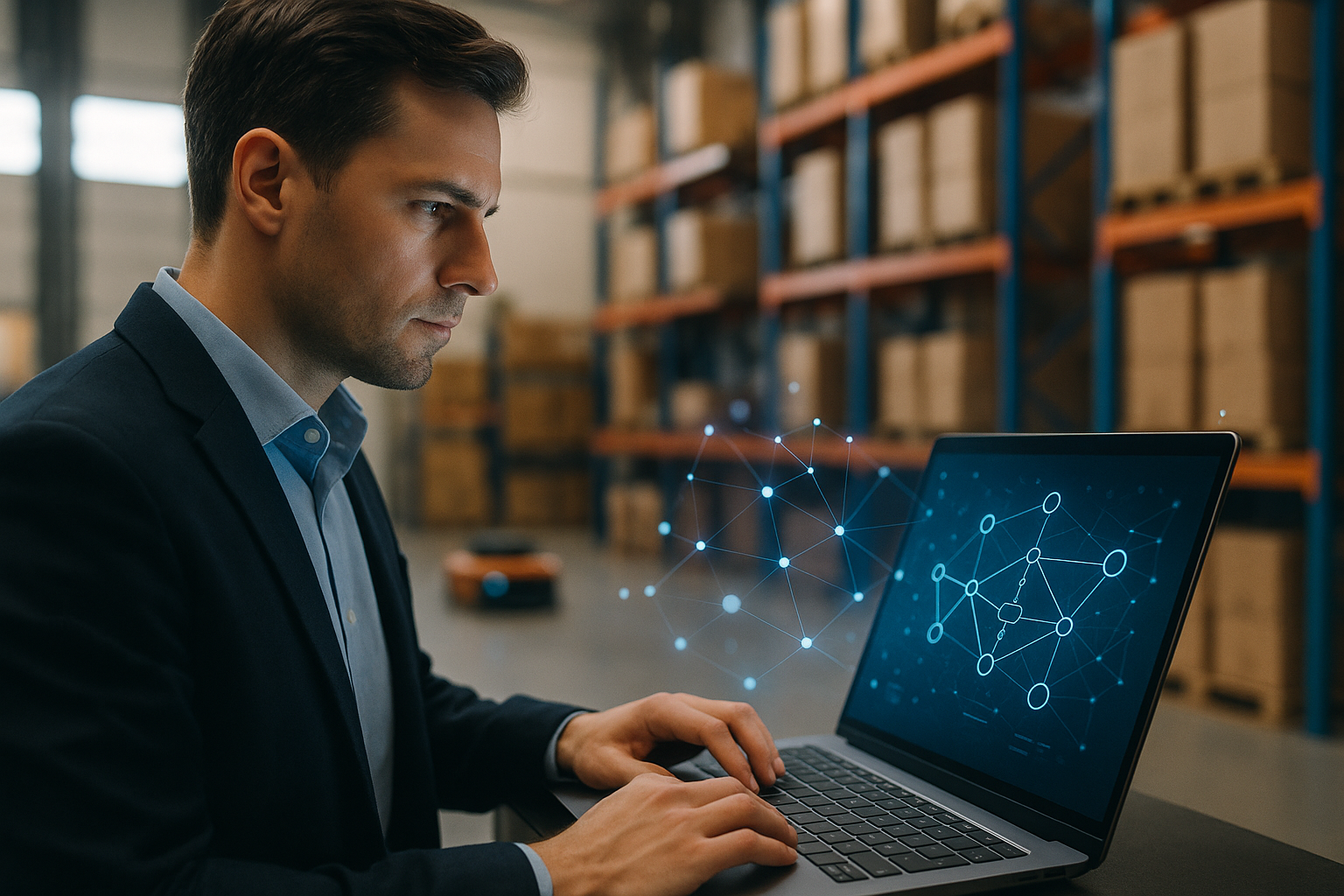
Multi-Agent AI for Warehouse Operations: The Command Layer Connecting Floor to Supply Chain
As manufacturers, retailers, and 3PLs race to modernize, multi-agent AI for warehouse operations is emerging as the command layer that connects real-time data, autonomous agents, and cross-functional planning. By fusing feeds from IoT sensors, RFID, scanners, and robots into a live digital twin, operations teams can continuously optimize slotting, routing, labor allocation, and energy usage—reducing travel time and bottlenecks while increasing fulfillment speed and accuracy [1][2].
What a Warehouse Digital Twin Looks Like in Practice
A warehouse digital twin aggregates continuous signals from the floor—inventory scans, robot telemetry, worker location, equipment status—into a synchronized view of inventory, queues, and asset states. This foundation supports dynamic decisions about pick-paths, replenishment, and dock scheduling. In practice, these systems adjust slotting assignments, reprioritize orders, and reconfigure storage layouts to cut picking times and travel distances while improving accuracy [1][2].
- Real-time visibility: Sensors and scanners maintain up-to-the-minute inventory positions and task queues [1][2].
- Optimization at the edge: AI-driven slotting optimization and routing minimize congestion and wasted motion [1][2].
- Continuous improvement: Systems learn ordering patterns to place items together, accelerate bundle assembly, and streamline fulfillment [1][2].
Multi-Agent AI for Warehouse Operations: Robots, Software Agents, and Human Workers
Multi-agent robotics coordination brings together physical robots, software agents, and human workers under shared policies. AI brokers task assignments in near real time, shifting resources as priorities change—such as rush orders or a surge in returns—while maintaining safety and throughput. During peak season, policies can reroute robots around congestion, rebalance labor between picking and packing, and elevate replenishment tasks to sustain service levels [1][2].
Explainable AI in warehousing helps operators understand why the system moved a high-velocity SKU closer to a pack station or reprioritized a carrier pickup window, preserving trust and enabling human-in-the-loop overrides when needed [2]. When implemented well, this command layer reduces errors and idle time, while ensuring that humans, bots, and software agents collaborate effectively on the same, synchronized plan [1][2].
Operational Use Cases: Slotting, Routing, Labor Allocation, and Energy
The most common high-impact starting points include:
- Slotting and re-slotting: Optimize storage layouts by demand patterns and affinity to shorten pick paths [1][2].
- Pick-path routing: Minimize backtracking and congestion with continuously updated routes [1][2].
- Labor orchestration: Balance picking, packing, and replenishment workloads as order priorities shift [1][2].
- Asset and energy management: Improve equipment utilization and reduce energy consumption via smarter task sequencing and idle-time reduction [1][2].
Operations teams can track KPIs such as pick rate, order accuracy, worker travel distance, dock-to-stock time, equipment utilization, and energy per order to quantify ROI and guide iterative improvements [1][2].
Ambient IoT and End-to-End Supply Chain Visibility
Ambient IoT extends the digital twin beyond the building, continuously streaming item location and condition data from warehouse to truck to shelf. This enables predictive modeling, automated replenishment decisions, and proactive risk management that surpass traditional ERP snapshots. With real-time signals, supply chain teams can optimize inventory positioning, allocation, and in-transit diversion to match demand while reducing stockouts and waste [3].
Network-Level Intelligence: Integrating Warehouses with Procurement, Merchandising, and Finance
When the warehouse becomes a strategic sensor and actuator within the enterprise, AI connects operational decisions with planning across logistics, procurement, merchandising, and finance. NVIDIA’s use of interconnected planning models illustrates how aligning supply, demand, and financial planning can convert the supply chain from a cost center into a growth engine [4][6]. In retail and CPG, agentic AI also supports internal operations, employee assistance, and customer engagement—feeding field demand signals back into planning loops for better responsiveness [5].
Explainability, Governance, and Human-in-the-Loop Controls
Trust and transparency are critical as AI policies reprioritize orders and adjust layouts. Explainable recommendations and auditability allow supervisors to validate decisions, enforce safety constraints, and intervene when needed [2]. For additional governance guidance, see the NIST AI Risk Management Framework (external).
Implementation Roadmap and Practical Considerations
A pragmatic path to an AI command layer:
- Data readiness: Ensure clean integrations for IoT, RFID, WMS, and robotics data to power the digital twin [1][2].
- Pilot high-impact cases: Start with slotting, routing, or labor orchestration where value is measurable and quick to realize [1][2].
- Integrate ambient IoT: Extend visibility to transport and retail endpoints for predictive replenishment and risk mitigation [3].
- Scale to planning: Connect warehouse signals to logistics, procurement, merchandising, and finance for integrated decision-making, following models highlighted in NVIDIA’s ecosystem [4][6].
- Build governance: Embed explainability and human-in-the-loop controls into workflows and SOPs [2].
For additional playbooks on evaluation and rollout, Explore AI tools and playbooks.
Conclusion
A multi-agent AI command layer, anchored by a warehouse digital twin and extended by ambient IoT, enables real-time optimization of slotting, routing, labor, and energy while generating high-resolution supply chain intelligence. As vendor examples show, integrating warehouses with planning across the business aligns supply, demand, and financial outcomes—and turns operations into a strategic differentiator [1][2][3][4][5][6].
Sources
[1] AI in Warehouse Management: Impacts & Use Cases
https://www.invensis.net/blog/ai-in-warehouse-management
[2] AI in Warehouse Management: Impacts and Use Cases – Oracle
https://www.oracle.com/scm/ai-warehouse-management/
[3] AI in Supply Chains: Smarter Visibility with Ambient IoT – Wiliot
https://www.wiliot.com/ai-in-supply-chains-visibility-optimization-transformation
[4] The Supply Chain Behind NVIDIA’s Meteoric Rise | Anaplan Blog
https://www.anaplan.com/blog/supply-chain-behind-nvidia-meteoric-rise/
[5] From Warehouse to Wallet: New State of AI in Retail and CPG …
https://blogs.nvidia.com/blog/ai-in-retail-cpg-survey-2026/
[6] NVIDIA’s Supply Chain, Decoded: How It Outperformed the Industry …
https://medium.com/@Leo-Analysis/comprehensive-analysis-nvidias-supply-chain-performance-measurement-2f9dc98e61dd
