
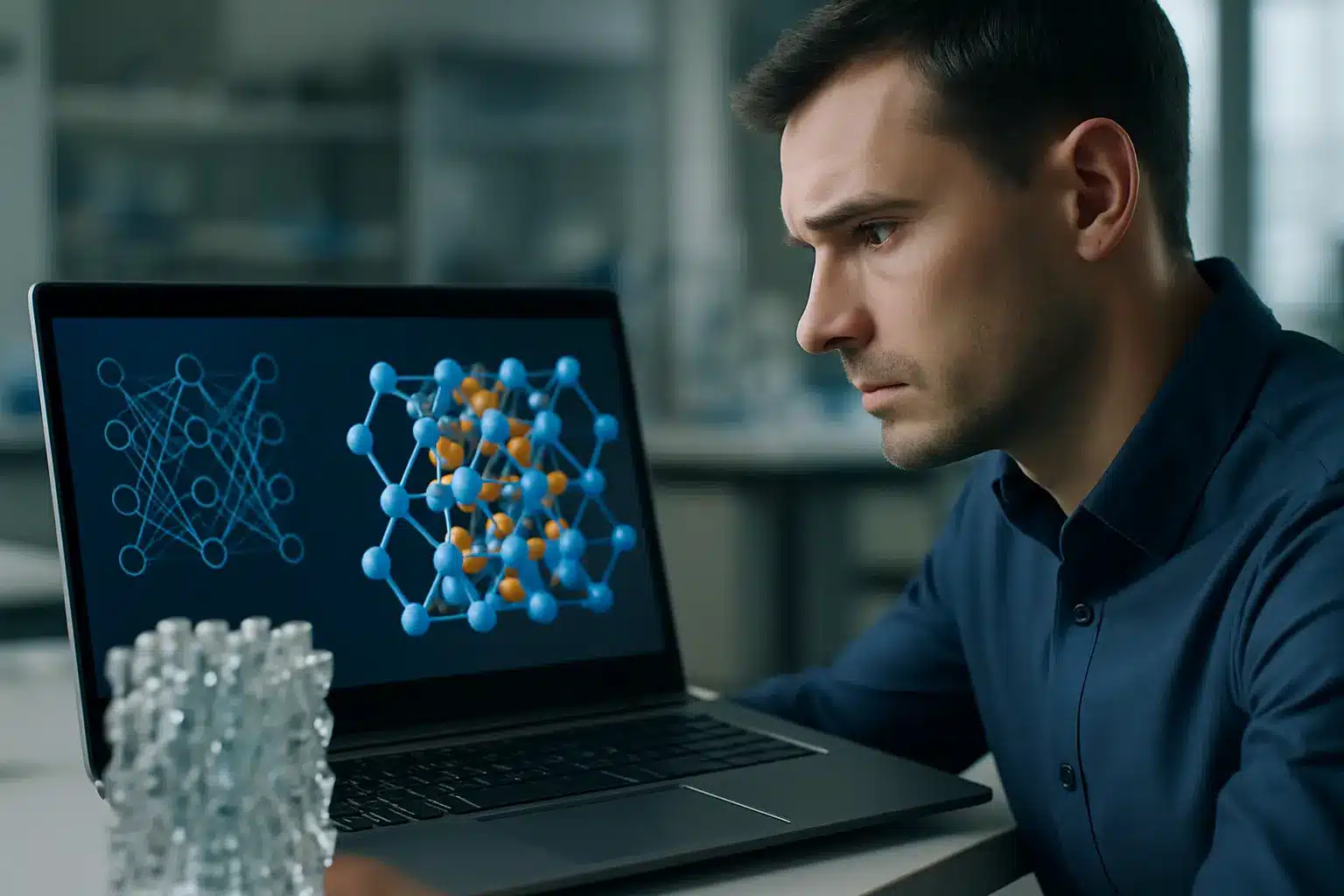
Advancing AI for materials with the MatterSim-MT multi-task materials model
MatterSim and its multi-task extension advance atomistic simulation with a single AI model that predicts a rich set of materials properties across broad chemistries and conditions. The MatterSim-MT multi-task materials model is trained on large-scale first-principles data, aiming to compress expensive quantum-mechanical calculations into fast surrogates for screening, simulation, and experimental planning [1][2][3].
Quick summary: What MatterSim and MatterSim-MT are
MatterSim and MatterSim-MT are AI models for atomistic simulation that move beyond traditional interatomic potentials toward a materials foundation model trained on density functional theory data. MatterSim-MT is designed to handle arbitrary elemental combinations across wide thermodynamic conditions, reaching about 5000 K and 1000 GPa, while supporting unified, multi-property prediction for in silico characterization [1][2]. Technical readers can dig into the arXiv preprint for details [1].
Key capabilities: multi-task predictions beyond energies and forces
MatterSim-MT jointly predicts energies and forces alongside vibrational and thermal transport quantities, as well as electronic-structure-derived observables. These include maximum phonon frequencies, phonon group velocities, atomic Bader charges, magnetic moments, Born effective charges, and dielectric tensors, enabling characterization and simulations under external perturbations such as electric fields using one model [1][2][3]. For teams evaluating a DFT surrogate model, this scope reduces model switching and simplifies workflows for screening and design [1][2].
Practical implications include:
- Using phonon prediction AI to assess dynamical stability during structure screening [1][2].
- Estimating thermal transport behavior with a thermal transport AI model to prioritize candidates [1][2].
- Leveraging Bader charge prediction AI and dielectric tensors to anticipate field responses and bonding characteristics [1][2][3].
Why the MatterSim-MT multi-task materials model matters now
Benchmarks highlight strengths in phonon-related properties. Reported errors are around 1 THz for maximum phonon frequencies and about 23 km/s for phonon group velocities, both central for evaluating dynamical stability and heat conduction pathways in materials [1][2]. The framework can rapidly approximate phase stability and other finite-temperature behaviors, which supports high-throughput screening and faster down-selection before more costly calculations [1][2].
Performance highlights and benchmarks
Beyond individual metrics, the multi-task setup helps produce consistent predictions across energy, force, vibrational, and transport targets. This coherence supports integrated analysis where one set of outputs informs the next stage of simulation or experiment planning [1][2]. The coverage of arbitrary elemental combinations and extreme conditions up to roughly 5000 K and 1000 GPa broadens applicability across chemistry and pressure-temperature space, which is useful for exploratory campaigns and early-stage materials discovery [1][2].
Use cases for businesses and R&D teams
The models can serve as fast filters in discovery pipelines. MatterSim-MT can estimate phase stability within minutes, accelerating pre-screening before committing to full first-principles runs or lab work [1][2]. For R&D groups, that translates into:
- High-throughput screening of structures with phonon stability checks and transport-relevant signals [1][2].
- Prioritizing candidates for synthesis using multi-property outputs that anticipate behavior under fields and at finite temperature [1][2].
- Accelerating simulation campaigns by substituting a DFT surrogate model during early iterations, then confirming top picks with higher-accuracy methods [1][2][3].
Limitations and best practices
Performance is bounded by the underlying reference data. MatterSim-MT is trained on PBE-based DFT, and accuracy may degrade for strongly correlated materials or chemistries where this functional is less reliable [1][3]. Coverage across composition and structure space, while broad, remains incomplete, so untested regimes may show failure modes [1][2][3].
Mitigations include fine-tuning on higher-accuracy electronic-structure data to correct systematic errors. The developers note that such fine-tuning is supported and can improve predictive reliability. Teams should validate on domain-relevant benchmarks, monitor confidence when extrapolating, and treat high-stakes decisions with confirmatory calculations or experiments [1][3].
Integration and roadmap: extensibility and pipeline tips
The framework is general. Additional first-principles-computable properties can be integrated using the same multi-task strategy, pointing toward increasingly comprehensive materials foundation model development over time [1][2]. For integration:
- Start with a pilot that measures speedup and fidelity when swapping in MatterSim-MT for early-stage screening, then escalate to broader deployment [1][2][3].
- Track property-specific error behavior, especially around phonons and transport where current strengths are evident, and around chemistries where PBE is known to be limited [1][2][3].
- Use the model card for implementation notes and fine-tuning guidance [3].
The MatterSim-MT multi-task materials model can slot into existing pipelines as a fast gatekeeper, while its extensibility supports long-term roadmaps for richer property coverage. For readers building repeatable workflows and governance, consider templates from ToolScopeAI to explore AI tools and playbooks.
Where to learn more and source references
Primary technical details are available in the arXiv preprint and the project’s model card on GitHub [1][2][3]. Teams can plan pilot studies that combine fast screening with targeted fine-tuning for domain materials and properties, followed by selective validation on high-accuracy methods [1][3].
Sources
[1] MatterSim-MT: A multi-task foundation model for in silico materials characterization
https://arxiv.org/html/2605.07927v1
[2] MatterSim-MT: A multi-task foundation model for in silico materials …
https://arxiv.org/html/2605.07927
[3] mattersim/MODEL_CARD.md at main · microsoft/mattersim
https://github.com/microsoft/mattersim/blob/main/MODEL_CARD.md
