
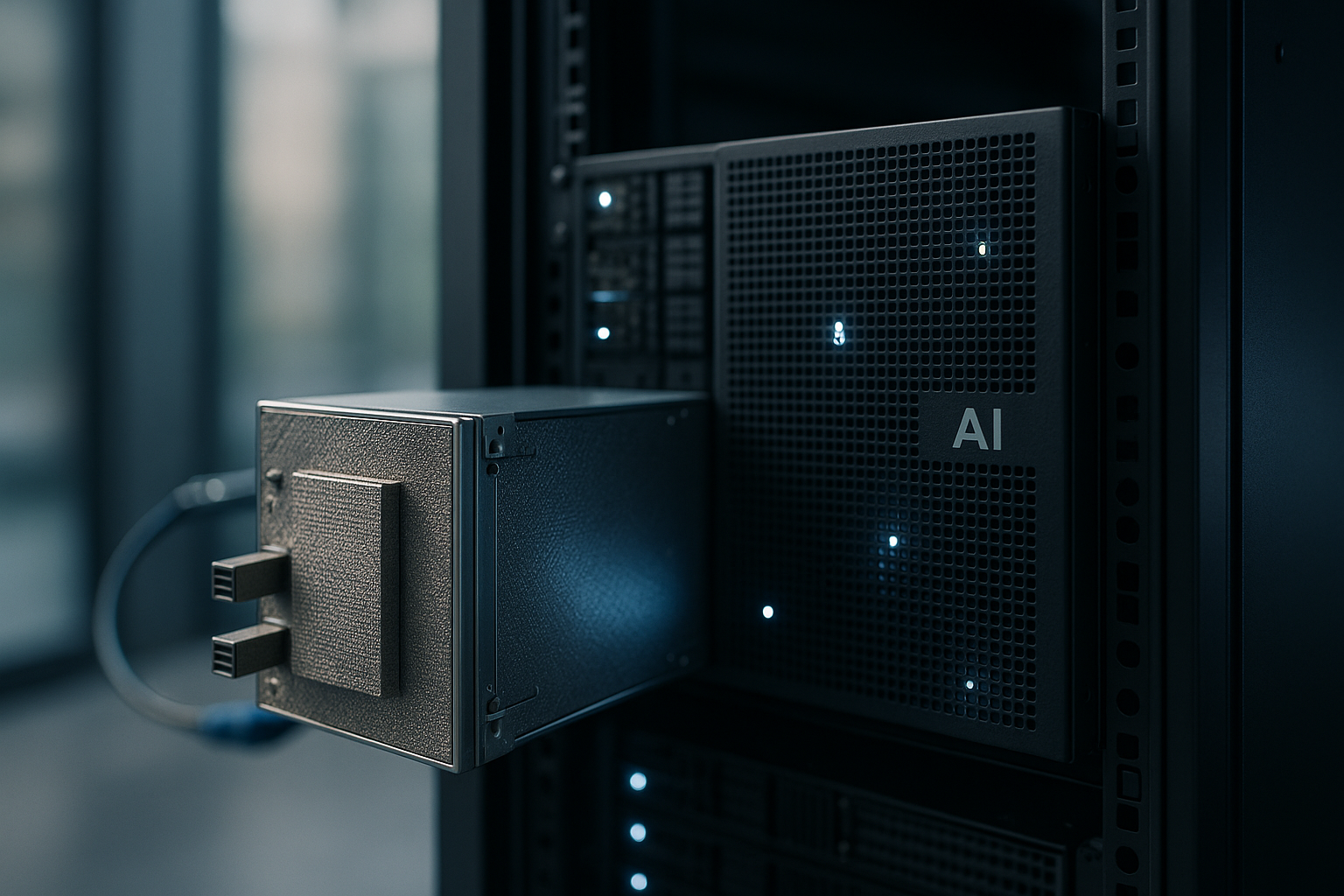
Redefining BlueField-4 secure AI infrastructure for NVIDIA Vera Rubin NVL72
Introduction: The new stack for secure, gigascale AI
NVIDIA’s Vera Rubin NVL72 rack couples Rubin GPUs and Vera CPUs for large-scale training and inference, and brings the BlueField-4 DPU into the Enterprise AI Factory validated design to remove infrastructure contention from AI workloads [1][2][3]. It’s a pragmatic blueprint for BlueField-4 secure AI infrastructure: offload the heavy lifting of networking, storage, and security to the DPU, return CPU/GPU cycles to model execution, and enforce hardware-rooted zero-trust across tenants [3].
Why BlueField-4 secure AI infrastructure matters now
In AI factories, infrastructure services often compete with training and inference for compute. BlueField-4 shifts those services onto the DPU, improving data-path efficiency and freeing the Rubin/Vera complex to focus on model throughput [3]. With NVL72 positioned for large-scale deployments, the combination targets both performance and operational isolation in multi-tenant environments [1][2][3].
What is BlueField-4 and the Astra secure resource model?
BlueField-4 pairs a 64-core NVIDIA Grace-class CPU with a co-packaged ConnectX-9 SuperNIC, delivering 800 Gb/s networking and roughly six times the compute performance of BlueField-3 [3]. The DPU is a core element of the validated Enterprise AI Factory design, enabling operators to consolidate infrastructure services onto a high-throughput, low-latency control plane separate from GPU/CPU resources [3].
Security is anchored by the BlueField Advanced Secure Trusted Resource Architecture (Astra). Astra enforces secure bare-metal instances, zero-trust tenant isolation, and comprehensive software-defined control—foundational for multi-tenant AI factories running sensitive workloads [3].
How DPU offload improves performance and data paths
By offloading networking, storage, and security, BlueField-4 reduces contention with AI workloads and streamlines end-to-end data movement [3]. Key benefits include:
- Higher throughput interconnects with ConnectX-9 SuperNIC 800Gbps, enabling faster east–west traffic and cluster scaling [3].
- Approximately 2x faster GPU access to data storage compared to prior-generation designs [3].
- A multiservice architecture that supports native service function chaining, so multiple network, storage, and security functions can run concurrently on the DPU without impacting GPU performance [3].
These capabilities underpin DPU offload for AI workloads on Rubin systems and help AI factories scale up to four times larger than earlier BlueField-3-based designs [3].
DOCA microservices and multiservice architectures
NVIDIA DOCA microservices enable containerized networking and security functions to be composed directly on the DPU, close to the data path [3]. Operators can chain multiple services—such as encryption, segmentation, or telemetry—while keeping the GPU complex focused on model execution [3]. This aligns with Rubin NVL72 deployments where infrastructure operations must evolve without disrupting training and inference pipelines [2][3]. For broader context on the software framework, see the official NVIDIA DOCA (external).
Security architecture: zero-trust, multi-tenancy, and Astra enforcement
Astra’s secure resource model brings zero-trust enforcement to the DPU, isolating tenants at the hardware level and supporting secure bare-metal instances [3]. With policy enforcement and AI runtime security executed on BlueField-4, operators can implement a zero-trust AI factory that aligns with multi-tenant requirements and consistent, software-defined control across racks [3].
Operational and deployment considerations for Vera Rubin NVL72 racks
Rubin-based AI factories leverage BlueField-4 for infrastructure offload and integrate Spectrum-6 Ethernet switches for scale-out connectivity, establishing a fabric that matches the NVL72 performance envelope [2][3]. The architecture supports factories up to four times larger than prior-generation designs, with the DPU’s 800 Gb/s links and enhanced compute headroom enabling cluster growth [3]. As teams plan rollouts, they should account for DPU-hosted services, orchestration integration for DOCA microservices, and staged upgrades that avoid contention with active training [3].
ROI and TCO considerations: where the approach pays off
Organizations should weigh DPU consolidation of networking, storage, and security services against the cost of diverting GPU cycles to non-AI tasks. Returning CPU/GPU capacity to models, accelerating GPU–storage data paths, and scaling out with 800 Gb/s networking can reduce time-to-train while simplifying operations around the AI fabric [3]. These gains are amplified in multi-tenant clusters where Astra’s isolation and policy enforcement run on the DPU [3].
Migration checklist and best practices
- Validate NVL72 rack integration with BlueField-4 for target workloads; confirm GPU–storage throughput improvements along expected baselines [3].
- Stand up DOCA microservices for core networking and security functions; implement service function chaining to minimize data-path hops [3].
- Configure Astra-based policies for secure bare-metal instances and tenant isolation; verify zero-trust segmentation and runtime controls on the DPU [3].
- Align Spectrum-6 switch topology, addressing, and QoS with 800 Gb/s links to support scale-out growth [2][3].
For additional implementation playbooks, Explore AI tools and playbooks.
Conclusion: next steps for architects and operators
Vera Rubin NVL72 and BlueField-4 combine high-speed data movement with hardware-rooted security and offloaded infrastructure services, enabling secure scale to gigascale AI workloads [1][2][3]. For teams building or expanding AI factories, this blueprint brings immediate levers—DPU offload, Astra isolation, and DOCA-based services—to optimize performance and multi-tenant security on day one [3].
Sources
[1] NVIDIA Launches Vera Rubin Architecture at CES 2026
https://www.storagereview.com/news/nvidia-launches-vera-rubin-architecture-at-ces-2026-the-vr-nvl72-rack
[2] Inside the NVIDIA Rubin Platform: Six New Chips, One AI …
https://developer.nvidia.com/blog/inside-the-nvidia-rubin-platform-six-new-chips-one-ai-supercomputer/
[3] NVIDIA Launches BlueField-4
https://blogs.nvidia.com/blog/bluefield-4-ai-factory/
