
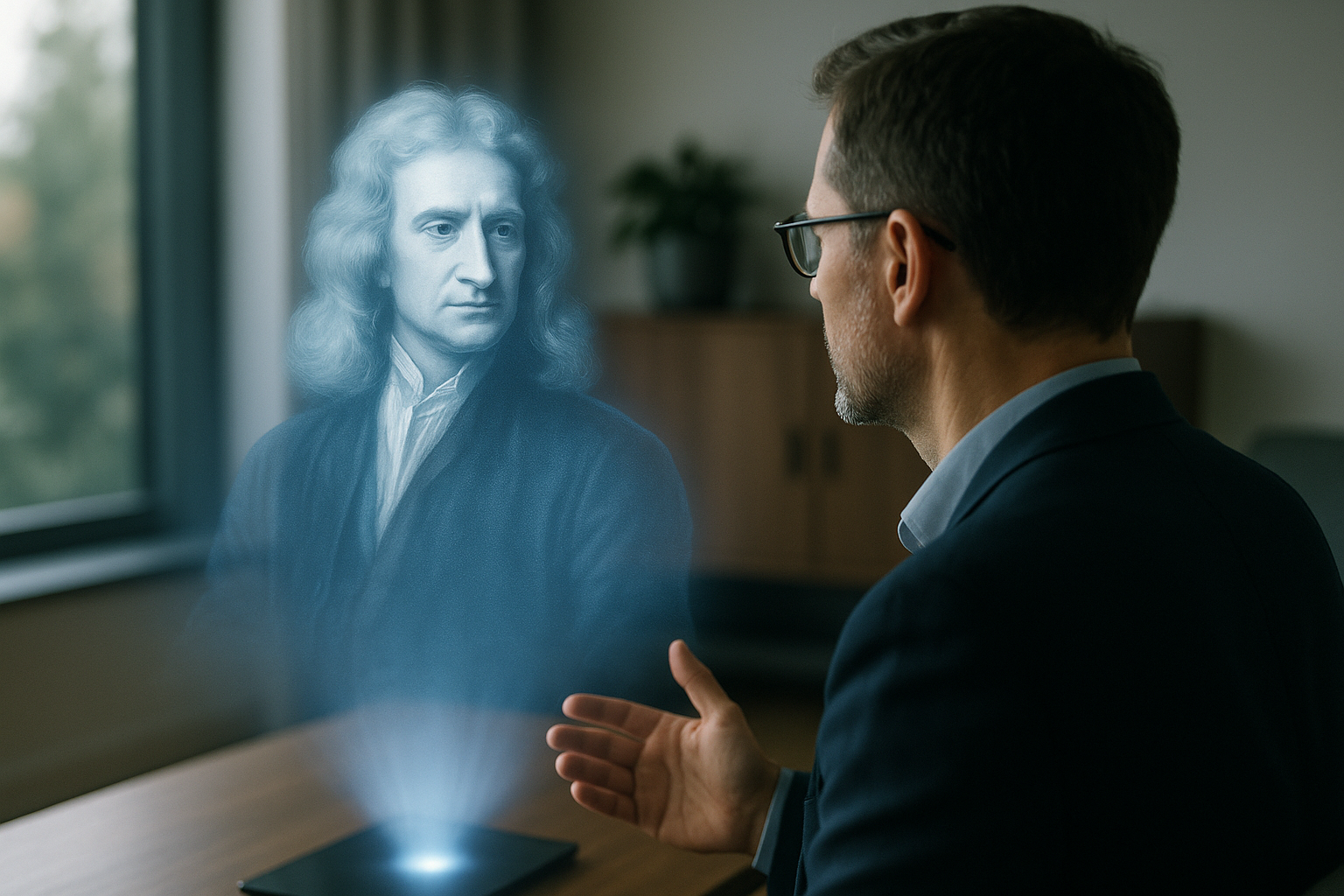
Talk to Your Own Personal Isaac Newton With Holographic AI Avatars
Holographic AI avatars are no longer sci-fi cameos—they’re showing up as real-time, interactive assistants and brand representatives that can converse, recognize users, and scale across environments. For businesses, the appeal is clear: always-on, on-message interactions that attract attention, educate customers, and free staff for higher-value tasks [1].
Holographic AI avatars in the wild: Retail, education, healthcare
Early deployments point to strong engagement and measurable brand benefits. In retail and public venues, AI hologram assistants and 3D displays are used to draw foot traffic, deliver consistent product education, and support storytelling before a human handoff—improving pre-sale understanding and experience quality [1]. Brands have experimented with holographic try-ons and immersive showcases; for example, Nike worked with a hologram display provider to highlight products in-store, demonstrating consumer appetite for visually compelling, interactive formats [2]. Broader immersive activation trends suggest that hologram-mediated engagement can boost persuasion and memory when executed thoughtfully [3].
These patterns translate well to virtual historical avatars—think a curated, expert-style “Isaac Newton” guiding learners through scientific principles or brand-linked education. The same real-time interactivity and presence that works for store explainers can power museum guides, classroom assistants, or themed brand ambassadors, provided the presentation stays transparent and accurate [1][3].
Ailias’s approach: Building a historical expert avatar (the Isaac Newton example)
A viable approach for a historical expert involves training on curated texts and clearly sourced explanations, then presenting the persona through a holographic interface that’s responsive and easy to access (in-store displays, kiosks, or mobile-triggered interactions). The key is design clarity: users must understand they’re engaging with a synthetic guide—not a real or resurrected person—and marketing should avoid any misleading implications about identity or endorsement [4]. Done right, virtual historical avatars can blend education with immersive presence without crossing ethical lines [4].
Ethics and transparency: Distinguishing avatars from deepfakes
Transparent design separates useful, on-brand assistants from problematic deepfakes. Ethical guidelines recommend unambiguous disclosure that the interaction is with an AI system, consistent labeling in interfaces and communications, and alignment of responses with well-defined, vetted content sources. Deceptive mimicry of identifiable individuals erodes trust and can trigger reputational and legal fallout; responsible deployments emphasize clarity, consent, and context over shock value [4]. These avatar transparency best practices are especially crucial when a character resembles a known figure—even unintentionally [4].
Legal risks and compliance checklist (ELVIS, NO FAKES, rights of publicity)
Rights of publicity, misappropriation, and contractual restrictions increasingly reach into digital replicas and lookalikes—including AI avatars that resemble or evoke real people. Legal guidance emphasizes that companies should secure explicit, informed, written consent for any name, likeness, or voice use; narrowly define permitted use cases and distribution channels; and avoid unauthorized replicas altogether. New and proposed measures, including state-level protections like the ELVIS Act and federal proposals such as the NO FAKES Act, heighten scrutiny and push for robust consent frameworks and careful drafting of rights and limitations [5][6].
- Obtain written consent covering name, image, likeness, and voice; specify media, territories, and duration [5][6].
- Define “no-go” zones (e.g., sensitive topics, endorsements) and implement governance for updates and takedowns [5].
- Document data sources and training materials; maintain versioned logs and auditability [5][6].
- Vet marketing copy for clarity about synthetic nature; avoid implying real-person involvement or endorsement without explicit permission [4][5].
For broader policy context, see the U.S. Copyright Office’s AI initiative (external) for ongoing developments in authorship and originality frameworks: U.S. Copyright Office’s AI initiative (external).
Implementation playbook: Tech, deployment channels, and integration tips
From retail floors to public venues, successful rollouts combine reliable holographic display technology with conversational AI tuned for the environment. Practical deployment channels include in-store hologram displays and mobile access points that let users engage via browsers or QR codes—scaling reach beyond a single screen. As with any assistant, plan for multilingual support, session handoffs to staff, and safe response boundaries to keep interactions on-brand and compliant [1]. For structured frameworks and templates, you can Explore AI tools and playbooks.
Measuring success: KPIs, ROI, and reporting for avatar deployments
Treat avatar pilots like any retail or experiential program: instrument them. Useful metrics include dwell and interaction time, pre-sale education completion, handoff rates to staff, conversion and basket impact during activated hours, and post-visit brand recall. Compare pilot zones against matched controls, then refine scripts, visuals, and placement based on what drives the best outcomes. Consistent reporting helps attribute ROI to the assistant’s influence on engagement and staff efficiency [1][3].
Case studies and hypothetical scenarios
- Retail: 3D holograms and virtual representatives have shown power to attract attention and explain products prior to human consultation—boosting engagement and setting up better-informed sales conversations [1][2].
- Hypothetical “Isaac Newton” guide: A themed scientific expert could greet visitors, answer curated questions, and hand off to staff or deeper digital content—delivering education and memorable brand storytelling, while remaining explicitly synthetic and compliant with likeness safeguards [3][4][5][6].
Conclusion: Next steps for business leaders
Start with a narrow, high-traffic use case; design for transparency; and lock down rights. Build consent and content governance into contracts and operations. Pilot, measure, and iterate—keeping legal guardrails and user trust at the center. With careful execution, hologram avatars for retail and education can deliver standout experiences without inviting avoidable AI avatar legal risks [1][4][5][6].
Sources
[1] AI Holograms Revolutionize Customer Engagement – LinkedIn
https://www.linkedin.com/posts/guardianone_guardianone-aihologram-artificialintelligence-activity-7413822087745667072-wlsC
[2] Nike’s Fashion Retail Innovation: 3D Holograms with HYPERVSN
https://hypervsn.com/case-studies/nike-innovation-retail-hologram
[3] How Virtual Reality is Revolutionizing Brand Persuasion – LinkedIn
https://www.linkedin.com/posts/ahmedalahmary_virtualreality-futureofretail-hologramhustle-activity-7308419554177609728-kh3h
[4] Deepfakes in business? How to use AI avatars ethically
https://simpleshow.com/blog/deepfakes-in-business-how-to-use-ai-avatars-ethically-a-guide/
[5] The Business of AI Avatars: Key Legal Risks and Best Practices
https://www.afslaw.com/perspectives/alerts/the-business-ai-avatars-key-legal-risks-and-best-practices
[6] Digital Avatars Deep Dive Series: Navigating the Legal and …
https://www.mofo.com/resources/insights/250922-digital-avatars-deep-dive-series-navigating
