
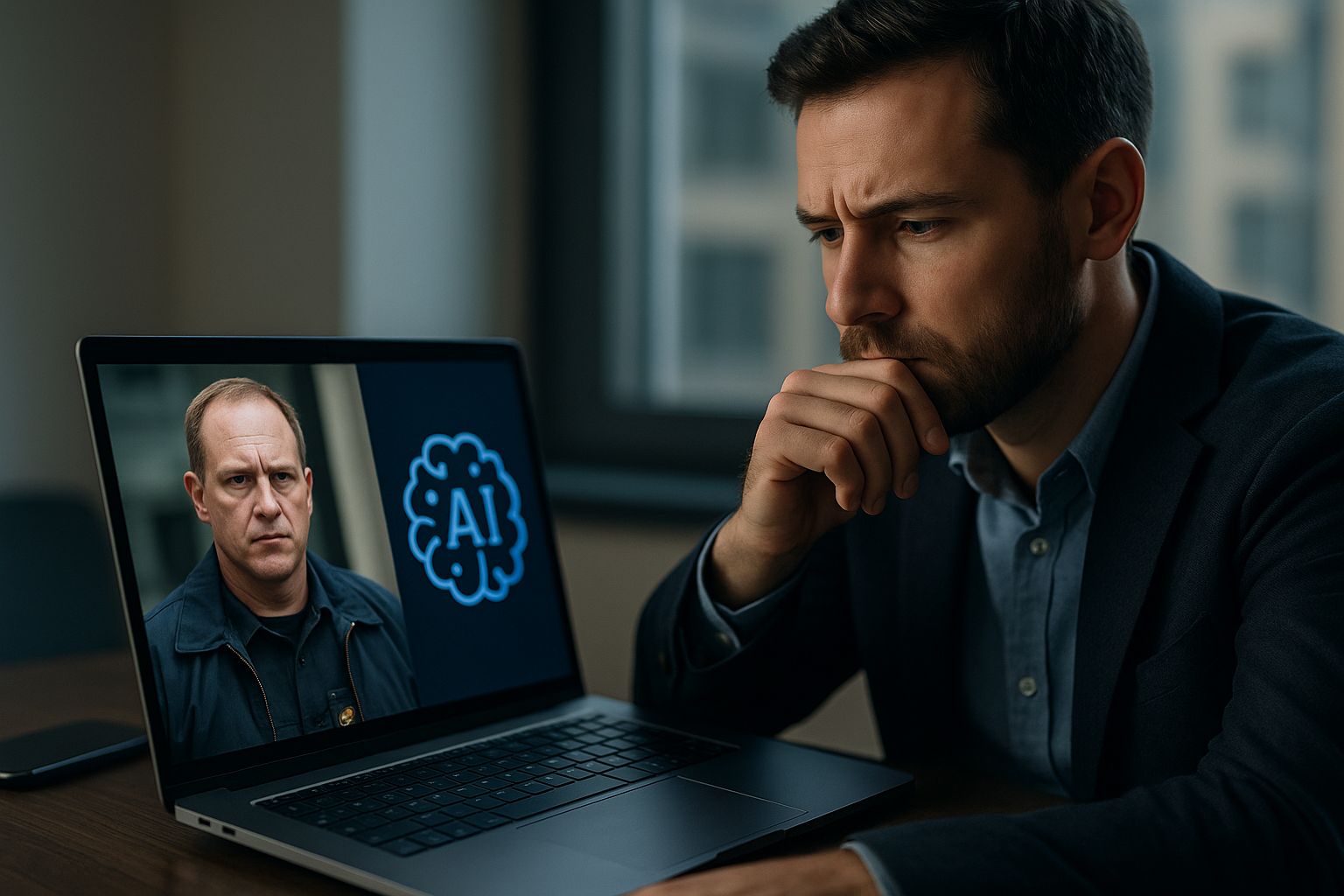
People Are Using AI to Falsely Identify the Federal Agent Who Shot Renee Good — A Case Study in AI-generated misidentifications
The death of Renee Good in Minneapolis has been followed by a fast-moving online campaign to identify the officer involved—driven in part by AI-generated faces and mis-captioned clips. These AI-generated misidentifications spread by turning masked screenshots into seemingly definitive “unmasking,” despite verified footage that never reveals the agent’s face or affiliation as claimed in many posts [1].
Quick summary: What happened and why it matters
BBC Verify reports that viral images and claims showing the supposed officer’s unmasked face are fabrications. Authentic video indicates Good was in the driver’s seat, the officers’ vests were marked “Police,” not “ICE,” and crucially, the agent’s face was never visible—undermining any claim of a certain identification. Some circulating posts nonetheless present AI-invented faces and incorrectly label personnel as ICE, despite clear visual evidence to the contrary [1]. The result is a textbook case of synthetic media misinformation creating false certainty and real-world risk.
What BBC Verify and other fact-checks found
- Multiple “unmasking” images are AI-generated and inconsistent across versions.
- Verified footage never shows the agent’s face.
- Visual evidence shows “Police” markings, contradicting ICE-label claims [1].
Beyond the specific case, law-enforcement analyses warn that misinformation and deepfake misidentification can erode public trust, complicate operations, and heighten hostility toward officers [2]. Europol notes that synthetic media can be paired with doxxing to target individuals cast as abusive officers, leveraging public anger to incite harassment or violence [3].
How AI image tools invent faces from thin evidence
GenAI tools infer “likely-looking” outputs from limited inputs. When prompted with a masked screenshot or low-information frame, they do not recover truth; they produce statistically plausible guesses. That is why different attempts yield inconsistent faces—and why these visuals should never be treated as real identifications. In short: AI face generators can’t reconstruct real faces from masked screenshots, and treating their outputs as facts creates a dangerous illusion of certainty [1,5].
This mechanism aligns with how AI hallucination images emerge: the model fills in gaps rather than verifying ground truth. In cases like the Good shooting, that tendency transforms ambiguity into false confidence at scale [5].
Harms and risks: misinformation, public perception, and officer safety
Police-focused research underscores the operational and safety fallout when synthetic media gains traction: it can distort perceptions of police conduct, spur hostility, and undermine trust in official communications [2]. Europol further warns that deepfakes combined with doxxing amplify risk to wrongly identified individuals by making them targets for harassment or violence [3]. The dynamic in Minneapolis mirrors these concerns—AI unmasking images and deepfake misidentification can rapidly escalate tensions and expose real people to harm [1–3].
AI-generated misidentifications: a verification checklist
For journalists, platforms, and brands, treat AI-derived “identifications” as unverified until proven otherwise. Practical steps include:
- Confirm what the authentic footage actually shows: angle, visibility, markings (e.g., “Police” vs. ICE), and whether a face is ever visible [1].
- Compare claims across versions; inconsistent faces are a red flag for synthetic media [1].
- Use reverse image search and basic forensic checks before publication or amplification [2].
- Clearly label AI-created or AI-edited visuals, disclose uncertainty, and avoid definitive language without corroboration [4,6].
- Document verification steps and maintain logs for accountability and post-publication review [2].
For deeper professional standards, see the International Fact-Checking Network’s principles at Poynter for additional context on verification practices (external).
Practical best practices for platforms and brands
- Establish rapid review paths for AI unmasking images, including takedown protocols when doxxing risks appear [2,3].
- Require disclosure when visuals are AI-created or AI-edited; standardize labels across feeds and dashboards [4,6].
- Train moderators and comms teams on synthetic media misinformation and escalation playbooks [2,3,6].
- Communicate uncertainty proactively in public statements; resist pressure to confirm identities without vetted evidence [2,6].
Enterprise guidance highlights transparency, clear labeling, and verification before publication—core safeguards that reduce legal, safety, and reputational risk when synthetic media spreads [4,6].
Policy and legal considerations for organizations
The combination of rapid virality and false identifications creates reputational exposure and potential legal risk. Organizations should implement incident-response procedures, legal review pathways, and internal standards for handling AI-generated identifications—especially when they could contribute to doxxing or public endangerment [2–4,6]. Policies that mandate labeling, verification, and documented editorial judgment help prevent the collateral damage of AI-generated misidentifications [2,4,6].
Tools, further reading, and resources
- Law enforcement and the challenge of deepfakes: Europol’s analysis on synthetic media and operational risk [3].
- Best practices for using AI-generated visuals responsibly: enterprise and brand guidance on transparency and labeling [4,6].
- Preventing harmful “hallucinations”: reminders that outputs may be plausible but unverified, calling for careful review workflows [5].
For ongoing coverage, explore our AI tools and playbooks.
Conclusion and action items
- Treat AI unmasking images as unverified until original, vetted evidence supports them [1,4,6].
- Label AI-created visuals, communicate uncertainty, and avoid definitive identification claims without corroboration [4,6].
- Build escalation and takedown protocols to mitigate doxxing risks, informed by law-enforcement analyses and Europol guidance [2,3].
In moments of public crisis, the cost of error is high. Applying disciplined verification and transparent labeling is the surest way to curb the spread of AI-generated misidentifications [1–6].
Sources
[1] Debunking false claims about Minneapolis ICE shooting – BBC News
https://www.bbc.com/news/live/c1lzvyjm3vet
[2] The battle against misinformation and disinformation campaigns
https://www.police1.com/chiefs-sheriffs/the-battle-against-misinformation-and-disinformation-campaigns-is-your-police-department-prepared
[3] [PDF] Facing reality? Law enforcement and the challenge of deepfakes
https://www.europol.europa.eu/cms/sites/default/files/documents/Europol_Innovation_Lab_Facing_Reality_Law_Enforcement_And_The_Challenge_Of_Deepfakes.pdf
[4] Best Practices For Using AI To Develop Images – Forbes
https://www.forbes.com/sites/kimberlywhitler/2025/01/12/best-practices-for-using-ai-to-develop-images/
[5] How to Prevent AI Hallucinations in Small Business – Tech Life Future
https://www.techlifefuture.com/prevent-ai-hallucinations-in-small-business/
[6] AI guidelines | Enterprise Brand, Communications and Marketing
https://brandguide.asu.edu/execution-guidelines/ai-guidelines
