
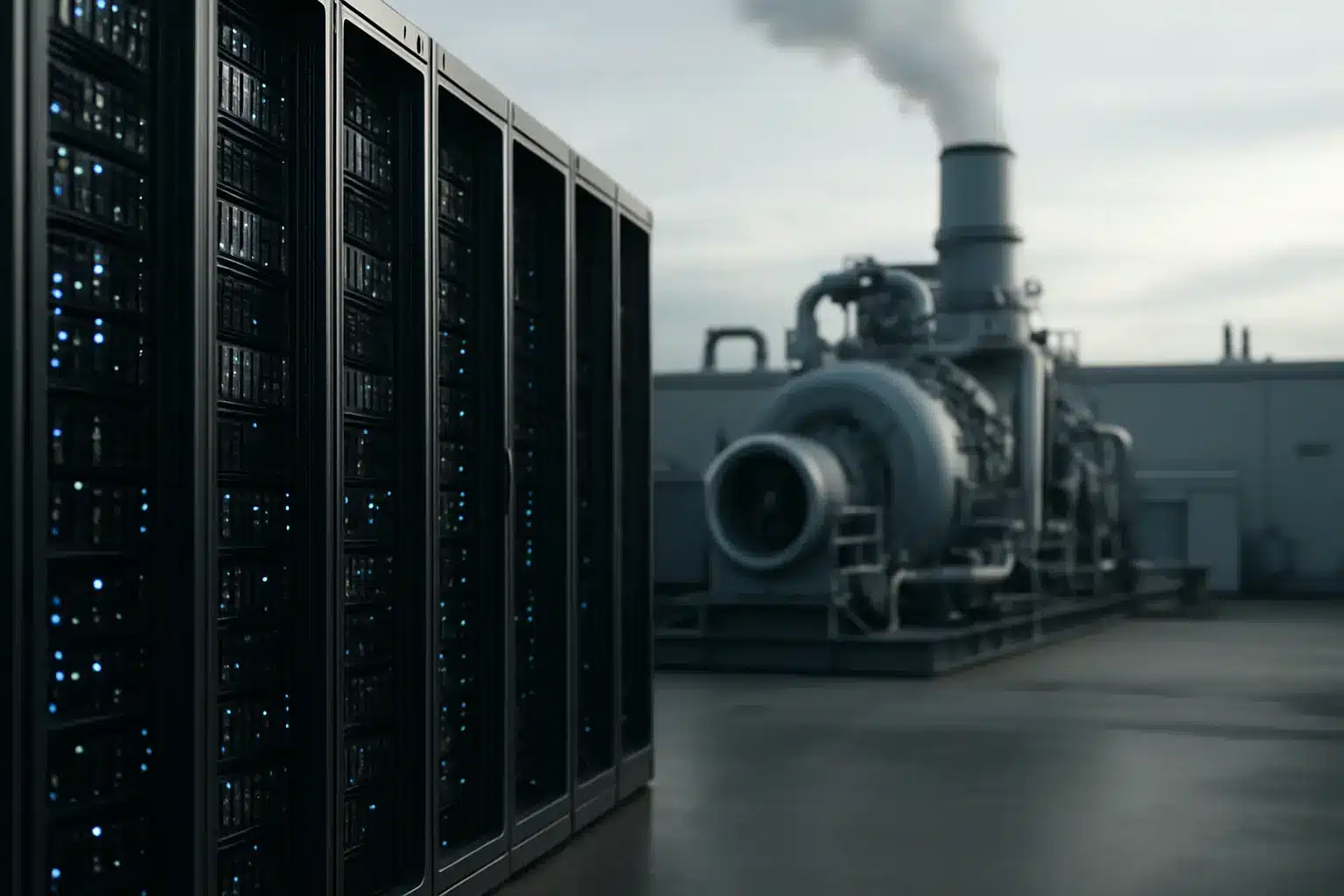
AI Data Center Gas Turbines: Inside SpaceX’s Self-Powered Compute Strategy
Musk-affiliated AI campuses are moving to self-power with large natural gas turbines as operators race to build and run vast GPU clusters. Wired reporting describes xAI’s Colossus 1 in Memphis as among the largest AI supercomputers, with roughly 220,000 Nvidia H100, H200, and GB200-class GPUs installed in about 122 days, and gas turbines already in place [2][3]. The strategy reflects a broader shift toward vertically integrated, on-site generation to bypass strained grids and permitting delays for new transmission. For buyers and tenants, the appeal of AI data center gas turbines is steady power at the scale modern training runs demand [2][4].
Why AI data center gas turbines are back for AI
Industry materials highlight operational advantages for GPU-heavy sites: fast start, the ability to run around the clock, and flexibility to burn various fuels. Operators can also design systems that export excess power to the grid when needed, aligning with microgrid-style architectures for resilience and uptime [4]. These factors help explain the momentum around gas-powered data centers for large-scale AI workloads, where even brief interruptions can stall multimillion-dollar training runs [4].
A LinkedIn industry view frames the trend as a comeback for gas equipment amid the AI boom, driven by power scarcity and the need to move fast on capacity [1]. Pairing turbine-backed microgrids with high-density clusters is becoming a default pattern in current builds, including projects tied to SpaceX AI data centers and other hyperscale efforts [1][2].
Scale and emissions: what permits and reporting reveal about Colossus and Stargate
Wired’s review of permits and project documents puts hard numbers on the footprint. For xAI’s Colossus campuses, individual site permits allow more than 6.4 million tons of CO2-equivalent emissions per year, with the combined total for Colossus 1 in Memphis and Colossus 2 in Southaven, Mississippi exceeding 12.8 million tons annually. Reporters note that the per-site emissions are comparable in total to more than 30 average gas-fired power plants and sufficient electricity for about 1.5 million homes [2].
Separate filings for the Stargate buildout, backed by OpenAI, Oracle, and SoftBank, describe simple-cycle gas turbines at a 900-acre campus in Texas and related facilities in New Mexico and other states. Permit documents reviewed indicate Stargate-related gas projects could emit more than 24 million tons of greenhouse gases per year [2].
Colossus 1 stands out for speed and scale. The site is described as one of the largest AI supercomputers, hosting roughly 220,000 Nvidia GPUs across H100, H200, and GB200-class hardware, with the campus reportedly built in about 122 days. Turbines are already installed to power the cluster [2][3].
Regulatory and environmental risks for operators
On-site generation brings operators under a complex web of federal, state, and local rules, including EPA New Source Performance Standards and continuous emissions monitoring requirements. Compliance and reporting are central to permitting and ongoing operations for gas turbine data centers [2][5]. Communities near proposed sites are pressing environmental justice concerns tied to local air quality and health risks, which can drive tighter scrutiny, delays, or new conditions on permits [2].
Analysts warn that rapid AI buildouts anchored in gas may lock in high emissions for decades if not paired with strict controls or alternative energy strategies [2]. Operators face a moving regulatory landscape and need clear plans for monitoring, abatement, and community engagement aligned to the latest guidance. See the EPA’s New Source Performance Standards for stationary sources for baseline federal requirements in this area in addition to state and local rules (external).
Business and operational implications for AI builders and tenants
- Capital intensity for turbine procurement and on-site infrastructure [2][4].
- Operating exposure to fuel price volatility and emissions controls [2][5].
- Reputational and siting risk tied to environmental justice and community opposition [2].
- Compliance overhead, including monitoring, reporting, and adherence to evolving standards [2][5].
For tenants, contract terms may increasingly reflect emissions liabilities and reporting duties, especially where data center emissions permits are material to operations. Some operators may explore selling excess power to the grid or structuring joint ventures with utilities to offset costs, given vendor-stated flexibility in turbine configurations [4].
Alternatives and mitigation: how operators can balance power needs and sustainability
- Hybridize with storage and renewables via microgrid architectures to cut runtime and emissions from turbines while maintaining uptime [4][5].
- Strengthen monitoring and verification with third-party systems to meet permit and continuous monitoring needs [5].
- Stage builds so early phases use turbines for headroom, then backfill with contracted clean energy as grid capacity and interconnections mature [2][4].
- Engage communities early with transparent health and air quality plans to address siting concerns and environmental justice issues [2].
These measures will not erase the footprint, but they can align gas-backed designs with near-term performance needs and longer-term sustainability goals.
Takeaways for decision-makers
- Colossus shows how fast self-powered campuses can scale, but the emissions and compliance burdens are equally large [2][3][5].
- Stargate’s permitted totals illustrate how AI buildouts can rival national emissions profiles if safeguards lag [2].
- Treat AI data center gas turbines as a bridge with defined guardrails: strict monitoring, phased decarbonization, and clear community commitments [2][4][5].
For deeper operational guidance and vendor comparisons, including GPU cluster design and site planning, Explore AI tools and playbooks.
Sources
[1] AI boom drives comeback for old gas turbines – LinkedIn
https://www.linkedin.com/posts/sheridandoug_ai-naturalgas-energy-activity-7336364928729063424-UCvv
[2] New Gas-Powered Data Centers Could Emit More Greenhouse Gases Than Entire Nations
https://www.wired.com/story/new-gas-powered-data-centers-could-emit-more-greenhouse-gases-than-entire-nations
[3] Anthropic Gets in Bed With SpaceX as the AI Race Turns Weird
https://www.wired.com/story/anthropic-spacex-compute-deal-colossus
[4] Gas Power Technology for Data Centers | GE Vernova
https://www.gevernova.com/gas-power/industries/data-centers
[5] Data Center Emissions Monitoring | Encino Environmental Services
https://encinoenviron.com/data-center-emissions-monitoring
