
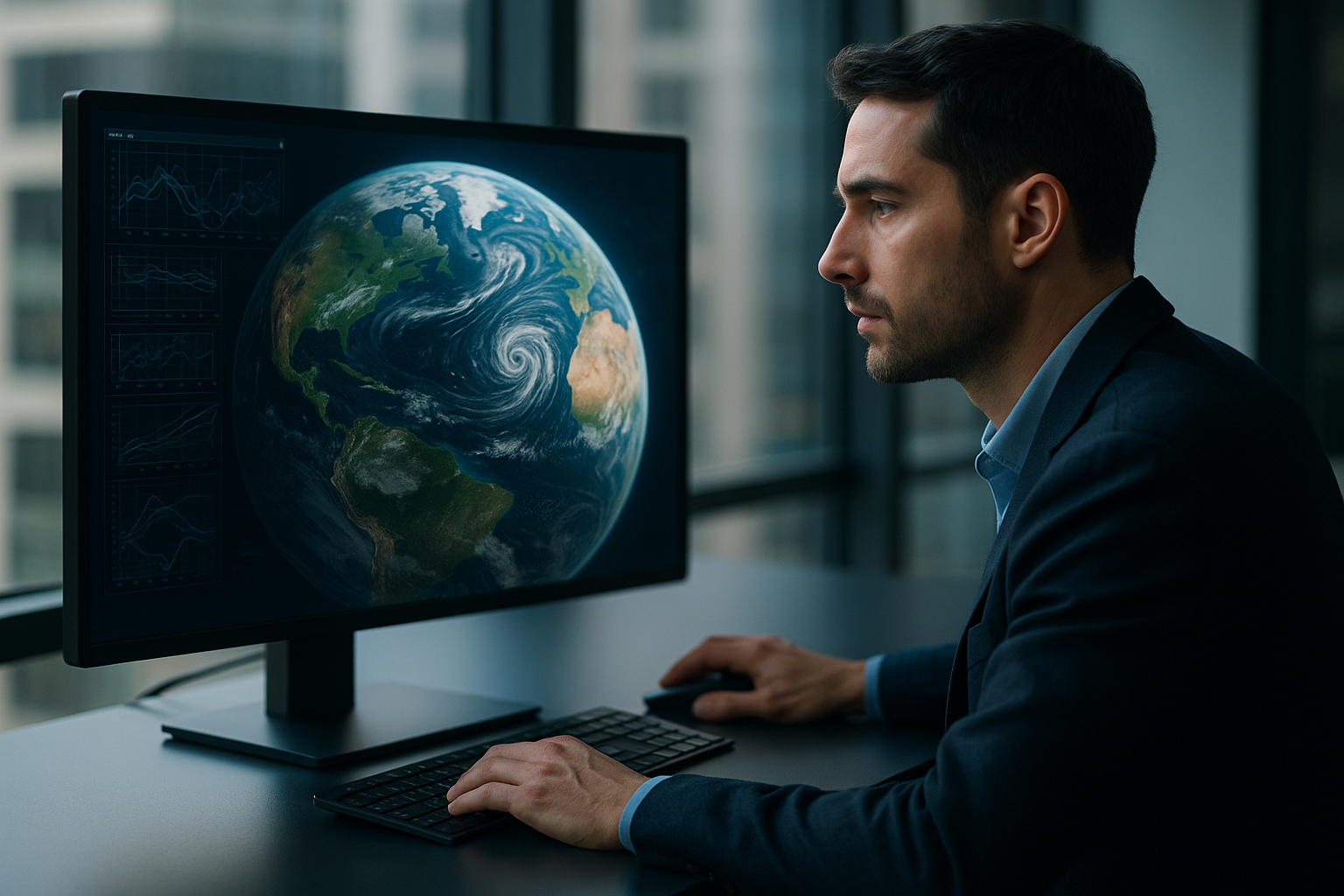
NVIDIA Earth-2 Debuts as an Open AI Weather Platform for Faster, Scalable Forecasting
NVIDIA introduced Earth-2, a fully open, accelerated AI platform that unifies pretrained models, libraries, frameworks, and visualization tools for weather and climate forecasting—positioned for scientists, startups, enterprises, and governments to deploy and fine-tune on their own infrastructure. The open AI weather platform aims to deliver faster, cost-effective forecasting across medium-range prediction, nowcasting, and AI-based downscaling [1][2].
Why an open AI weather platform changes the forecast
Earth-2 departs from traditional numerical weather prediction that leans on CPU-based supercomputers and physics solvers, instead emphasizing generative and transformer-based AI architectures for speed and efficiency. NVIDIA highlights compute and energy savings, especially when producing high-resolution outputs via AI downscaling, versus CPU-based numerical approaches [1][2]. In head-to-head comparisons, its Medium Range model (Atlas) is reported to outperform Google DeepMind’s GenCast across more than 70 variables, underscoring the potential for accuracy gains with modern AI-first pipelines [2][3][4].
Key components: Medium Range (Atlas), nowcasting (StormScope), CorrDiff and FourCastNet 3
- Medium Range using the new Atlas architecture targets 15-day global forecasts, a critical window for planning in energy, logistics, and public safety. NVIDIA reports accuracy improvements over GenCast on a wide set of weather variables [2][3][4].
- Earth-2 Nowcasting, powered by the StormScope model, generates kilometer-scale, country-scale predictions of local storms and hazardous weather for zero- to six-hour windows, producing outputs within minutes for time-sensitive operations [2][3][4].
- CorrDiff and other AI downscaling tools enable high-resolution, probabilistic forecasts at a fraction of the compute time required by CPU-based numerical models—reporting substantial savings at 2.5 km resolution that can translate into faster updates and lower costs [2][3].
- FourCastNet 3 advances global forecasting and probabilistic outputs, supporting enterprise needs for scenario planning and risk-aware decision-making [2][3].
Together, these components form an end-to-end pipeline: data processing, global and local forecasting, AI downscaling, and high-resolution visualization [1][2].
Developer and deployment tooling: PhysicsNeMo, Earth2Studio, GitHub and Hugging Face
NVIDIA’s PhysicsNeMo framework provides the scaffolding to train and fine-tune Earth-2 models—and even third-party models—enabling organizations to adapt baselines to their regions, sensors, or business metrics. Earth2Studio, available through GitHub and Hugging Face, accelerates experimentation and workflow assembly so teams can move from R&D to production faster [1][2]. For enterprises evaluating how to deploy NVIDIA Earth-2 on-premise, the stack’s open models and frameworks are designed for controlled environments where data governance and latency are paramount, while also supporting cloud-based workflows for scale [1][2].
Visualization and integration: Omniverse and OpenUSD
Built on NVIDIA Omniverse and OpenUSD, Earth-2 supports global-scale, interactive visualization of geospatial and climate data. Stakeholders can explore simulations, interrogate local impacts, and present clear, immersive context for operational briefings and policy discussions—bridging data science and decision-making on a single canvas [1][2]. For additional reference on traditional weather model providers, see the European Centre for Medium-Range Weather Forecasts (ECMWF) (external).
Business use cases and early adopters
Early adopters span national meteorological services, The Weather Company, energy firms such as TotalEnergies and Eni, and companies like G42, Spire Global, and JBA Risk Management. Reported use cases include local severe-weather prediction, energy grid and capacity planning, logistics optimization, and detailed flood risk assessment—areas where AI nowcasting and high-resolution downscaling can materially improve speed-to-insight and operational outcomes [2][3][4].
Operational considerations: accuracy, risk, and limitations
While reported accuracy gains and major efficiency improvements are compelling, operational rollouts will still require verification against ground truth, careful handling of probabilistic outputs, and attention to data assimilation workflows. Many organizations may adopt hybrid approaches—pairing AI weather models with established systems and human oversight—before fully transitioning mission-critical operations [1][2][3].
How to get started: evaluation checklist and next steps
- Define objectives: nowcasting for rapid alerts, medium-range planning, or high-resolution risk modeling [1][2].
- Assess infrastructure: on-prem GPUs vs. cloud for training, inference, and visualization; confirm data governance needs [1][2].
- Data and regions: identify local sensors and observational feeds for fine-tuning with PhysicsNeMo [1][2].
- Rapid prototyping: use Earth2Studio on GitHub/Hugging Face to assemble workflows and compare baselines [1][2].
- Pilot and validate: benchmark against operational metrics, stress-test during severe events, and iterate [2][3].
For broader context on implementation patterns, explore our practical guides: Explore AI tools and playbooks.
Conclusion: strategic implications for enterprises and governments
NVIDIA Earth-2 consolidates open models, training frameworks, and immersive visualization into a cohesive platform that organizations can deploy on their own terms. For leaders weighing cost, speed, and accuracy, the combination of Medium Range (Atlas), StormScope-based nowcasting, and AI downscaling offers a pathway to faster updates and more granular insights—qualities that are increasingly essential for resilience and risk-aware operations [1][2][3][4][5]. As the ecosystem grows across GitHub, Hugging Face, and partner integrations, this open AI weather platform is positioned to accelerate forecasting innovation from the lab to the field [1][2].
Sources
[1] AI-Powered Climate and Weather Simulation Platform | NVIDIA Earth-2
https://www.nvidia.com/en-us/high-performance-computing/earth-2/
[2] the World’s First Fully Open Set of Models and Tools for AI Weather
https://blogs.nvidia.com/blog/nvidia-earth-2-open-models/
[3] Nvidia launches Earth-2 open AI weather forecast models and tools
https://siliconangle.com/2026/01/26/nvidia-launches-earth-2-open-ai-weather-forecast-models-tools/
[4] Nvidia’s new AI weather models probably saw this storm coming …
https://tech.yahoo.com/ai/articles/nvidia-ai-weather-models-probably-140000925.html
[5] NVIDIA Earth-2: Revolutionizing Weather Forecasting and Disaster …
https://www.youtube.com/watch?v=L4L_0Q48nDU
