
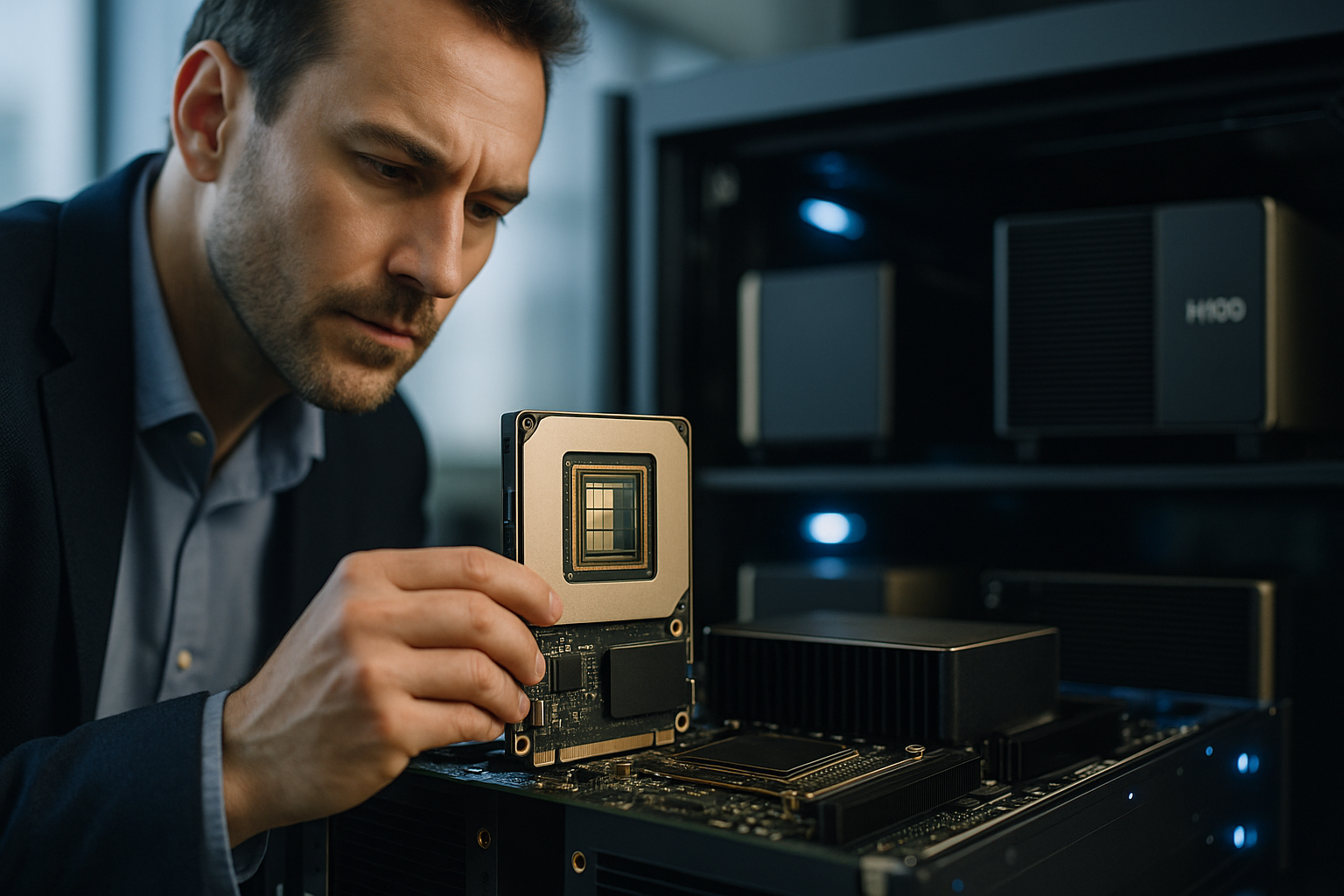
Delivering Massive Performance Leaps for Mixture of Experts Inference on NVIDIA Blackwell GPU for MoE inference
Modern MoE systems are straining today’s inference stacks. As organizations plan upgrades, the Blackwell GPU for MoE inference is emerging as a pivotal lever for throughput and latency, thanks to memory and interconnect advances that directly target expert routing and cross‑GPU communication overheads [1][2][3].
Quick primer — How Mixture of Experts inference works and its bottlenecks
MoE models distribute computation across many specialized experts but activate only a small subset per token. This sparsity increases total parameters without linearly scaling compute, shifting pressure to routing efficiency, memory bandwidth, and interconnect performance. In large deployments, cross‑GPU communication and expert sharding can dominate end‑to‑end latency and cost, making throughput depend as much on fabric and memory as on raw FLOPs [1][2][3].
Blackwell GPU for MoE inference: architecture features that matter
Blackwell is expected to deliver about 2.5× the AI performance of Hopper‑class H100 GPUs, driven by tighter HBM integration, faster interconnects, and architectural optimizations. For MoE inference, these improvements reduce the overhead of expert routing and cross‑GPU communication—common bottlenecks when scaling expert parallelism across many accelerators [1][2][3].
- HBM benefits for MoE inference: Larger, faster on‑package memory better sustains sharded expert parameter sets and high‑throughput token routing.
- NVLink improvements for MoE serving: Faster inter‑GPU links lower the latency penalty of dispatching tokens to remote experts and aggregating results.
- Scheduling and parallelism: Architectural optimizations can help keep more experts fed while minimizing stalls from communication and memory waits [1][2][3].
Performance expectations: Blackwell vs H100 and A100 for sparse inference
H100 already delivers up to roughly 4× the performance of A100 on some AI workloads, largely due to higher compute throughput, increased memory bandwidth, and interconnect advancements. With Blackwell projected to provide around 2.5× H100’s AI performance, the step‑function gain is especially impactful for sparse MoE workloads where routing and bandwidth often gate scaling. In practice, this means higher tokens‑per‑second at a given latency target and more headroom for larger expert pools before fabric saturation [1][2][3].
At the same time, Hopper‑class H100 remains a strong performer for both training and real‑time inference of large language models. As Blackwell boards arrive at the top tier, H100 is expected to move into a more attractive value tier—useful for augmenting capacity where latency is less critical [1][2][3].
Deployment patterns: hybrid Blackwell + H100 clusters
A pragmatic approach for production is to deploy hybrid Blackwell H100 clusters. Place latency‑critical MoE routing and serving on Blackwell, and shift background or less latency‑sensitive inference to discounted H100 nodes. This aligns resources with workload SLOs while improving overall utilization and cost‑efficiency. Operators should tune placement to minimize cross‑tier hops, keep hot experts resident on Blackwell, and schedule bulk or batched jobs on H100 to absorb bursty demand [1][2][3].
For practical playbooks on capacity planning and rollout mechanics, explore our AI tools and playbooks.
Cost and TCO considerations for large‑scale MoE serving
Total cost of ownership hinges on GPU class, memory type, interconnect speed, and utilization. Packaging and memory choices are decisive: GDDR‑based accelerators can sharply reduce hardware costs but are less suitable for very large MoE models, where memory capacity and bandwidth are decisive. By contrast, Blackwell’s high‑end HBM‑centric design targets massive MoE systems where expert parallelism, memory bandwidth, and interconnect throughput dominate performance and cost per inference [1][2][3].
- Match GPU memory to model size and sharding strategy to avoid offloading overheads.
- Favor faster fabrics for expert‑parallel MoE to cut routing latency and idle time.
- Balance cluster mix: use Blackwell for the latency path, H100 for capacity and batch serving [1][2][3].
For official updates on architecture and software enablement, see NVIDIA’s developer blog (external).
Practical checklist: optimizing MoE inference on Blackwell
- Right‑size expert sharding to fit HBM and minimize cross‑GPU traffic.
- Co‑locate frequently selected experts to reduce routing hops.
- Use topology‑aware placement to exploit high‑bandwidth links.
- Monitor token routing skew, interconnect utilization, and memory bandwidth.
- Provide fallback to H100 nodes for burst handling and background jobs [1][2][3].
Conclusion and next steps
Blackwell’s compute uplift, HBM capacity/bandwidth, and faster interconnects directly target MoE’s core pain points—routing overhead and cross‑GPU communication. Expect substantial throughput and latency gains versus H100, while H100’s improving price‑performance enables cost‑effective hybrid fleets. Teams should run targeted PoCs on representative MoE workloads, model the TCO impact of memory and fabric choices, and phase deployments to align with service‑level goals and budget windows [1][2][3].
Sources
[1] NVIDIA H100: Price, Specs, Benchmarks & Decision Guide – Clarifai
https://www.clarifai.com/blog/nvidia-h100
[2] NVIDIA H100 Price Guide 2025: Detailed Costs, Comparisons …
https://docs.jarvislabs.ai/blog/h100-price
[3] NVIDIA AI GPU Pricing: A Guide to H100 & H200 Costs | IntuitionLabs
https://intuitionlabs.ai/articles/nvidia-ai-gpu-pricing-guide
