
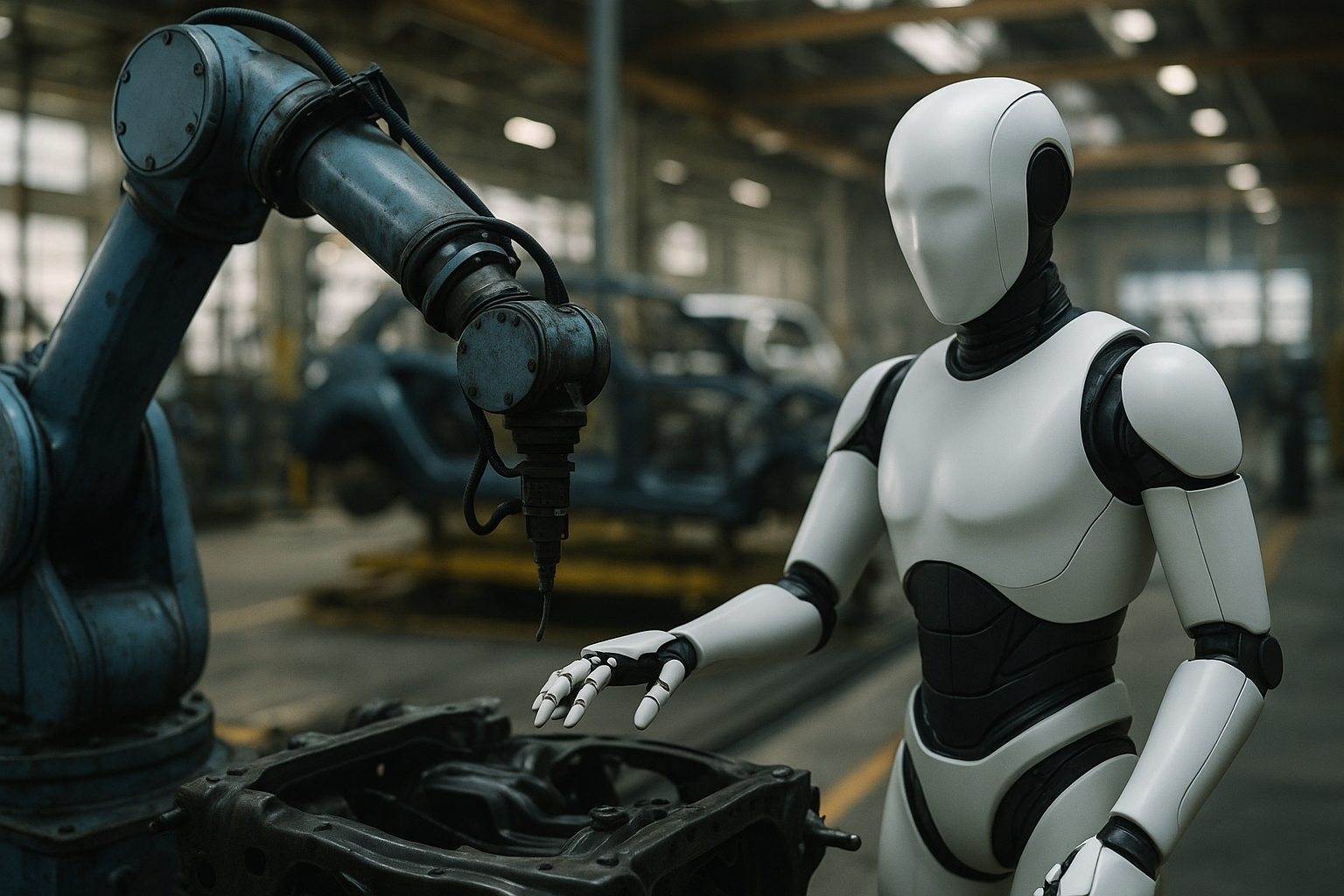
Gemini Robotics industrial humanoid control is coming to the factory floor
Manufacturers have long wanted robots that can adapt to new parts and workflows without weeks of reprogramming. DeepMind’s Gemini Robotics points to that future: an end‑to‑end vision‑language‑action system that interprets natural instructions, understands its environment, and executes multi‑step tasks. Early results suggest a step‑change for Gemini Robotics industrial humanoid control in factories and warehouses [3].
Gemini Robotics industrial humanoid control: how it differs from traditional programming
Traditional industrial robots are typically scripted for narrow, repeatable tasks. Gemini Robotics instead unifies perception, spatial reasoning, planning, and actuation so a single model can interpret goals and act accordingly. The Gemini Robotics‑ER variant directly controls robots end‑to‑end and has achieved 2–3x higher task success than earlier Gemini 2.0 configurations on benchmark tasks, indicating stronger reliability for multi‑step operations [3].
Beyond direct control, the system can generate task‑specific code to handle new objectives. When code alone is insufficient, it uses in‑context learning from a few human demonstrations to adapt, blending autonomy with human guidance for faster iteration on the floor [3].
Multi‑embodiment: from ALOHA 2 to Franka and the Apollo humanoid
DeepMind trained Gemini Robotics primarily on the ALOHA 2 dual‑arm platform, then transferred the learned policy to other embodiments—including Franka‑based arms and the Apptronik Apollo humanoid—without full retraining. This “multi‑embodiment” capability means the same AI policy can operate different robot bodies, reducing integration overhead and enabling cross‑platform deployments across workcells [3].
A collaboration with Apptronik connects Gemini to Apollo, where demos highlight general‑purpose handling in unstructured settings. This includes managing unknown objects and performing varied household or logistics‑style tasks—evidence that the approach can move beyond lab conditions and into environments that change day to day [2][3].
Real‑world demos: packing, sorting, and handling unknown objects
Apollo demonstrations show robots packing items, sorting laundry, and placing objects into containers while dealing with variability. These tasks mirror logistics and light assembly workflows—picking, kitting, staging, and packing—where adaptability is essential and exceptions are common [2][3].
For operations teams, the significance is less about any single task and more about the system’s breadth: one model interpreting instructions, perceiving scenes, and executing action sequences. That capability underpins the promise of Gemini Robotics industrial humanoid control across different stations and product mixes [3].
Practical implications for auto factory floors
Auto manufacturing constantly evolves—new trims, updated parts, and frequent line rebalancing. Gemini Robotics can help robots adapt to these changes by minimizing exhaustive reprogramming and enabling more flexible, code‑assisted task set‑ups. In practice, this could:
- Shorten time‑to‑deployment for new assemblies and tooling changes.
- Reduce engineering hours spent on bespoke scripts.
- Support re‑tasking robots across stations via multi‑embodiment policies.
These advantages align with broader goals to improve safety and reliability in autonomous decision‑making and expand access to advanced robotics beyond large enterprises—potentially unlocking new use cases for mid‑size manufacturers [3]. The result: more agile AI control for factory robots capable of handling multi‑step processes and exceptions [3].
Safety, reliability, and governance considerations
DeepMind emphasizes improving safety and reliability as Gemini moves robots from labs to workplaces. Businesses should validate claims by testing autonomy thresholds, monitoring failure modes, and ensuring integration with existing safety systems. Pilots should include guardrails, human oversight, and clear criteria for escalation or pause conditions as part of a staged rollout [3].
For an authoritative overview, see DeepMind’s announcement in its research blog—an external reference with technical context and examples: Gemini Robotics brings AI into the physical world (external) [3].
Implementation checklist and pilot roadmap
To de‑risk adoption, structure pilots with measurable milestones:
- Define task scope: multi‑step goals, success criteria, and exception policies [3].
- Select embodiment: start with a dual‑arm setup (e.g., ALOHA 2) or a compatible arm before moving to a humanoid, leveraging multi‑embodiment transfer [3].
- Configure control: apply Gemini Robotics‑ER for end‑to‑end control; use code generation for task logic and in‑context demonstrations for adaptation [3].
- Instrument KPIs: cycle time, task success rate, uptime, and redeployment speed [3].
- Stage rollout: expand from a single cell to multiple stations as reliability improves [3].
For additional tooling frameworks and templates, Explore AI tools and playbooks.
Cost and ROI framing for decision‑makers
While costs will vary by hardware and scope, a useful framing ties benefits to fewer engineering hours, faster deployments, and the option value of cross‑platform reuse. Gemini Robotics industrial humanoid control can reduce reprogramming churn and speed re‑tasking—two drivers that matter when product variants and takt times shift frequently on auto lines [3]. Align ROI estimates to avoided downtime during changeovers, reduced custom scripts, and the flexibility to redeploy robots across stations using the same policy [3].
Conclusion and where to watch next
Gemini Robotics brings vision‑language‑action robotics into real‑world contexts—dual‑arm systems and the Apptronik Apollo robot—showing multi‑step execution, transfer across embodiments, and early signs of practical adaptability [2][3]. For manufacturers, the next phase is disciplined piloting: validate safety, track KPIs, and expand where performance holds.
Sources
[1] Google DeepMind’s Gemini Robotics: Advancing AI …
https://medium.com/packt-hub/google-deepminds-gemini-robotics-advancing-ai-powered-problem-solving-in-the-physical-world-7d8afc665c65
[2] Apollo humanoid robot tackles unknown objects with Google …
https://interestingengineering.com/ai-robotics/google-deepmind-apollo-humanoid-robot
[3] Gemini Robotics brings AI into the physical world – Google DeepMind
https://deepmind.google/blog/gemini-robotics-brings-ai-into-the-physical-world/
