
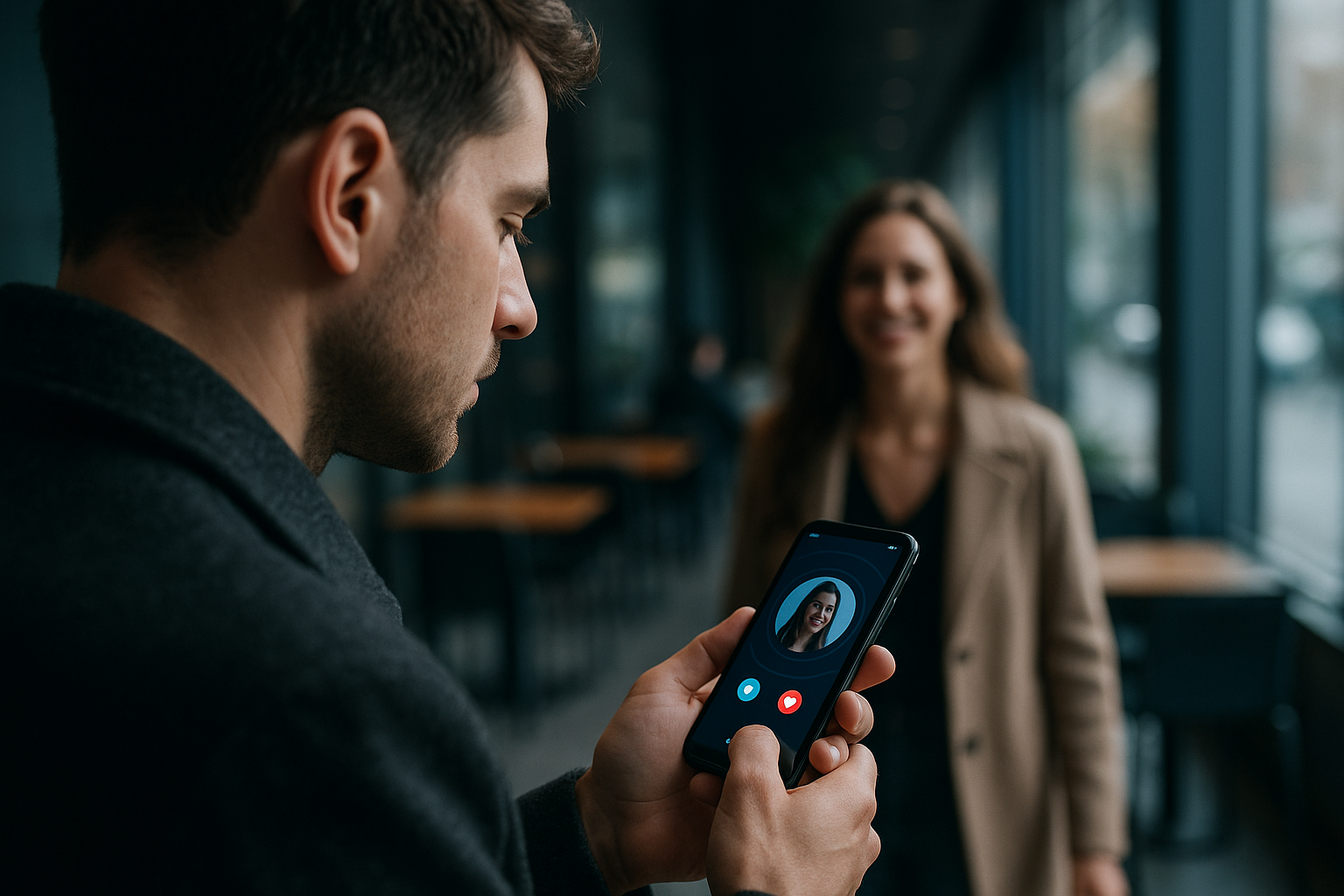
AI Dating Trends 2025: Why IRL Cruising Will Reassert Itself
Modern dating is increasingly digital—and increasingly automated. By 2024, online became the dominant way couples meet, while introductions via friends waned, setting the stage for AI dating trends 2025 to shape both product roadmaps and user expectations [3][5]. Yet even as AI spreads across the funnel, cultural narratives still celebrate serendipitous, in‑person chemistry—creating a strategic tension for product teams.
State of play: data-backed snapshot of modern dating
Online channels now account for a leading share of how couples meet, with friend- and family-based introductions declining sharply [3][5]. Over the last year, AI usage in dating reportedly climbed dramatically, with strong adoption among younger cohorts who use tools to filter matches, optimize profiles, and craft messages [3][2]. These shifts signal that users want help streamlining effort and logistics—without fully outsourcing emotional decision-making [2][5].
How platforms are using AI today
AI in dating apps now extends well beyond swipe-based ranking. Common applications include:
- AI match recommendation that infers preferences from swipes and conversations to better target compatibility [4][2].
- Profile optimization and message drafting to improve response rates and reduce friction, particularly for newer users [3][2].
- Translation tools to bridge language gaps and broaden potential matches across borders [4].
- AI dating safety tools, from fraud and bot detection to verification flows that reduce catfishing risk [4][2].
- Recommendations for date locations and activities, turning the app into a planning assistant—not only a matching marketplace [4].
These capabilities promise efficiency and, in some studies, correlate with slightly better relationship outcomes for couples who meet online, though the overall picture remains nuanced [5][6].
Emerging features: wingmen, pre-dating agents, and nudges to meet
The frontier is more radical. Concepts include AI “wingmen” that coach users in real time, and autonomous agents that chat or “pre-date” on a user’s behalf before handing over a short list of pre‑vetted prospects [1][2]. Platforms are also testing explicit nudges that move the interaction from chat to calendar, promoting faster transitions to in‑person meetings [4][3].
For product and ML teams, these features demand careful orchestration: safety and moderation workflows for agentic chats; clear disclosures to preserve trust; and conversion metrics that measure IRL outcomes, not just time‑in‑app. When aligning with AI dating trends 2025, teams should validate that automation enhances, rather than replaces, authentic first impressions [2][5].
Business incentives: engagement, retention, and revenue
AI also advances platform economics. Better ranking, messaging aids, and planning recommendations can increase engagement and upsell subscriptions. But there’s a structural tension: systems optimized for retention can devolve into loops that prolong swiping or chatting instead of facilitating timely, high‑quality matches and real‑world dates [7][5]. As dating app monetization and AI evolve together, operators face a strategic choice—optimize purely for near‑term revenue, or differentiate by aligning success metrics with user relationship progress [7].
Risks: authenticity, dependence, and ethical trade-offs
As AI intermediates more of the journey, users risk over‑reliance on prompts and agents, blurring authorship in early conversations and raising questions about consent, privacy, and manipulation [2][5]. Over‑optimization could steer attraction toward platform KPIs rather than personal values, while opaque models can entrench biases. Mixed findings on relationship stability underscore the need for transparency, user control, and guardrails that keep humans—rather than algorithms—in charge of intimate decisions [5][6]. For ethical framing, product leads can consult broader AI principles, such as the OECD AI Principles (external).
Cultural gap: why IRL cruising remains the emotional ideal
Despite the data showing online dominance, film and TV narratives still privilege spontaneous, offline meet‑cutes over app-based stories, reflecting ambivalence about algorithmic romance [5]. That gap hints at a durable desire for embodied, serendipitous encounters—an opportunity for teams to design flows that accelerate safe, in‑person meetings and celebrate the moment two people choose to leave the app. For deeper frameworks on aligning AI capabilities with human outcomes, see our AI product playbooks.
Recommendations for product teams
- Build for handoffs: Design nudges that move from chat to calendar to first date, with clear safety and consent checkpoints [4][3].
- Instrument IRL metrics: Track conversion to verified meetups and post-date feedback—not just swipes, chats, or time‑in‑app [7][5].
- Keep humans in the loop: Favor assistive coaching over fully autonomous “pre-dating” unless users opt in with transparent disclosures [1][2].
- Align incentives: Tie premium features to progress (e.g., verified dates, safety tools), not endless browsing [7].
- Localize responsibly: Use translation, fraud detection, and activity recommendations to broaden access while maintaining rigorous trust & safety [4][2].
Conclusion: pragmatic forecast and next steps
AI will remain infrastructural to digital matchmaking—spanning ranking, safety, and planning—while the cultural ideal of in‑person connection persists. Product leaders who embrace AI dating trends 2025 yet optimize for timely, safe IRL outcomes will better balance engagement with user trust. Watch signals like agentic features, offline conversion rates, and content norms that celebrate leaving the app—because in dating, the win is what happens off‑screen [3][7][5][8].
Sources
[1] hawk tuah girl built an AI dating app – as seen on
https://asseenonbyochuko.substack.com/p/hawk-tuah-girl-built-an-ai-dating
[2] Is AI the future of dating? Here’s what you need to know
https://www.calm.com/blog/ai-dating
[3] Love in the Age of AI Dating Apps [2025 Statistics]
https://www.tidio.com/blog/ai-dating-apps/
[4] AI in Dating Apps: Impacts, Benefits, and Future Trends 2025
https://www.octalsoftware.com/blog/ai-in-dating
[5] Love and algorithms: The future of dating apps
https://www.apa.org/news/podcasts/speaking-of-psychology/dating-apps
[6] Dating App Success Stories: What We Can Learn From the Apps …
https://thisisglance.com/blog/dating-app-success-stories-what-we-can-learn-from-the-apps-that-made-it
[7] How dating apps make a killing by stealing from social media
https://growthcurve.co/how-dating-apps-are-hanging-on-to-users-and-revenue-by-becoming-social-media
[8] Online dating apps as a marketing channel: a generational …
https://redaedem.org/EJMBE/num_anteriores/Vol.%2030.%20Num.%201.%202021.pdf
