
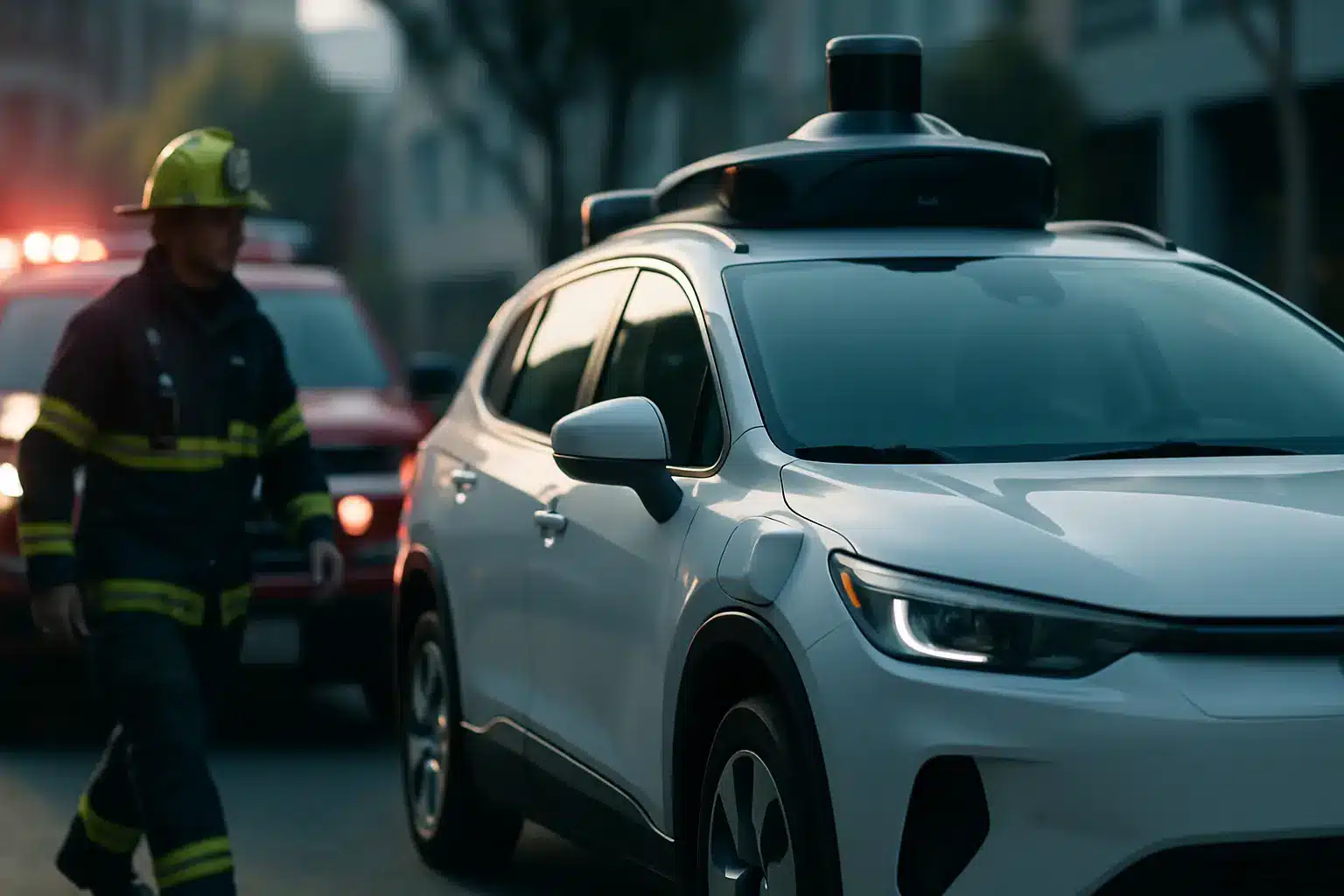
Emergency First Responders Say Waymos Are Getting Worse: Tracking Waymo emergency responder incidents
City officials and public-safety leaders in San Francisco and Austin say interactions with Waymo’s driverless vehicles are getting more difficult, not easier. Their accounts describe a pattern of Waymo emergency responder incidents that include vehicles freezing in chaotic or un-signaled environments, committing more traffic-control violations, and burdening police, fire, and EMS with on-scene problem solving that can delay response [1].
What First Responders Are Reporting
San Francisco documented dozens of autonomous vehicle interference events with emergency operations, rising through 2023. The city’s emergency management director told federal regulators that Waymo appeared to be backsliding from earlier safety improvements, citing recent incidents where cars drove through darkened intersections during a power outage and then blocked traffic until officers physically moved them [1].
Austin public-safety officials point to a lack of what they call social awareness. They describe cars hesitating or stopping in ways humans would not. Reported incidents include Waymos passing stopped school buses with extended stop arms and flashing lights, as well as an instance where a robotaxi blocked an ambulance en route to a mass shooting until a police officer entered the vehicle to move it [1][5]. These are stark examples of a robotaxi obstructing emergency scenes and traffic, with real operational costs.
Data and Research: University, Municipal, and NHTSA Findings
A research effort tied to the University of Washington and Texas A&M details growing counts of robotaxi incidents, including obstruction of emergency scenes and erratic stops, aligning with San Francisco’s own data indicating Waymo incidents rose several-fold in 2023 [1][4]. Separately, Texas A&M’s transportation research on first responder interactions with automated vehicles outlines the challenges of coordinating with AVs, including training gaps and on-scene protocols [6].
At the federal level, the National Highway Traffic Safety Administration opened a preliminary evaluation into specific automated driving system behaviors reported for Waymo, while it also closed a broader 14‑month investigation without identifying systemic safety defects. The agency cited Waymo’s recalls and responsiveness in closing that case [7][8]. That dual status is central to any NHTSA evaluation Waymo behavior discussion: some targeted questions remain even as a wider safety defect finding did not materialize.
Waymo emergency responder incidents: Operational Failures and On-Scene Burdens
First responders in both cities say they have effectively become unpaid roadside assistance. They report immobilized vehicles, unexpected halts in live traffic, and scene blockages that force officers and firefighters to take on tasks that belong to an operator’s field support team [1][2]. Officials also point to remote support delays Waymo users encounter, describing long on-hold times and difficulties reaching company staff who can safely disengage or redirect cars [1].
Austin officials characterize the underlying issue as limited social awareness. In practice, that can manifest as hesitations at chaotic scenes or nonstandard behavior that a human driver would resolve quickly, but an AV cannot [1][5]. The operational effect is cumulative: even brief stops can stack into significant delays for EMS or fire when traffic is compressed around an incident.
Waymo’s Response and Industry Context
Waymo says it has engaged with local officials and added features to help manage these situations, including manual disengagement that allows first responders to move vehicles at their request [1]. The company frames its posture as collaborative and safety focused. In parallel, the regulatory backdrop remains mixed. NHTSA’s preliminary evaluation continues to examine specific behaviors, while the earlier 14‑month review concluded without a systemic safety defect finding after the company initiated recalls and cooperated with regulators [7][8].
Implications for Cities, Fleet Operators, and Emergency Services
For city and public-safety leaders, the reports highlight the impact of robotaxis on emergency response times, training needs for on-scene personnel, and the importance of operator communications that work under stress. Municipalities may consider how incident reporting flows to both local authorities and state or federal agencies, how to structure service-level expectations for remote support, and what data sharing is required to monitor interference trends over time [1][4][6].
Fleet operators and mobility managers should assess field staffing for rapid response, triage protocols for blocked lanes or intersections, and procedures to ensure school-bus and emergency-vehicle rules are strictly enforced by the stack. The evidence suggests that gaps in social awareness and decision-making at complex scenes can translate quickly into public-safety risks [1][5].
Recommendations: Short-term Steps and Policy Options
- Establish a dedicated contact path to the operator’s remote support with documented response-time targets and escalation tiers [1].
- Train police, fire, and EMS on how to request manual disengagement and safely move vehicles at scenes, where supported [1][6].
- Standardize incident reporting to local authorities, and require operators to share de-identified logs of conflicts, stops, and diversions around emergency scenes [1][4].
- Explore systems that broadcast emergency vehicle locations to AV operators to improve scene awareness and routing, as evaluated in municipal research [4].
For ongoing coverage of AV policy and deployments, see our AI news coverage.
What to Watch Next
Regulatory actions and city policies may shift if incident counts continue to rise or if the current federal evaluation surfaces repeat behaviors at scale. Watch for operator updates to remote support staffing and on-scene tools, and for municipalities to codify first responder interactions with Waymo and other AV fleets [1][4][7][8]. For broader federal context, see NHTSA’s automated vehicle safety overview NHTSA resource (external).
FAQ: First Responder Interactions
- What should a responder do if a robotaxi is blocking a scene? Follow agency protocols and contact the operator’s support line. If available, request manual disengagement to move the vehicle [1][6].
- How are incidents documented? Cities have begun tracking obstruction events and erratic stops, and researchers are compiling municipal reports to assess trends [1][4].
- What is Waymo’s current regulatory status? NHTSA has opened a preliminary evaluation into certain behaviors, and a separate 14‑month investigation closed without a systemic safety defect finding [7][8].
Sources
[1] Emergency First Responders Say Waymos Are Getting Worse | WIRED
https://www.wired.com/story/emergency-first-responders-say-waymos-are-getting-worse/
[2] Emergency Responders Say They’re Now Unpaid “Roadside Assistance” for Confused Waymos
https://futurism.com/advanced-transport/emergency-responders-roadside-assistance-waymo
[3] Confused Waymos Keep Getting in the Way of Emergency Responders And They’ve Had Enough – AOL
https://www.aol.com/lifestyle/confused-waymos-keep-getting-way-192638297.html
[4] Broadcasting the Locations of Emergency Vehicles to Robotaxi Operators to Improve Safety and Mobility
https://www.seattle.gov/documents/Departments/SDOT/ProjectsAndPrograms/Autonomous%20Vehicles/2026_University_of_Washington_Sustainable_Transportation_Lab_Report%20on_SDOT_Digital_Conflict_Area_Awareness_Management_Program.pdf
[5] Waymo plans to skip safety meeting after robotaxi blocked ambulance: ‘We answered all questions’
https://www.yahoo.com/news/articles/waymo-skips-austin-meeting-robotaxi-103000594.html
[6] [PDF] First Responder Interactions with Automated Vehicles
https://static.tti.tamu.edu/tti.tamu.edu/documents/0-7199-R1.pdf
[7] NHTSA Closes Waymo Investigation: Key Takeaways for the AV Industry | Husch Blackwell
https://www.huschblackwell.com/newsandinsights/nhtsa-closes-waymo-investigation-key-takeaways-for-the-av-industry
[8] [PDF] Waymo – ODI RESUME
https://static.nhtsa.gov/odi/inv/2024/INOA-PE24016-12382.pdf
