
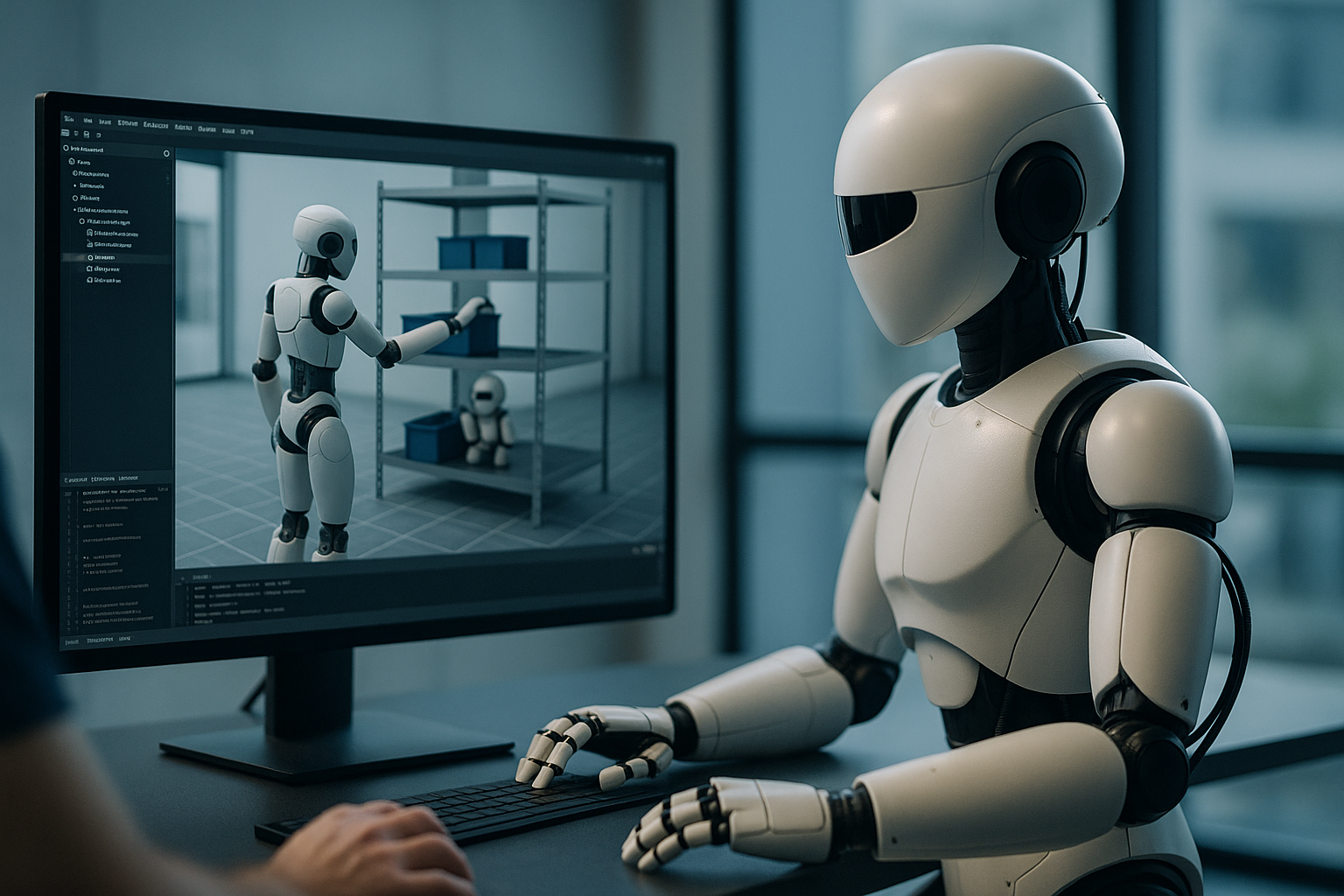
Synthetic data generation for robotics: NVIDIA Isaac Sim and OSMO for end-to-end workflows
High-fidelity simulation and cloud-native orchestration are converging to give robotics teams a practical path from virtual scenes to real-world performance. NVIDIA’s stack ties together Isaac Sim for scene authoring and data capture with OSMO for multi-stage pipeline execution—an approach designed to scale synthetic data generation for robotics and accelerate development across perception, manipulation, and navigation tasks [1][3].
Core components for scalable physical AI
Isaac Sim is built on NVIDIA Omniverse and OpenUSD, enabling teams to construct realistic, simulation-ready environments and robots. Developers import environment assets, add SimReady objects and robots, and configure dynamic mobility scenarios. With Omniverse Replicator, they can programmatically vary scenes and capture labeled synthetic datasets to train and validate models for core robotic capabilities [1][3].
The same end-to-end pipeline can extend beyond data generation to training, reinforcement learning, and software-in-the-loop testing, allowing teams to reuse instances as they iterate. This continuity supports faster experimentation and more reliable transfer from sim to real [1][3].
Designing workflows with synthetic data generation for robotics
A pragmatic end-to-end workflow follows a clear sequence:
- Scene authoring: Build OpenUSD-based scenes with assets and robots arranged for target tasks.
- Scenario generation: Use Replicator to introduce domain variations—lighting, textures, object placement, and motion—to reveal edge cases.
- Labeled capture: Render and export annotations for perception, manipulation, and navigation training.
- Training and validation: Reuse synthetic datasets in model training and validate against varied scenarios, then advance to software-in-the-loop testing.
This approach helps teams systematically cover rare events and environmental diversity that are costly or unsafe to replicate in the real world. It also provides a reproducible backbone for iterative improvements as models and tasks evolve [1][3].
Orchestration and reproducibility with NVIDIA OSMO
OSMO provides a cloud-native layer to orchestrate multi-stage robotics workflows across heterogeneous compute, including on-premises clusters, private clouds, and public clouds such as AWS. This is critical for scaling simulation, data generation, and training without retooling pipelines for each environment [2].
Reproducible specifications and lineage tracking are central to robust experimentation. By managing complex, multi-container workloads and tracking data and model versions, teams can audit results and rerun experiments with confidence—key for regulated industries and large multi-team programs [1][3].
Advanced authoring and augmentation
OpenUSD is the shared language for scenes and assets, allowing teams to scale authoring and reuse across projects. Semantic search and code-driven scene generation accelerate iteration by making it easier to discover assets and modify scenes programmatically. Foundation-model-based augmentation can further enrich training sets by diversifying both real and synthetic video, increasing robustness without manual scene rework [1][3]. For background on the underlying scene format, see the OpenUSD specification (external).
These capabilities collectively reduce bottlenecks in scene assembly, dataset creation, and scenario coverage—moving more effort into model development and validation where it matters most [1][3].
Hybrid deployment: scaling across on-prem and AWS
Many teams combine on-prem resources with public cloud to balance cost, throughput, and availability. AWS offers accelerated infrastructure for robotics simulation with NVIDIA, giving teams on-demand capacity for large-scale scenario sweeps and training cycles. OSMO’s orchestration across this hybrid footprint allows the same pipeline to run where it is most efficient, while maintaining consistent specifications and tracking [2].
This flexibility is particularly useful when scaling synthetic data generation for robotics during peak testing windows or when experimenting with new model architectures that demand bursts of compute [2][3].
Use cases and ROI across robot types
The workflow targets mobile robots and manipulators—including AMRs, humanoids, and industrial arms—where variation-rich datasets, reproducible experiments, and fast iteration cycles drive performance. Teams can benchmark progress by tracking dataset diversity, training time, and real-world transfer quality as they move from synthetic data to field trials [1][3].
By unifying simulation, data capture, and orchestration, organizations can standardize processes, shorten development loops, and reduce risk—outcomes that resonate for engineering leaders and operations teams alike [1][3]. For additional frameworks and checklists, Explore AI tools and playbooks.
Best practices and pitfalls
- Start with a minimal, reproducible pipeline that covers scene authoring, variation, labeled capture, training, and validation.
- Emphasize coverage: drive domain randomization and scenario diversity early to surface edge cases.
- Maintain lineage for datasets and models to enable audits and reliable reruns.
- Use hybrid resources to scale efficiently, and keep specifications consistent across environments.
These practices help teams get value quickly while leaving room to evolve models and tasks without restructuring the pipeline [1][2][3].
Sources
[1] Robotics Simulation | Use Case – NVIDIA
https://www.nvidia.com/en-us/use-cases/robotics-simulation/
[2] AWS offers accelerated robotics simulation with NVIDIA
https://www.therobotreport.com/aws-offers-accelerated-robotics-simulation-nvidia/
[3] Build Synthetic Data Pipelines to Train Smarter Robots with NVIDIA Isaac Sim
https://developer.nvidia.com/blog/build-synthetic-data-pipelines-to-train-smarter-robots-with-nvidia-isaac-sim/
