
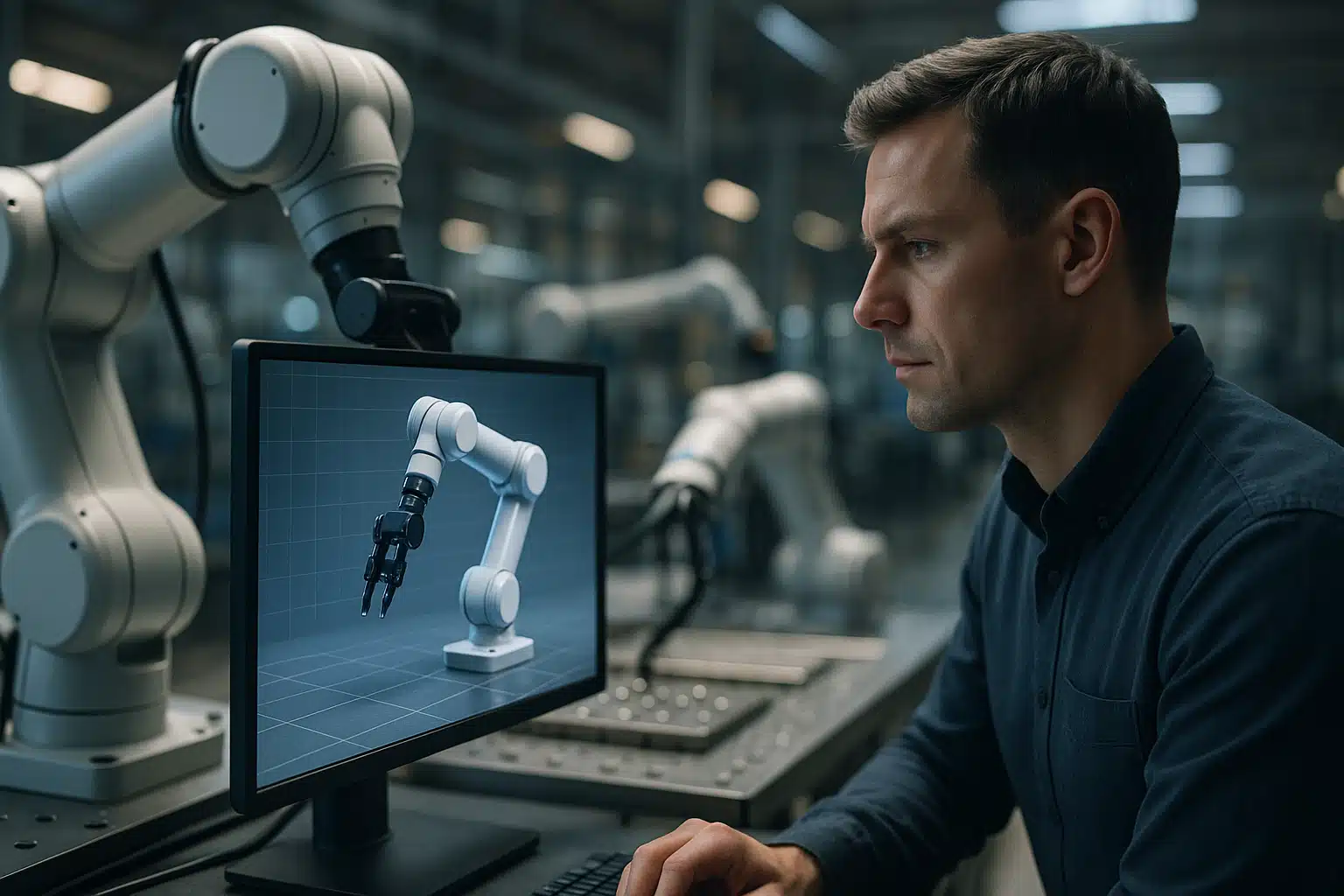
From Simulation to Production: sim-to-real robotics for manufacturing
Manufacturers are moving from hand-engineered, task-specific automation to AI-native workflows that couple high-fidelity simulation, perception, and control. In this shift, platforms like NVIDIA Isaac Sim and Omniverse are used to design, train, and validate robots virtually, then transfer behaviors to production hardware, a pattern often described as sim-to-real robotics for manufacturing [1][2].
Building sim-to-real robotics for manufacturing
High-fidelity simulation and digital twins underpin the modern robotics lifecycle. NVIDIA and partners highlight how Isaac Sim and Omniverse support virtual design, physics-accurate testing, and validation at scale before any on-site commissioning, reducing integration risk and disruption to production [1][2]. Partners including Cyngn, Doosan Robotics, Delta Electronics, and Wandelbots illustrate pipelines where learned behaviors are trained and tested in detailed digital replicas of factories or warehouses, then transferred to real robots [1][2]. This approach helps teams plan deployments, verify performance, and streamline rollout windows [1][2]. For product documentation, see NVIDIA’s Isaac Sim docs external.
Training and validation inside digital twins
With simulation as the backbone, teams generate scenario coverage and validate control policies before touching physical cells. Isaac Sim and Omniverse are used to synthesize environments and sensor inputs, stress-test perception and planning, and evaluate results against defined metrics in the virtual domain [1][2]. By front-loading testing in high-fidelity digital twins, operators can cut on-site iterations and focus field work on fine-tuning rather than first-pass integration [1][2]. These practices support sim-to-real robotics for manufacturing when moving from virtual trials to staged pilots and production [1][2].
Edge runtime: Jetson-based controllers and GPU-accelerated perception
On the factory floor, edge AI platforms consolidate motion control, multi-camera vision, and high-level decision-making into a unified stack. Examples include Vention’s MachineMotion AI and KUKA’s KR C5 Micro-2 extension, which build on NVIDIA Jetson to run real-time inference alongside deterministic control [1][2]. CUDA-accelerated libraries enable perception and planning workloads such as 3D vision for bin-picking, autonomous navigation, and adaptive manipulation, helping robots respond to dynamic environments without cloud latency [1][2]. This architecture supports sim-to-real robotics for manufacturing by aligning the runtime with the same GPU-accelerated toolchain used in simulation [1][2].
Operational use cases: bin-picking, navigation, adaptive manipulation
The ecosystem features practical deployments across manufacturing and logistics. Partners demonstrate GPU-accelerated bin-picking for unstructured parts, autonomous navigation for intralogistics, and adaptive manipulation for variable tasks, each validated first in simulation to reduce on-site trial-and-error [1][2]. By training and testing against realistic digital twins, teams report shorter commissioning windows and fewer disruptions when shifting to physical robots [1][2]. These workflows align with sim-to-real robotics for manufacturing where ROI hinges on predictable rollout and uptime [1][2].
Lowering barriers: modular hardware, no-code tools, and robots as a service
A new wave of startups, with backing from companies such as Amazon and NVIDIA, focuses on modular hardware, no-code or low-code configuration, and service-based delivery models that fit small and medium manufacturers. Notable examples include Robco and Tutor Intelligence [3]. These offerings aim to reduce upfront engineering, support faster reconfiguration, and make robots as a service for manufacturers a viable path to adoption [3]. For buyers evaluating options, no-code robotics platforms and modular industrial robot hardware can simplify pilots and scale-outs [3].
Monitoring and operations: AI agents and video-based oversight
Beyond control, AI agents process factory video and sensor streams to monitor workflows, flag anomalies, and guide interventions [1][2]. By running analysis on the edge, teams can detect issues quickly and standardize responses across lines or sites. This complements simulation-driven deployment by maintaining a feedback loop from production back to virtual testing and retraining when needed [1][2].
Challenges and production best practices
Enterprises still balance safety, integration complexity, and edge reliability. The pattern emerging from partners is to anchor projects in digital twins, validate policies and perception pipelines at scale, and then deploy in stages with clear metrics for throughput, uptime, and quality [1][2]. Simulation-first planning helps reduce robot commissioning time with digital twins, while GPU-accelerated runtimes keep perception and control responsive on the floor [1][2]. Teams can also align internal playbooks around these steps to improve repeatability across programs. To dive deeper into implementation patterns, explore AI tools and playbooks at ToolScopeAI Explore AI tools and playbooks.
The road ahead: generalist models and transferable skills
Foundation and generalist AI models are emerging to give robots reusable skills and cross-domain adaptability, aiming to accelerate reprogramming and scale from simulation into production [1][2]. As these models mature, they could strengthen sim-to-real robotics for manufacturing by standardizing core capabilities across applications while keeping domain-specific fine-tuning in the loop [1][2].
Sources
[1] NVIDIA Partners Showcase Cutting-Edge Robotic and Industrial AI …
https://blogs.nvidia.com/blog/robotics-industrial-ai-automate/
[2] NVIDIA and Partners Highlight Next-Generation Robotics …
https://blogs.nvidia.com/blog/automatica-robotics-2025/
[3] Amazon & NVIDIA are investing in these 8 AI + robotics startups
https://www.youtube.com/watch?v=kVbVbVhzNZM
