
Physics-Constrained Generative Design for Personalized 3D‑Printed Items
Generative AI is moving past pretty renders toward products that survive everyday use. The emerging blueprint is simple: keep a physics engine in the loop so every generated geometry satisfies strength, thermal, and flow constraints, then layer AI to explore options and personalize fit. That’s the promise of physics-constrained generative design—and it matters as teams accelerate 3D-printed, one-off items without sacrificing safety or manufacturability [1][2][3].
Physics-driven vs data-driven: a productive hybrid
Physics-driven design starts from governing equations—structural mechanics, fluid dynamics, heat transfer—so shapes emerge from first principles rather than learned templates. This approach inherently respects constraints like stiffness, flow resistance, thermal performance, and material limits. Data-driven methods, from reinforcement learning to models trained on past designs, add speed, aesthetic exploration, and personalization. The winning workflow uses physics solvers as feasibility filters and AI for refinement and rapid search [1].
Core methods: topology and fluid topology optimization
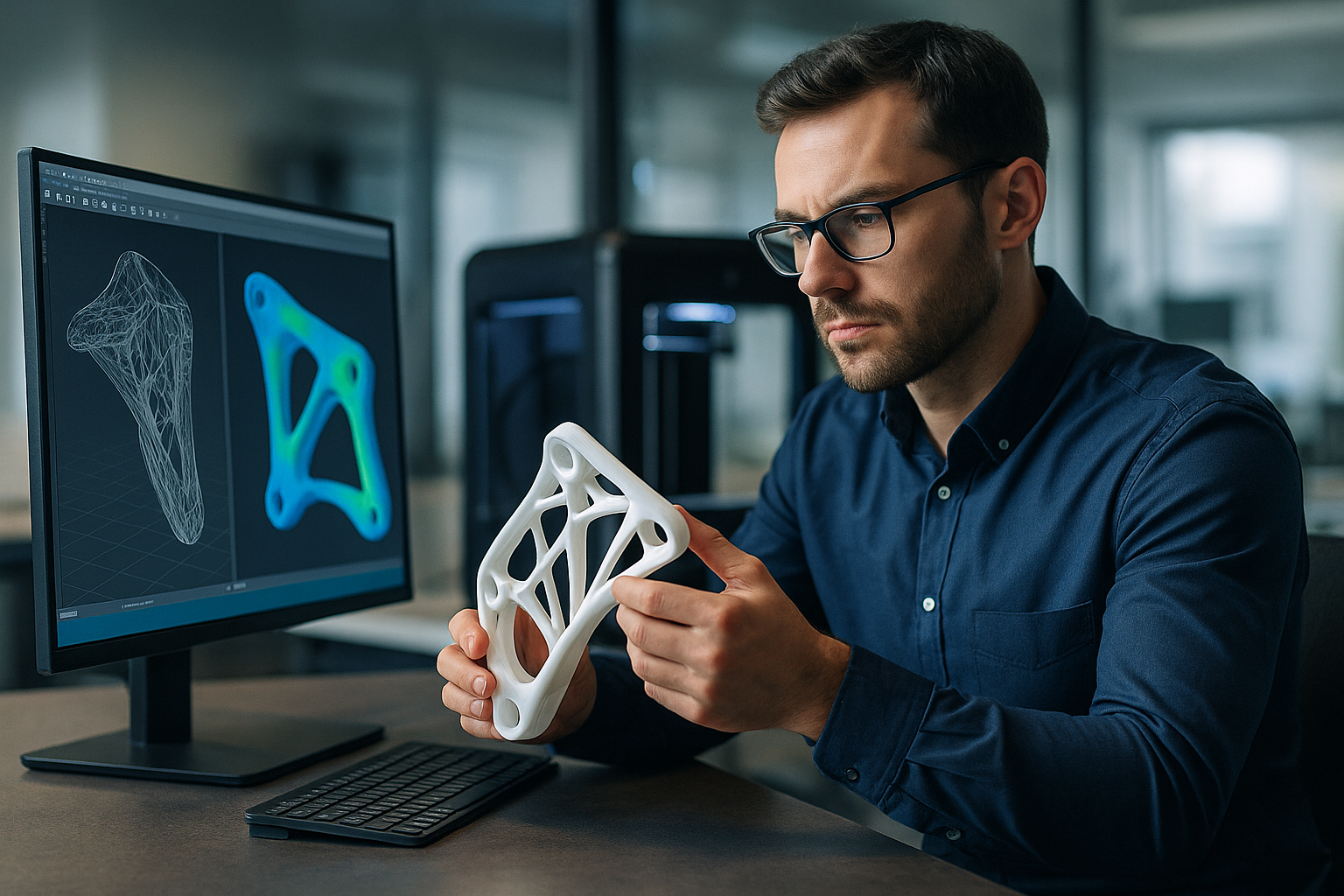
Generative topology optimization can minimize weight while maintaining stiffness or strength, producing organic, lattice-like geometries that are difficult to conceive manually. Fluid topology optimization extends the idea to channels and manifolds, where the algorithm discovers internal flow paths that reduce pressure drop or improve heat transfer. In both cases, solvers enforce boundary conditions, loads, and material constraints so candidates meet real-world requirements rather than merely resembling prior parts [1].
Inside physics-constrained generative design
An end-to-end workflow integrates CAD, simulation, and the generative engine. Engineers specify loads, boundary conditions, materials, and manufacturing methods—metal additive, polymer printing, or milling—then the software proposes candidate geometries that satisfy those conditions. Tight coupling to additive manufacturing is critical because printers can realize the complex, organic forms these solvers often create. Platforms can also evaluate multiple materials and processes, ranking designs so teams can compare trade-offs before committing to fabrication [2].
Tooling to know: nTop, Creo, and physics-first approaches
- nTop supports custom generative workflows, allowing teams to connect external solvers or AI models into the pipeline—useful when combining physics feasibility with data-driven personalization.
- PTC’s Creo offers Generative Topology Optimization and a cloud-based Generative Design Extension that can assess different materials and manufacturing options, helping engineers shortlist viable parts quickly.
- Physics-first approaches, such as fluid topology optimization for manifolds and heat exchangers, illustrate how starting from equations yields novel yet feasible geometries.
These capabilities reflect a broader shift toward platforms that merge CAD, simulation, optimization, and manufacturability analysis in one loop [1][2].
Manufacturing: design for additive from the start
Generative design for 3D printing benefits from design-for-additive rules: specify process constraints upfront so the solver avoids unprintable features and minimizes supports. Additive manufacturing also enables part consolidation—combining assemblies into a single geometry—cutting weight and potential failure points. Industrial examples show lighter, stronger parts achieved through generative workflows and printing, highlighting the route from concept to production-ready components [2][3].
Use cases: from cooling channels to wearables
Fluid topology optimization is especially effective for compact heat exchangers, manifolds, and cooling channels in products where internal flow matters. On the structural side, generative approaches have delivered large weight reductions and part consolidation; a well-known example is a 3D-printed automotive bracket that became lighter yet stronger after generative redesign. Extending these methods to personal items—custom ergonomics, wearables, or individualized medical components—means coupling user data with physics constraints so each object is safe and efficient for its specific use [1][3].
Business checklist: from data to validation
- Capture user and use-case data; translate it into loads, boundary conditions, and allowable materials/processes in CAD/CAE.
- Use the physics solver as a hard gate; let AI search and personalize within those constraints.
- Compare candidates across materials and processes, leveraging platform ranking features to balance performance and manufacturability.
- Validate with simulation, then print prototypes to confirm performance.
- Track KPIs such as weight, stiffness, thermal behavior, cost, and lead time to quantify ROI [1][2][3].
Risks and what’s next
Physics-constrained workflows reduce failure risks by enforcing material and performance limits, but teams still navigate printability constraints and process trade-offs. As toolchains mature, expect tighter feedback loops where AI-driven personalization rapidly iterates within physics limits, especially for one-off, safety-critical items [1][2].
For terminology and standards context, see the ISO/ASTM 52900 additive manufacturing terminology (external). To level up your stack, explore our practical guides: Explore AI tools and playbooks.
Sources
[1] Physics-Driven Design vs Data-Driven Generative Design – ToffeeX
https://toffeex.com/physics-driven-design-and-data-driven-design-best-results-combined/
[2] Top Generative Design Software for 3D Printing in 2023 – 3Dnatives
https://www.3dnatives.com/en/the-top-design-softwares-for-1505236/
[3] Generative Design: Short Introduction [+Examples] – BigRep
https://bigrep.com/posts/generative-design/
