
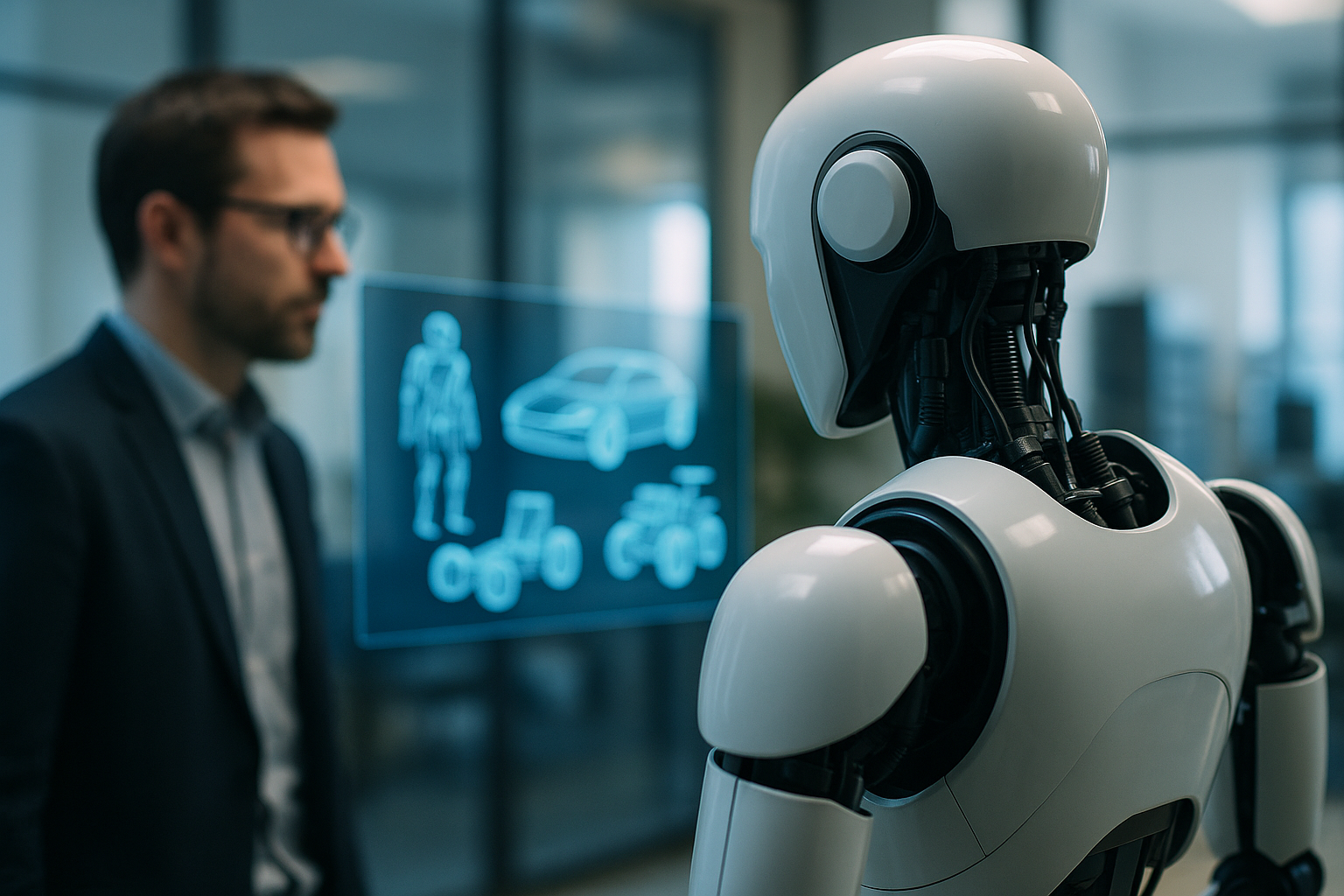
Into the Omniverse: Physical AI Foundation Models and Frameworks Advance Robots and Autonomous Systems
NVIDIA used CES 2026 to frame a new phase of robotics and autonomy centered on open models, simulation-first workflows, and an integrated toolchain. The company’s pitch: physical AI foundation models tied tightly to Omniverse allow teams to develop, validate, and deploy more safely and cost-effectively across robots and autonomous vehicles. [1][3][6]
What NVIDIA Means by Physical AI: Models, Tools, and Platform
NVIDIA describes “physical AI” as an open, platform-centric stack that integrates models, simulation, and hardware for embodied systems. The ecosystem spans Omniverse services, Isaac Sim/Isaac Lab, CUDA, and Jetson edge processors, with simulation acting as the central integration and validation layer. High‑fidelity digital twins, synthetic data generation, and GPU‑accelerated physics enable teams to train perception, control, and planning across massive scenario libraries—including rare edge cases—before deploying to real machines. [1][6]
This approach leverages NVIDIA Omniverse simulation to unify data, physics, and rendering with tools like Isaac Sim for robot development and Isaac Lab for reinforcement learning, imitation learning, and motion planning. By pairing models with infrastructure, the platform aims to reduce fragmentation and promote interoperability in robotics and AV programs. [1][6]
Key Open Models: Cosmos, Alpamayo, and Isaac GR00T
NVIDIA highlighted three open assets as core pillars:
- Cosmos: a world model platform focused on environment and behavior understanding for embodied systems. [1]
- Alpamayo autonomous driving stack: an open, inspectable inference stack positioned to help teams analyze failure modes and build common logic for safety. [1][3]
- Isaac GR00T vision-language-action: a foundation model tailored for humanoid robots that links perception and action within the platform. [1][3]
These releases are presented as shared baselines designed to lower R&D costs and promote interoperability across robotics and autonomy projects. Industry voices echo the significance of open releases for practical adoption and evaluation. [1][2][3]
Simulation, Differentiable Physics, and Synthetic Data
At the heart of the workflow is simulation that mirrors the real world with fidelity. Isaac Sim and Omniverse support digital twins for robotics, while GPU‑accelerated, differentiable physics engines such as Newton/Warp enable large‑scale, realistic robot training and validation. This makes it feasible to exercise rare and unsafe scenarios in a controlled environment, generating the synthetic data needed for robust perception and planning. [1][6]
NVIDIA Isaac Lab unifies reinforcement learning, imitation learning, and motion planning in one framework, providing a coherent sandbox to train policies before transferring to hardware. Demonstrations and practitioner coverage reinforce how simulation-first workflows can derisk deployment and clarify design parameters for computer vision and manipulation. [1][4][5][6]
Physical AI Foundation Models in Practice
Simulation-driven development is already reshaping robotics timelines. Teams can iterate over synthetic datasets, validate edge-case handling, and refine controllers using differentiable physics, then bridge to real robots with consistent tools and runtime. This aligns with how industrial and robotics leaders build on NVIDIA’s hardware–software stack to speed development and improve safety outcomes. [1][4][6]
Within this ecosystem, physical AI foundation models become the connective tissue between data, policies, and runtime. By anchoring model training to Omniverse and Isaac Lab, teams can scale testing and standardize evaluation across diverse tasks—from manipulation to autonomy. [1][6]
Workflows: From Cloud Training to Edge Deployment
The platform envisions a pipeline from cloud training in Omniverse to real‑time execution on Jetson edge processors, with CUDA acceleration across the stack. Teams can validate on digital twins, benchmark policies with Isaac Lab, and deploy optimized models to robots and vehicles, maintaining consistency from sim to edge. This end‑to‑end workflow is central to NVIDIA’s approach to operationalizing physical AI at scale. [1][6]
For additional technical context, see NVIDIA’s Omniverse developer materials (external), and explore internal resources like Explore AI tools and playbooks for implementation planning.
Open Source and Safety: Why an Inspectable Stack Matters
NVIDIA frames the open release of Alpamayo and related components as a deliberate move toward collaborative safety engineering. By enabling automakers, researchers, and startups to inspect failure modes, share edge cases, and co‑develop common logic, an open-source autonomy stack can mitigate the risks of fragmented systems and duplicated effort. The aim is to establish common baselines that improve transparency, reproducibility, and safety validation across the industry. [1][2][3]
Business Impact: Cost, Speed, and Risk
Simulation‑first robotics workflows promise shorter development cycles, lower R&D costs, and improved safety before physical trials. Digital twins for robotics and synthetic data generation help teams quantify performance under diverse conditions and focus real‑world testing where it matters most. As organizations standardize on shared models and tools, they can accelerate time‑to‑market while maintaining stronger safety assurance. [1][4][6]
Conclusion: What to Watch Next
Expect rapid iteration on open models like Cosmos, the Alpamayo autonomous driving stack, and Isaac GR00T vision‑language‑action as communities contribute data and evaluations. The combination of Omniverse, Isaac Sim and Isaac Lab, and Jetson hardware suggests a maturing path from research to deployment—grounded in simulation and open, inspectable foundations. [1][3][6]
Omniverse documentation (external)
Sources
[1] Into the Omniverse: Physical AI Open Models and Frameworks …
https://blogs.nvidia.com/blog/physical-ai-open-models-robot-autonomous-systems-omniverse/
[2] Physical AI Analysis: From Information Intelligence to Real-World …
https://medium.com/@naddod/physical-ai-analysis-from-information-intelligence-to-real-world-intelligence-8e13aa2606b4
[3] NVIDIA Keynote Takeaways: Open Models and Robot Foundation
https://www.linkedin.com/posts/data-dawn_nvidia-live-at-ces-2026-activity-7414673674424926208-Ss8q
[4] NVIDIA Omniverse Trains Robots in Simulation – LinkedIn
https://www.linkedin.com/posts/fogoros_ces2026-ai-digitaltransformation-activity-7414316083500703745-2u6c
[5] Robot Programming With NOVA & NVIDIA Isaac Sim – YouTube
https://www.youtube.com/watch?v=dCwNkjkzJcY
[6] Robotics Simulation | Use Case – NVIDIA
https://www.nvidia.com/en-us/use-cases/robotics-simulation/
