
Orbital AI Data Centers: Feasibility, Risks & Environmental
AI’s infrastructure needs are accelerating faster than most utilities can keep up, raising electricity, carbon, and water use—and prompting serious debate over orbital AI data centers feasibility. Analysts warn AI workloads could soon rival major cities in emissions and drive substantial water consumption for cooling, pushing operators to seek siting strategies that materially reduce their footprint [1][2].
Why location matters for AI data center impacts
AI is rapidly becoming the dominant driver of data center growth. Environmental researchers detail how training and serving large models amplify power demand, carbon intensity, and water draw, especially on fossil-heavy grids and in regions relying on evaporative cooling [1][2]. The industry’s interest in unconventional locations stems from the potential to tap cleaner power, cut cooling water, and sidestep local constraints that are increasingly drawing public concern [1][2][3].
Terrestrial levers and near-term alternatives
State-level modeling indicates that siting in cleaner grids, accelerating grid decarbonization, and boosting efficiency could slash U.S. AI data center emissions by roughly three-quarters and water withdrawals by more than four-fifths, even as demand grows [3]. That makes siting decisions a high-impact lever for the environmental impact of AI data centers [3].
Meanwhile, Microsoft’s Project Natick offers a tangible precedent for physical relocation as a design variable. The underwater initiative demonstrated multi‑year, lights‑out operation, leveraging ambient ocean cooling and the potential to pair with local renewables—evidence that moving compute can change both engineering and permitting constraints [7][8][9]. The Project Natick underwater data center experience underscores how alternative environments can reduce failure rates and simplify thermal management compared with some land-based deployments [7][8].
What ‘orbital data centers’ would look like
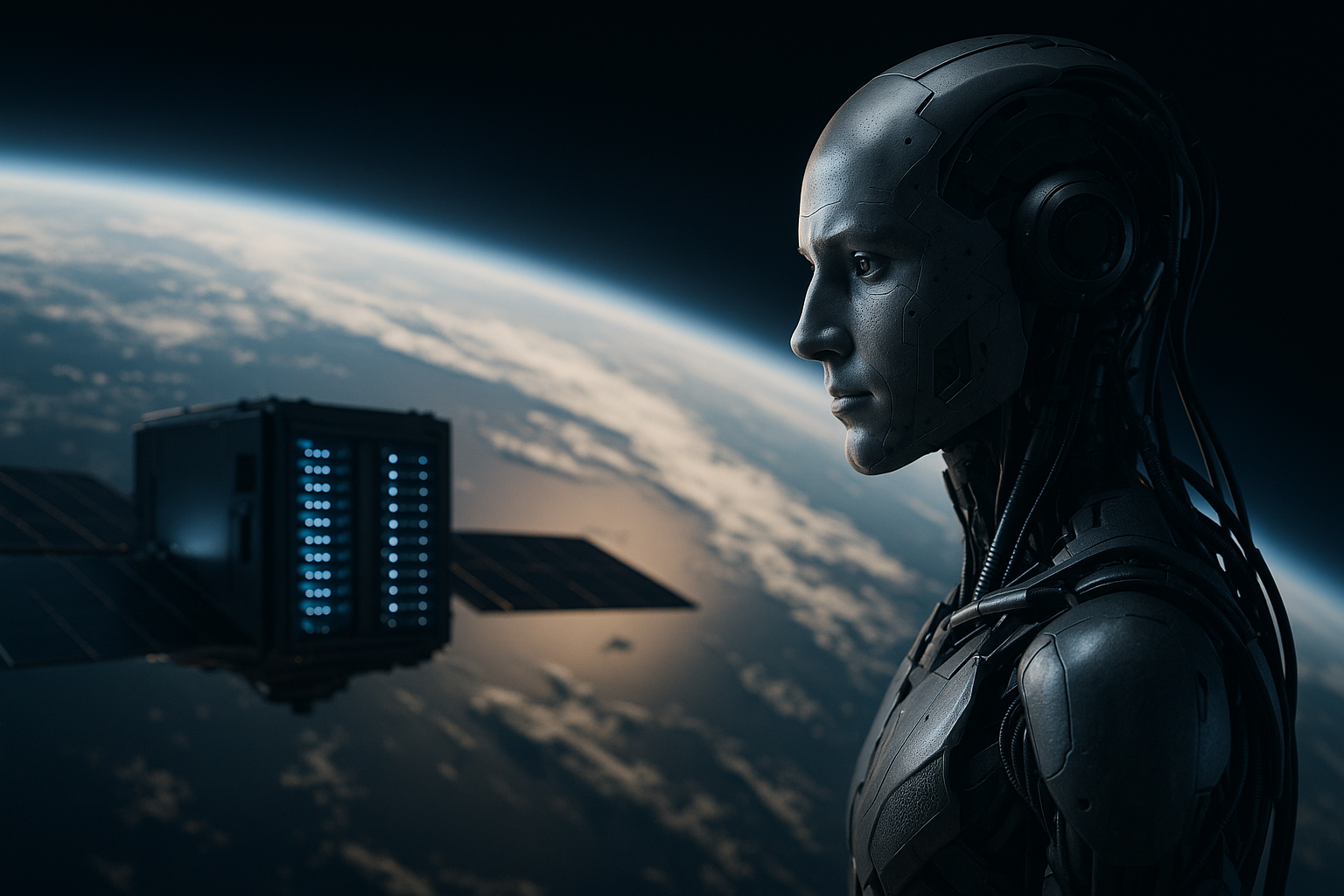
Proposals for space-based data centers envision constellations of computing satellites powered by continuous solar energy, linked via space-to-ground optical connections and supported by large radiator panels for heat rejection. University–industry efforts and European initiatives describe architectures that cluster compute with power generation and thermal control in orbit, removing terrestrial land and freshwater requirements while placing workloads closer to space assets [4][5][6].
Assessing orbital AI data centers feasibility
Backers argue that orbital systems could achieve long-duration, solar-powered operation, especially if launch costs continue to fall and in-space manufacturing matures over the next 10–15 years [4][5][6]. The concept aims to bypass land use conflicts and water-intensive cooling while exploiting near-continuous sunlight in certain orbits [5][6].
Technical engineering challenges
The physics of space is unforgiving. Radiation can degrade or flip bits in commercial hardware, forcing choices between heavy shielding mass and sophisticated error-correction approaches—both of which add complexity and cost [5][6]. In vacuum, heat can leave only via radiation, so heat rejection solutions for space data centers radiators require expansive, lightweight panels that further increase launch mass [5][6].
Operationally, fleets must support autonomous monitoring, fault isolation, and remote repair strategies, while minimizing collision risk and debris generation in already congested orbits. Responsible end‑of‑life planning with assured deorbiting is essential to avoid exacerbating orbital hazards—central among orbital data center challenges [5][6].
Environmental and economic tradeoffs
The headline promise—no freshwater cooling and clean solar power—must be weighed against launch emissions data centers would incur upfront. Analyses emphasize that any climate advantage depends on amortizing those emissions over long lifetimes and high utilization; otherwise, advanced terrestrial sites on decarbonizing grids may remain superior [5][6]. Economics follow a similar logic: high initial capital and logistics costs versus potential long-term operational benefits if space hardware can operate reliably for many years [5][6].
For policy context on European ambitions, see the European Space Agency’s overview of its ASCEND concept in orbital power and computing European Space Agency ASCEND (external).
Performance, latency, and realistic use cases
Latency is a mixed bag. While most AI services are better served from terrestrial networks, some niche workloads—such as on-orbit processing of satellite data, or inference closer to remote geographies via optical links—could benefit from proximity in space [5][6]. For mainstream training and consumer inference, terrestrial infrastructure will likely remain dominant for the foreseeable future [6].
Regulatory, operational, and safety considerations
Beyond engineering, governance will shape feasibility. Operators must plan for collision avoidance, debris mitigation, and verifiable end‑of‑life deorbiting. These guardrails are necessary to ensure orbital growth does not worsen space debris risks as constellations scale [6].
Timeline and prerequisites for feasibility (10–15 year view)
Momentum is building in academia and industry, with proposals pointing to a roughly 10–15 year path to a fully operational system, contingent on falling launch costs, advances in in-space manufacturing, and long‑lived autonomous operations [4][5][6]. These milestones will determine whether orbital AI data centers feasibility moves from concept to pilot and, eventually, commercial scale [4][6].
For practical frameworks on AI infrastructure planning, Explore AI tools and playbooks.
Conclusion: A niche future, not a near-term panacea
Space-based data centers are technically plausible and environmentally promising for specific niches. Yet, compared with nearer-term options—strategic siting, efficiency improvements, grid decarbonization, and even subsea deployments—the orbital path remains speculative and contingent on multiple breakthroughs. The prudent approach: pursue aggressive terrestrial mitigation now while tracking space efforts that could complement, not replace, earthbound capacity in the decade ahead [1][2][3][4][5][6][7][8][9].
Sources
[1] Explained: Generative AI’s environmental impact | MIT News
https://news.mit.edu/2025/explained-generative-ai-environmental-impact-0117
[2] The carbon and water footprints of data centers and what this could …
https://www.sciencedirect.com/science/article/pii/S2666389925002788
[3] ‘Roadmap’ shows the environmental impact of AI data center boom
https://news.cornell.edu/stories/2025/11/roadmap-shows-environmental-impact-ai-data-center-boom
[4] Big Idea Challenge powers orbital data center development
https://news.arizona.edu/news/big-idea-challenge-powers-orbital-data-center-development
[5] The Quiet Race to Build Data Centers in Space – E1 Ventures
https://e1ventures.substack.com/p/the-quiet-race-to-build-data-centers
[6] Space-Based Data Centers Could Power AI with Solar Energy—At a …
https://www.scientificamerican.com/article/data-centers-in-space/
[7] A Comprehensive Study of Microsoft’s Underwater Data Centers
https://tijer.org/tijer/papers/TIJER2503006.pdf
[8] Project Natick Phase 2 – Microsoft
https://natick.research.microsoft.com/
[9] How Microsoft kept its underwater datacenter connected while …
https://www.microsoft.com/insidetrack/blog/how-microsoft-kept-its-underwater-datacenter-connected-while-retrieving-it-from-the-ocean/
