
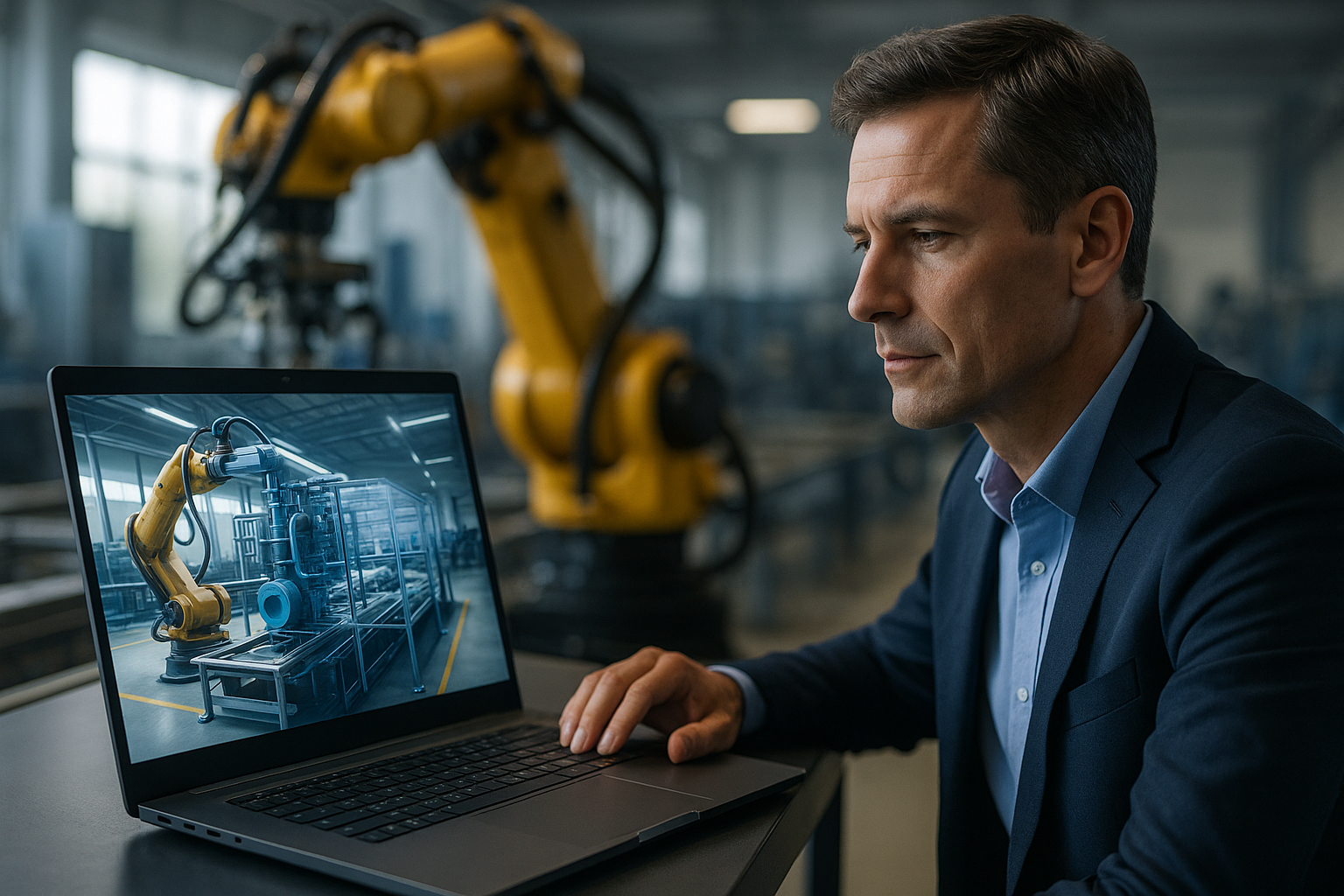
Into the Omniverse: How an Omniverse digital twin for manufacturing accelerates design and operations
Industrial leaders are moving from static, siloed models to a simulation‑native approach that closes the loop between design, engineering, and live operations. The Omniverse digital twin for manufacturing brings engineering models, sensor data, and AI into a single, physics‑accurate environment so teams can validate factories, predict issues, and optimize performance before and after go‑live—all within a shared, interoperable 3D backbone [1].
What is NVIDIA Omniverse and OpenUSD — The 3D Data Backbone
OpenUSD enables interoperable, high‑fidelity 3D scenes that unify fragmented engineering, simulation, and operations data. Omniverse uses this backbone to connect CAD/PLM systems, real‑time telemetry, and domain tools into a consistent digital representation of products, production lines, and facilities, supporting collaborative workflows across disciplines [2]. For teams standardizing on 3D data interoperability, see the OpenUSD specification (external).
Why an Omniverse digital twin for manufacturing matters
Omniverse supports real‑time, physics‑accurate rendering and simulation, helping manufacturers create virtual factories that mirror the behavior of physical systems. This foundation reduces the need for physical prototypes and enables robust what‑if analysis across layouts, robotic paths, and process parameters—accelerating decision cycles from design through commissioning and operations [3].
How Digital Twins Become Closed‑Loop Systems
Closed‑loop digital twins continuously synchronize with shop‑floor data, ingesting live sensor and control signals to reflect current state and performance. By fusing telemetry with physics‑based simulation, these twins provide a safe environment to test control logic, train AI agents, and coordinate heterogeneous assets (robots, operators, AI assistants) that act back on the real world—improving safety, throughput, and resilience in production [1].
Mega Omniverse Blueprint: Facility‑Scale, Multi‑Agent Simulation
Reference workflows such as the Mega Omniverse Blueprint show how multi‑robot fleets, humans, and control logic can be coordinated inside a single virtual factory. Teams can validate cell designs, material flow, and safety protocols, and run throughput scenarios before deployment, reducing commissioning time and risk in brownfield and greenfield sites [1]. This capability also supports continuous improvement by letting operations teams test changes virtually before pushing to production.
Enterprise Case Studies and Ecosystems
Manufacturers are translating simulation‑native practices into measurable impact. For example, deployments highlight how virtual issue detection can boost throughput and reduce capex by uncovering “virtual capacity” before investing in hardware changes. Organizations such as PepsiCo and BlueScope illustrate how digital twins and AI can detect most issues virtually and create machine “fingerprints” to anticipate failures, cutting downtime and maintenance costs [1].
Ecosystem momentum is accelerating. Siemens is bringing its Xcelerator portfolio together with Omniverse to create an industrial metaverse where engineering models, physics simulations, and plant telemetry form a single source of truth for continuous optimization across the lifecycle [4][6][7]. Consulting and integration partners such as T‑Systems emphasize moving from pilots to production value with domain tools, connectors, and change management that align with enterprise realities [5].
Industrial AI: From Design Exploration to Predictive Operations
An industrial AI digital twin augments physics‑based simulation with pattern recognition, prediction, and optimization. During development, AI can evaluate hundreds of design or process variants far faster than traditional methods, reducing physical prototypes and compressing time‑to‑market. In operations, AI‑assisted twins forecast failures, optimize schedules, and coordinate multi‑agent systems in real time—driving continuous performance gains across automotive, CPG, energy, and logistics [1][6].
Infrastructure & Ecosystem: OVX, Cloud, and Partner Platforms
At production scale, high‑fidelity twins and real‑time simulation benefit from OVX‑class infrastructure Omniverse to render and simulate complex scenes with physics accuracy. Cloud and edge topologies stream data bi‑directionally to keep virtual and physical states in sync. Offerings such as Industrial AI Cloud simulation help teams run physics workloads orders of magnitude faster, pairing compute acceleration with domain applications. Together with Siemens Xcelerator Omniverse integrations and robotics/physics‑AI startups, these stacks enable scalable, secure deployments across the enterprise [1][7][8].
Business Case & ROI: What to Measure
- Throughput and OEE improvements from virtual validation and schedule optimization
- Reduced downtime via predictive insights and machine “fingerprints”
- Lower capex from virtual capacity discovery and fewer physical prototypes
- Faster commissioning through pre‑deployment layout and safety validation
Track time‑to‑decision, changeover time, unplanned stoppages, energy per unit, and model fidelity. Align pilots to high‑value bottlenecks, then scale to multiple lines and plants using the same OpenUSD backbone [1][2][4].
Implementation Roadmap: From Pilot to Continuous Optimization
- Data readiness: normalize CAD/PLM and telemetry to OpenUSD for industrial 3D data.
- Simulation fidelity: calibrate physics, controls, and sensing to real equipment.
- AI integration: deploy analytics and agents where they add measurable value.
- Ecosystem and connectors: use partner toolchains and services to accelerate adoption.
- Governance and skills: plan for model lifecycle, security, and change management.
This approach turns pilots into production value, with continuous optimization across design and operations [2][5][6]. For practical frameworks and vendor‑agnostic checklists, Explore AI tools and playbooks.
Risks, Limitations and Considerations
Enterprises should plan for integration complexity, data governance, and the compute needed for real‑time, physics‑accurate twins. Success hinges on aligning domain expertise, IT/OT collaboration, and partner ecosystems—particularly when extending twins across multiple plants and suppliers [4][5][7][8].
Conclusion
Omniverse‑based, closed‑loop twins are shifting factories from reactive control to continuously learned, data‑driven systems. By unifying engineering models, live telemetry, and AI, organizations can validate faster, operate smarter, and scale improvements across the lifecycle—turning simulation into a durable competitive advantage [1][7].
Sources
[1] How Digital Twins Are Scaling Industrial AI
https://blogs.nvidia.com/blog/how-digital-twins-scale-industrial-ai/
[2] What is NVIDIA Omniverse and How Will it Affect U.S. Manufacturing
https://www.automate.org/blogs/what-is-nvidia-omniverse-and-how-will-it-affect-u-s-manufacturing
[3] NVIDIA Omniverse | Digital Twin Applications in Industry
https://www.rs-online.com/designspark/nvidia-omniverse-for-digital-twin-applications-in-industry
[4] Siemens unveils technologies to accelerate the industrial AI revolution at CES 2026
https://www.cimdata.com/en/industry-summary-articles/item/29194-siemens-unveils-technologies-to-accelerate-the-industrial-ai-revolution-at-ces-2026
[5] From pilot projects to value creation – T-Systems
https://www.t-systems.com/de/en/insights/newsroom/management-unplugged/from-pilot-projects-to-value-creation-1148882
[6] The Digital Enterprise and the Synthesis of Industrial AI, Digital Twin and Data
https://blog.siemens.com/2026/02/the-digital-enterprise-and-the-synthesis-of-industrial-ai-digital-twin-and-data/
[7] Creating the Industrial Metaverse: Siemens Xcelerator + NVIDIA Omniverse
https://blogs.sw.siemens.com/thought-leadership/creating-the-industrial-metaverse-siemens-xcelerator-nvidia-omniverse/
[8] Exploring the Intersection of NVIDIA Omniverse, Digital Twins, and 3D Modeling
https://www.delltechnologies.com/asset/en-us/products/workstations/industry-market/exploring-the-intersection-of-nvidia-omniverse-digital-twins-and-3d-modeling.pdf
