
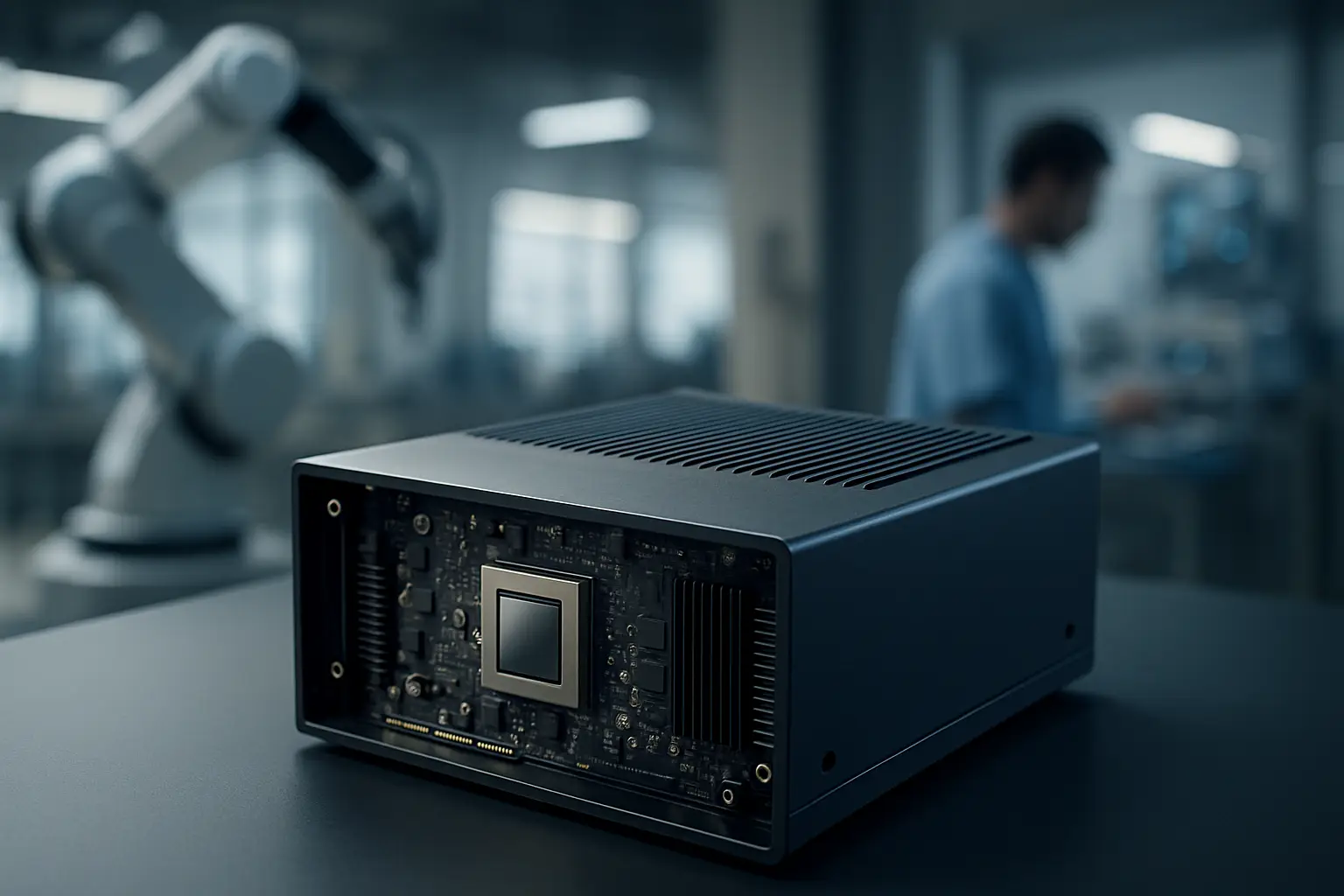
NVIDIA IGX Thor — IGX Thor edge AI platform for Industry, Robotics, and Medical
Real-time robotics, industrial automation, and medical devices need fast inference, deterministic latency, and long-term support. NVIDIA’s IGX Thor edge AI platform targets those requirements with Blackwell-based compute, high-throughput networking, and an industrial lifecycle designed for operational deployments in factories, hospitals, and autonomous systems [1][2][3].
What is IGX Thor? Architecture and compute highlights
IGX Thor combines an integrated GPU with an optional discrete GPU based on NVIDIA’s Blackwell architecture, delivering up to 5,581 FP4 teraflops of AI performance alongside 400 GbE-class connectivity for data-intensive workloads [1][2][3]. For buyers comparing generations, NVIDIA states the platform can provide up to 8x the iGPU compute and 2.5x the dGPU compute of IGX Orin, with 2x the network bandwidth for sensor-heavy pipelines [1][2][3]. For broader architectural context, see NVIDIA’s overview of Blackwell GPUs in the data center NVIDIA Blackwell architecture (external).
IGX T5000 vs T7000: choosing the right form factor
The family includes the IGX T5000 module and the IGX T7000 boardkit to fit different deployment profiles [1][2]. The IGX T5000 module targets compact industrial systems with 2,070 FP4 TFLOPS, 128 GB LPDDR5X, local NVMe storage, Wi‑Fi 6E, and standard I/O such as USB-C and HDMI [1][2]. By contrast, the IGX T7000 boardkit is built for high-throughput sensor ingest and features an NVIDIA ConnectX-7 SmartNIC and dual 200 GbE networking to sustain large multimodal streams [1][2].
Selection comes down to workload shape and I/O. The T5000 fits space- and power-constrained installations that still need strong inference at the edge. The T7000 suits robotics, machine vision, and other scenarios where multiple cameras, lidars, or medical instruments require consistent, low-jitter bandwidth into GPU memory [1][2].
Networking and sensor ingest: ConnectX-7, RDMA, and low-latency pipelines
The IGX T7000 uses a ConnectX-7 SmartNIC with RDMA so sensor data can move directly into GPU memory, reducing CPU overhead while cutting latency and jitter [1][2]. Dual 200 GbE links raise total throughput and double the bandwidth of prior dual 100 GbE IGX Orin designs, which benefits multimodal perception and other real-time sensor fusion tasks [1][2]. These network features are paired with the platform’s 400 GbE-class connectivity to align compute and I/O capacity for on-device inference at scale [1][2][3].
How the IGX Thor edge AI platform fits into deployment plans
IGX Thor is positioned for long-lived industrial deployments with an approximately 10-year lifecycle and long-term software support [1][3]. It runs NVIDIA AI Enterprise and NIM microservices, and connects to domain stacks including NVIDIA Isaac for robotics, Metropolis for visual AI, and Holoscan for multimodal sensor and medical-stream processing [1][2][3]. Teams can develop and test models in simulation, then deploy the same applications on certified edge systems in production environments [1][2][3].
For organizations standardizing on NVIDIA AI Enterprise at edge, these supported stacks help streamline integration and lifecycle management. They also give developers access to robotics and vision frameworks commonly evaluated during platform selection [1][2][3].
Real-world applications and vertical scenarios
Target applications include robotics, industrial automation, medical imaging, and multimodal perception requiring consistent real-time performance [1][2][3]. The IGX T7000 boardkit’s dual 200 GbE inputs with ConnectX-7 SmartNIC RDMA are aligned to sensor-intensive robotics and vision workloads that benefit from direct-to-GPU ingest and reduced CPU involvement [1][2]. The IGX T5000 module offers a compact option with LPDDR5X memory and NVMe for edge deployments where footprint matters, such as embedded systems on factory lines or in clinical devices [1][2].
Because the platform is industrial-hardened with long-term support, operations teams can plan for lifecycle stability in factory automation or regulated environments that require sustained availability windows [1][3].
Performance vs IGX Orin and procurement considerations
NVIDIA positions IGX Thor as a step up from IGX Orin, citing up to 8x the iGPU compute, 2.5x the dGPU compute, and 2x the network bandwidth, which directly affects real-time inference and high-throughput ingest [1][2][3]. Procurement checklists should include lifecycle commitments, supported software stacks, and alignment with existing robotics and medical pipelines. Teams evaluating networking should test end-to-end throughput and RDMA paths to GPU memory to validate latency and jitter targets in production-like environments [1][2][3].
Deployment checklist and integration best practices
- Scope workloads and I/O: establish expected FP4 throughput, sensor count, and bandwidth targets per node [1][2][3].
- Prototype with the IGX T5000 module or IGX T7000 boardkit based on footprint and ingest needs [1][2].
- Validate networking: configure ConnectX-7 SmartNIC RDMA and dual 200 GbE paths, then measure latency and CPU load under peak streams [1][2].
- Standardize the software stack with NVIDIA AI Enterprise, NIM, and the relevant Isaac, Metropolis, or Holoscan components [1][2][3].
- Plan for the approximately 10-year lifecycle and associated updates for industrial operations [1][3].
For additional playbooks on building and operationalizing AI systems, see our Explore AI tools and playbooks.
Sources
[1] NVIDIA IGX Thor – Industrial-Grade Edge AI platform
https://www.nvidia.com/en-us/edge-computing/products/igx/
[2] NVIDIA IGX Thor Powers Industrial, Medical, and Robotics Edge AI Applications
https://developer.nvidia.com/blog/nvidia-igx-thor-powers-industrial-medical-and-robotics-edge-ai-applications/
[3] NVIDIA IGX Thor Robotics Processor Brings Real-Time Physical AI
https://blogs.nvidia.com/blog/igx-thor-processor-physical-ai-industrial-medical-edge/
