
Using Simulation to Build Robotic Systems for Hospital Automation
Hospitals are managing rising demand with too few people. Around 2020 the global health workforce totaled roughly 65–70 million, yet the shortfall was still in the tens of millions and remains concentrated in regions such as Africa and the Eastern Mediterranean [1]. Policy updates project a shortage on the order of 11 million by 2030, even as high-income countries hold most workers and still need to recruit to meet demand and replace retirees [2][3]. In this context, hospital robotics simulation offers a practical path to design and validate automation that relieves routine workload while protecting safety.
Introduction: Why simulation matters for hospital robotics
The workforce imbalance threatens timely, safe, and efficient care unless new delivery models take hold [1][3]. High-income systems face aging populations and retirement waves, while many low- and middle-income settings continue to experience acute shortages [2][3]. These pressures make targeted automation appealing when it complements scarce staff rather than adding complexity.
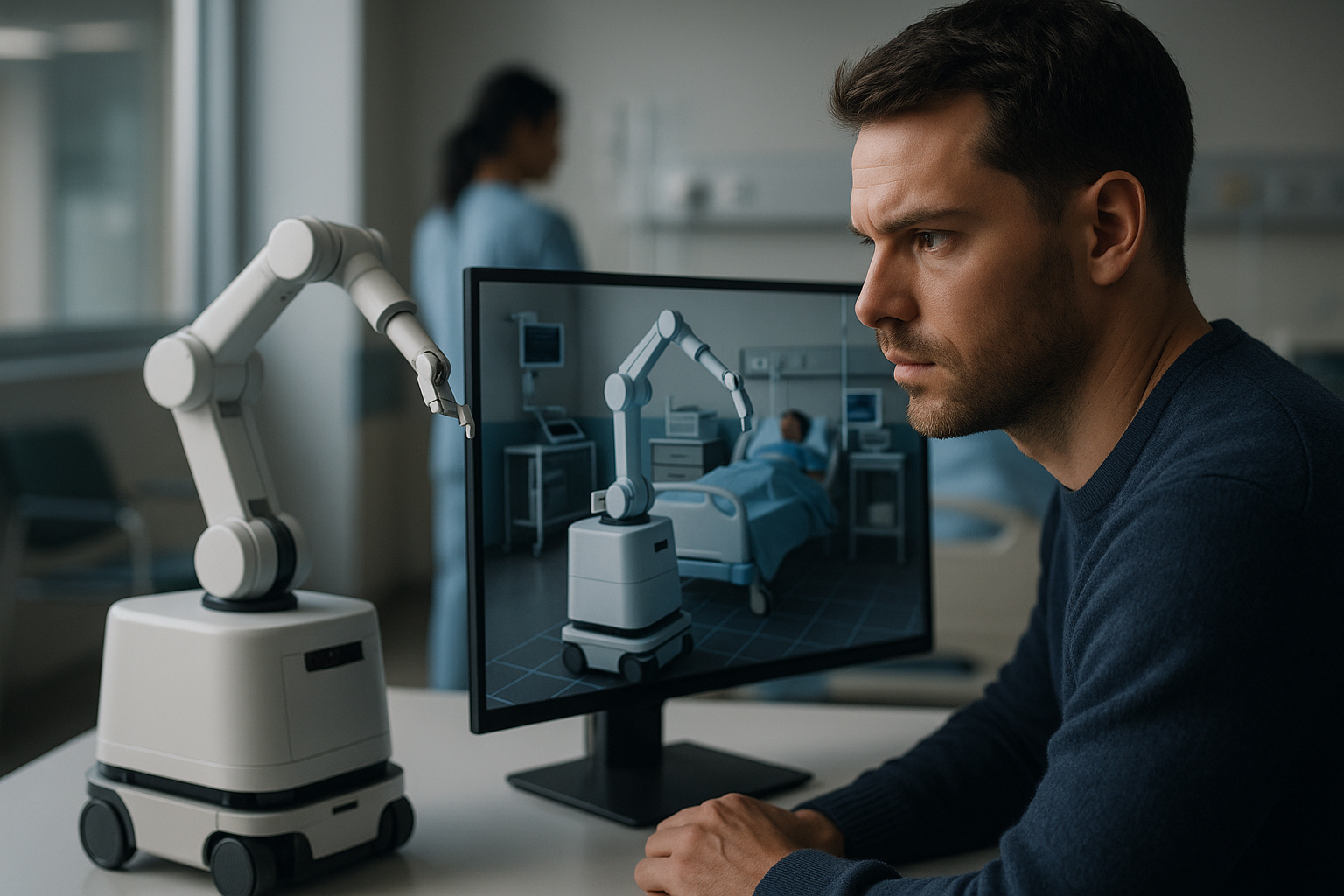
Simulation provides a low-risk way to prototype hospital robots for logistics, disinfection, bedside support, and pharmacy tasks. By building digital twin hospitals, teams can evaluate navigation, task scheduling, and safety behaviors at scale before a single bot enters a ward.
Why hospital robotics simulation is a practical starting point
- It preserves clinical operations while testing. Digital twins let teams explore layout changes, elevator constraints, and cleaning zones without live disruption.
- It aligns with human-robot workflow co-design so automation supports staff instead of creating new bottlenecks.
- It creates a repeatable path from prototype to pilot by validating navigation, throughput, and safety cases in advance.
These capabilities help address workforce shortages by reallocating repetitive tasks to robots and focusing human effort on complex care, consistent with strategies to optimize existing workers and infrastructure [2][3].
What a hospital digital twin includes
A useful model mirrors the real environment in enough detail to test behavior under pressure:
- Physical layout: rooms, corridors, elevators, charging docks, restricted and infection-control zones.
- Operational patterns: patient flow, staff routes, delivery windows, shift changes, handoff points.
- Policy constraints: access rules, cleaning protocols, and quiet hours.
Within this setting, teams can run scenario libraries that exercise routing, queuing, and priority rules for robot-assisted hospital logistics, pharmacy runs, and bedside supply delivery.
Simulation techniques: navigation, scheduling, and HRI testing
- Navigation and congestion: Simulate corridor density, elevator wait times, and detours to validate path planning and collision avoidance before live trials.
- Task allocation and timing: Model dispatch rules across fleets, predict queue buildup, and tune schedules that respect clinical priorities.
- Interaction and safety: Test human-robot interaction in simulated ward environments, including approach distances, passing etiquette, and alerting. This supports safety validation for hospital robots under varied loads and shift patterns.
These methods reduce rework later, creating traceable evidence for simulation-driven hospital automation programs.
Designing a pilot: from simulation to live deployment
A focused pilot plan lowers risk and shortens time to value:
- Model the target unit. Build the digital twin with current layouts, routes, and policies. Capture baseline metrics for comparison.
- Stress-test edge cases. Run peak traffic, elevator outages, and cleaning lockouts. Probe failure modes and recovery behavior.
- Involve stakeholders early. Use human-robot workflow co-design sessions with clinical, facilities, and infection-control teams to validate assumptions and handoffs [2][3].
- Predefine safety checks. Document virtual test cases for stopping distances, alerts, and access control to support safety validation for hospital robots.
- Stage the rollout. Move from lab to after-hours trials, then supervised shifts, then production.
- Track KPIs from day one. Compare simulated expectations to live results and iterate.
For broader context on workforce policy, see the World Health Organization’s human resources overview in this area via the World Health Organization (external).
Measuring impact: operational KPIs and ROI
Measure what matters to clinicians and operations:
- Time saved per delivery task and reduction in staff trips.
- Fleet uptime, mission success rate, and error rates.
- Corridor and elevator utilization during peaks.
- Infection-control adherence for routes and zones.
- Staffing cost offsets aligned with projected shortages and retirements [2][3].
Comparing live metrics to digital twin forecasts builds confidence and guides scaling decisions. For implementation guides and templates, you can explore AI tools and playbooks.
Adapting simulations for low-resource and global settings
Shortages and unequal distribution of personnel are persistent, so models should fit diverse infrastructure and staffing profiles [1][3]. Keep maps and policies modular, validate reliability under power or network constraints, and confirm that workflows reduce cognitive load rather than shifting it to scarce staff. These steps support resilient operations where the need is greatest [2][3].
Sources
[1] The global health workforce stock and distribution in 2020 and 2030
https://pmc.ncbi.nlm.nih.gov/articles/PMC9237893/
[2] Working for Health (W4H) – OECD/ILO/WHO initiative brochure
https://www.oecd.org/content/dam/oecd/en/topics/policy-sub-issues/health-workforce/W4H_BROCHURE_web_single.pdf/_jcr_content/renditions/original./W4H_BROCHURE_web_single.pdf
[3] Global strategy on human resources for health: workforce 2030 update
https://apps.who.int/gb/ebwha/pdf_files/EB156/B156_15-en.pdf
