
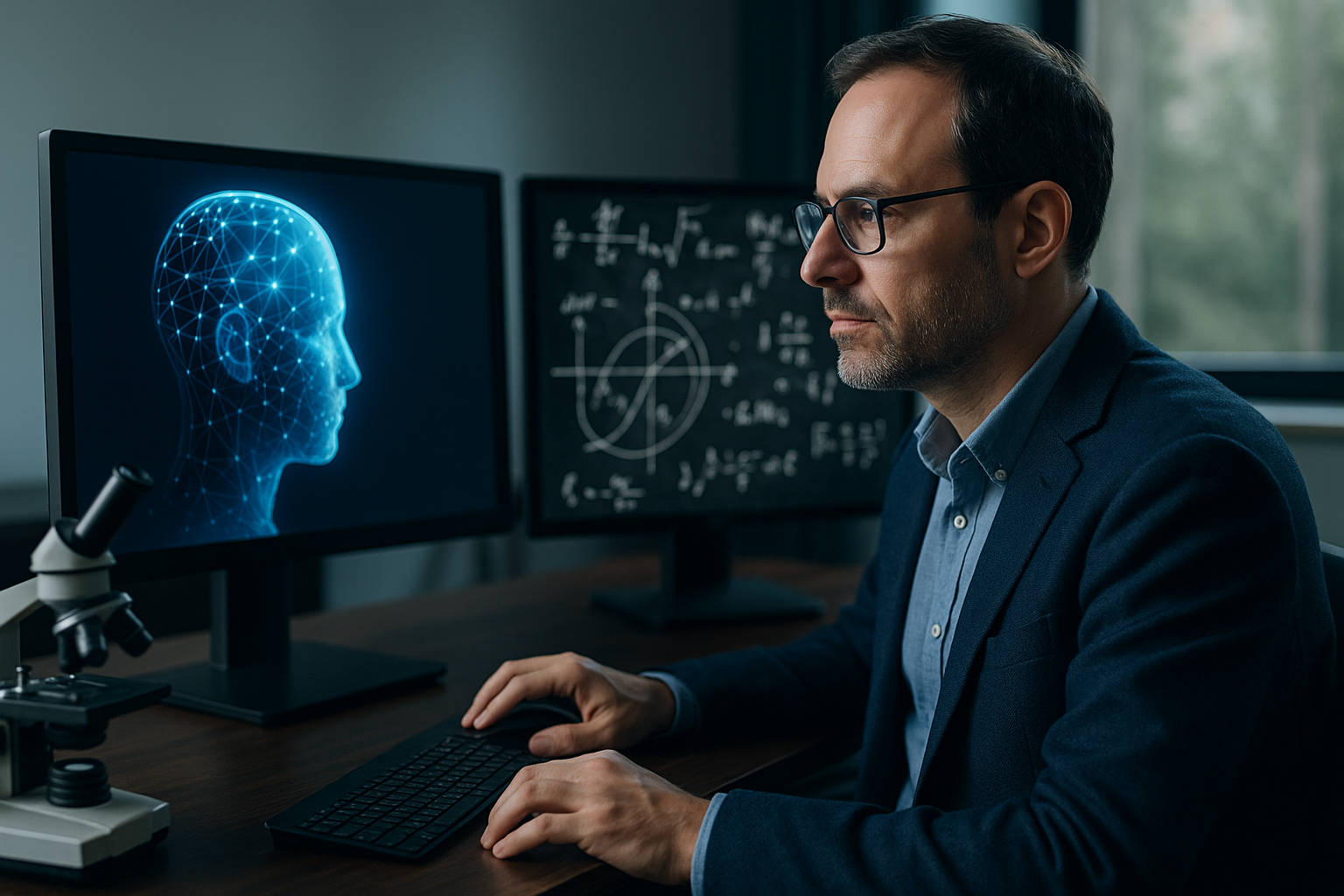
3 Questions: On the future of AI in physics research
AI’s next big laboratory is the mathematical and physical sciences. Across interviews and talks, Jesse Thaler argues that the future of AI in physics research hinges on a bidirectional exchange: AI enables discovery at unprecedented scale, while physics and math reshape AI to be trustworthy, interpretable, and aligned with scientific standards [1][2][3].
Executive summary: Why this convergence matters
Simulations, detectors, and surveys are generating data volumes and complexities that exceed traditional analytic and numerical methods. AI has moved from “nice-to-have” to essential, accelerating inference, enabling fast surrogates for expensive simulations, real-time event selection, and pattern discovery in high-dimensional data. The upshot for R&D leaders: competitive advantage will come from co-designing experiments and models so that AI is built into the scientific workflow from the start, not bolted on at the end [1][2][3].
Three framing questions shaping the field
- How do we harness AI for massive, complex datasets without sacrificing rigor? [1][2][3]
- How do we teach machines to think like physicists—embedding symmetries, conservation laws, robustness to systematics, and uncertainty from the ground up? [1][2]
- How do we architect human–AI workflows—”centaur science”—that pair algorithmic pattern recognition with human judgment, conceptual framing, and standards of proof? [1][2][3]
How AI is already used: case studies from cosmology, particle physics, and materials
Across cosmology and particle physics, AI systems act as discovery engines. They provide surrogate models for expensive simulations, speed up real-time event selection in detectors, and reveal patterns across high-dimensional datasets that are impractical to parse with conventional techniques. Related approaches carry over to materials science, where pattern discovery and fast approximation are similarly valuable. These deployments are not speculative—they reflect a pragmatic response to scale, cost, and complexity limits [1][2][3].
Teaching machines to think like physicists: methods and best practices
The core playbook is physics-informed machine learning. Rather than rely on black-box fitting, researchers encode physical structure directly into models and training objectives:
- Symmetries and conservation laws embedded in architectures and losses [1][2]
- Robustness to systematic effects as a design criterion, not a post-hoc patch [1][2]
- Explicit uncertainty quantification in predictions and downstream decisions [1][2]
For teams standing up pipelines, this means prioritizing models that respect known invariances, validating against controlled systematics, and reporting calibrated uncertainties. These practices raise confidence in results and reduce failure modes, especially in regimes where data are sparse, noisy, or biased [1][2].
Viewing learning algorithms as physical systems: loss landscapes and phase transitions
An emerging perspective treats learning algorithms themselves as physical systems. Using tools from statistical mechanics and field theory, researchers probe the geometry of loss landscapes and study phases—and potential phase transitions—as hyperparameters vary. This lens can clarify why some configurations generalize well, why optimization stalls, and how to navigate brittle regions of parameter space. For practitioners, it reframes hyperparameter tuning as mapping a phase diagram, guiding choices that improve stability, reliability, and interpretability [1][2].
Centaur science: designing human–AI workflows for discovery
“Centaur science” emphasizes tight human–AI collaboration across the research lifecycle. Large models assist with literature synthesis, connection-finding, hypothesis generation, and sensitivity/uncertainty studies; humans lead on causal reasoning, conceptual framing, and standards of proof. The result is not automation but augmentation—pairing machine pattern recognition and optimization with scientific judgment and accountability [1][2][3].
Practical implications include:
- Use large models to surface related work and candidate hypotheses; human experts curate and test [1][2][3].
- Automate sensitivity analyses and uncertainty audits; researchers interpret and set thresholds for action [1][2].
- Establish review protocols where human sign-off is required for claims and model updates [1][2][3].
For institutional context on high-energy physics, see CERN (external).
Co-design of experiments, simulations, and models: operational steps
Co-design means planning data, simulation, and model choices jointly so AI can deliver rigorous results:
- Target data collection to capture symmetries and relevant invariants the model will exploit [1][2].
- Build ML surrogates next to simulations, with fidelity tests that mirror scientific metrics [1][2].
- Tie evaluation to uncertainty quantification and robustness-to-systematics checks, not just accuracy [1][2].
- Prototype real-time selection pipelines early to de-risk detector or survey operations [1][2][3].
Teams seeking implementation playbooks can Explore AI tools and playbooks.
The future of AI in physics research: a co-evolutionary path
Looking ahead, the future of AI in physics research depends on co-design and centaur workflows that integrate AI at scale while maintaining scientific standards. As physical sciences adopt concepts from complexity, optimization, and algorithmic search, AI will, in turn, adopt symmetry, conservation, and uncertainty as first-class citizens—moving beyond prediction to provably trustworthy insight [1][2][3].
Sources
[1] In conversation: Jesse Thaler on AI and physics
https://www.firstprinciples.org/article/in-conversation-jesse-thaler
[2] Jesse Thaler Adventures in AI+Physics – Centaur Science: Adventures in AI+Physics
https://indico.cern.ch/event/1642790/attachments/3213656/5724820/jthaler_2026_02_04_CERN_Centaur.pdf
[3] How is AI reshaping physics? Watch the interview with NSF IAIFI Director
https://aiinstitutes.org/watch-the-discovery-engines-interview-with-nsf-iaifi-director/
