
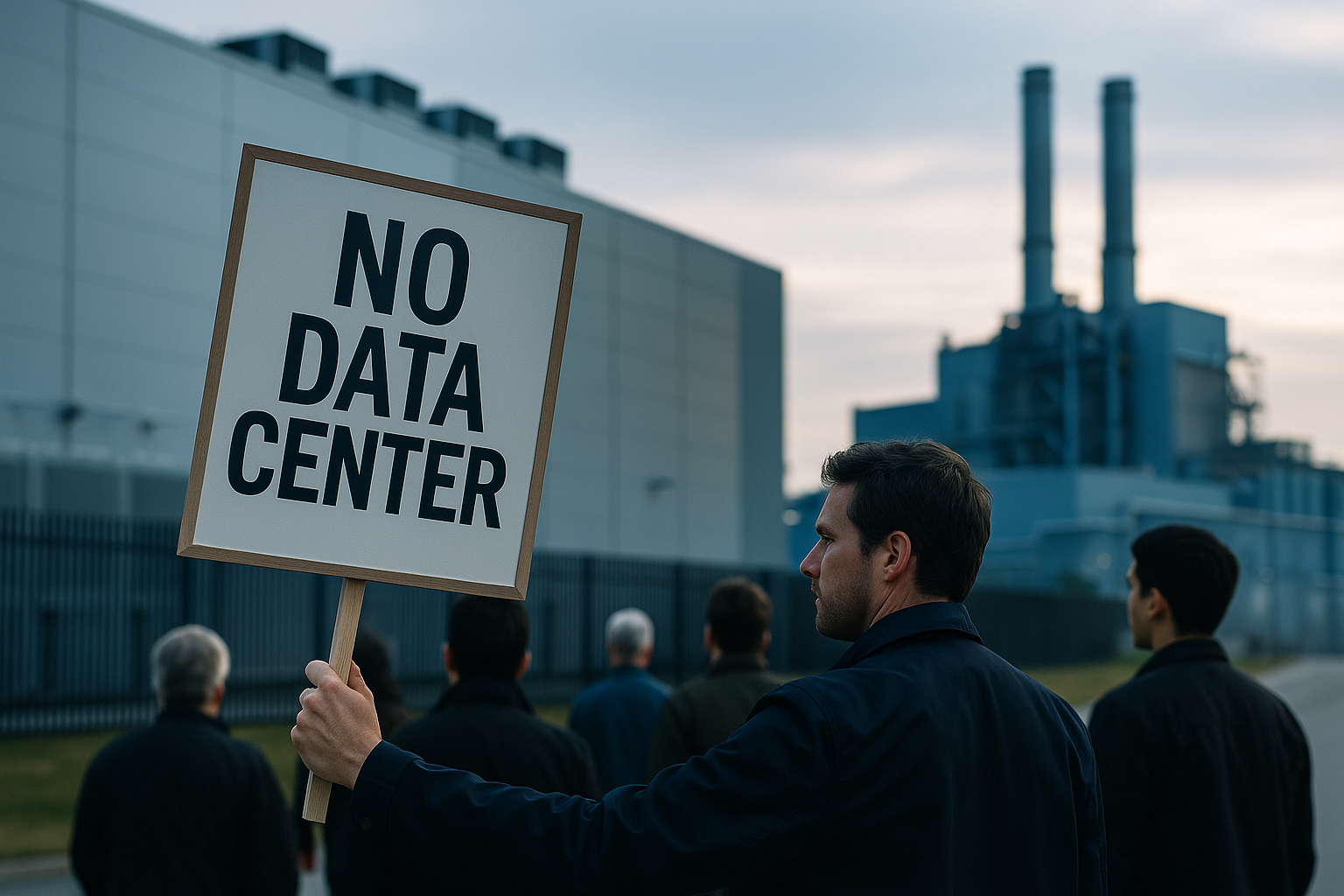
People Are Protesting Data Centers but Embracing the Factories That Supply Them: The rise of data center community opposition
Local fights over new digital infrastructure are reshaping where and how AI-era capacity gets built. The surge in data-heavy workloads has collided with rising data center community opposition, putting projects at risk and forcing operators to rethink engagement, water use, and visible local benefits [1][2][4].
Quick summary: Why this matters to businesses and communities
The cost of delays is mounting. Trackers show that $64–$98 billion in U.S. data center investments have been blocked or postponed since 2023, with cancellations and protests rising sharply into 2024–2025 [2][4]. The backlash spans the political spectrum and often centers on water, electricity, noise, land use, and whether facilities deliver enough jobs to justify local impacts [1][3].
What communities are protesting — the core concerns
Water tops the list. Medium-size data centers can use roughly 110 million gallons of water annually—about the same as 1,000 households—while national data center water use was estimated at around 449 million gallons per day in 2021 [1][5]. In many locations, residents worry about water scarcity and higher utility bills tied to large industrial loads [1][3][5].
- Noise from cooling and backup systems
- Loss of green space and changes to neighborhood character
- Potential declines in property values
- Limited direct employment due to automation relative to resource use [1][3]
As facilities scale to meet AI demand, electricity and water needs grow, intensifying scrutiny and media attention on environmental impacts and community tradeoffs [1][5].
The scale of cancellations and delays since 2023
Data Center Watch and other monitors report a steep increase in opposition, with tens of billions in projects delayed or canceled since 2023; the pace accelerated markedly in 2024–2025 [2][4]. Reasons include local environmental concerns, skepticism of subsidies for large out-of-state or foreign firms, and perceptions that facilities provide few local jobs relative to their footprint [1][2][4].
Why factories that supply data centers face less opposition
Server, chip, and electrical equipment factories tend to face less organized resistance. These projects are frequently promoted as job creators and as onshoring strategies that localize supply chains and mitigate tariffs—framing that resonates with local leaders and voters [1]. Communities often lack the capacity to fight both data centers and supplier factories simultaneously, while industry lobbying and PR further tilt sentiment toward manufacturing projects [1].
Data center community opposition: how AI workloads change the equation
AI-focused facilities can drive higher electricity and water consumption, magnifying local impacts and increasing public scrutiny. Many operators historically did not track water use, but the growth of AI workloads is pushing the industry toward more rigorous accounting and efficiency measures to address data center water use concerns [1][5].
Practical steps operators and suppliers can take
Operators, suppliers, and local partners can reduce friction and permitting risk with early, concrete commitments tied to community value:
- Track and disclose water use, thermal discharge, and efficiency metrics; set targets where feasible [5].
- Engage utilities and planners early to demonstrate grid and water stewardship, including alternatives that reduce potable water reliance [5].
- Mitigate noise with design and operational controls; communicate construction and operations schedules [1][3].
- Offer visible local benefits: local hiring and contracting, workforce training, and community benefit agreements aligned with public priorities [1][3].
- Provide clear, ongoing communications that explain site selection tradeoffs, infrastructure upgrades, and cost impacts to ratepayers [3][5].
For teams building supplier factories, maintain transparency on environmental impacts and tie investments to durable job creation and regional economic development to sustain community support [1]. For implementation playbooks on stakeholder engagement and procurement, explore our AI tools and playbooks.
Policy and planning solutions for governments and utilities
Policy experts recommend coordinated planning among operators, utilities, and local governments, shifting from project-by-project fights to regional frameworks for water and grid capacity. This includes comprehensive water and infrastructure impact assessments, clearer permitting pathways, and mechanisms to align ratepayer protections with industrial growth [3][5].
What investors, suppliers, and corporate buyers should watch
- Permitting and political risk: accelerating protests and data center cancellations 2024 2025 increase schedule uncertainty and capital costs [2][4].
- Water stress: locations dependent on potable water for cooling face higher opposition and reputational exposure [1][5].
- Jobs narrative: projects perceived as low-employment may draw sharper scrutiny; visible local benefits can shift sentiment [1][3].
- Portfolio balance: suppliers may encounter smoother paths than operators; co-locating manufacturing and compute may diversify risk while supporting onshoring goals [1].
For broader context on industrial water management standards, see the U.S. Environmental Protection Agency’s water reuse resources external.
Conclusion: balancing infrastructure growth and community trust
The path forward requires pairing capacity expansion with measurable local value. Transparent water accounting, early utility coordination, noise mitigation, and tangible jobs and contracting commitments can ease data center community opposition while keeping critical AI infrastructure on track [1][3][5]. Aligning operator actions with regional planning and community priorities is now a core execution risk—one that can be managed with sustained engagement and credible benefits.
Sources
[1] People Are Protesting Data Centers—but Embracing the Factories …
https://www.wired.com/story/data-center-criticism-factories-supply-us/
[2] $64 billion of data center projects have been blocked or …
https://www.datacenterwatch.org/report
[3] Why Communities Are Protesting Data Centers – And How …
https://www.datacenterknowledge.com/data-center-construction/why-communities-are-protesting-data-centers-and-how-the-industry-can-respond
[4] Scoop: Local Pushback, Canceled Data Centers Surged in 2025
https://heatmap.news/politics/data-center-cancellations-2025
[5] Strategies to Address Water Use Emerge in Wake of Community …
https://www.publicpower.org/periodical/article/strategies-address-water-use-emerge-wake-community-opposition-data-centers
[6] Communities Push Back Against AI Data Center Expansion
https://www.laprogressive.com/techie-tips/ai-data-center-expansion
