
Blackwell GPU inference cost reductions: How providers are cutting token costs by up to 10x
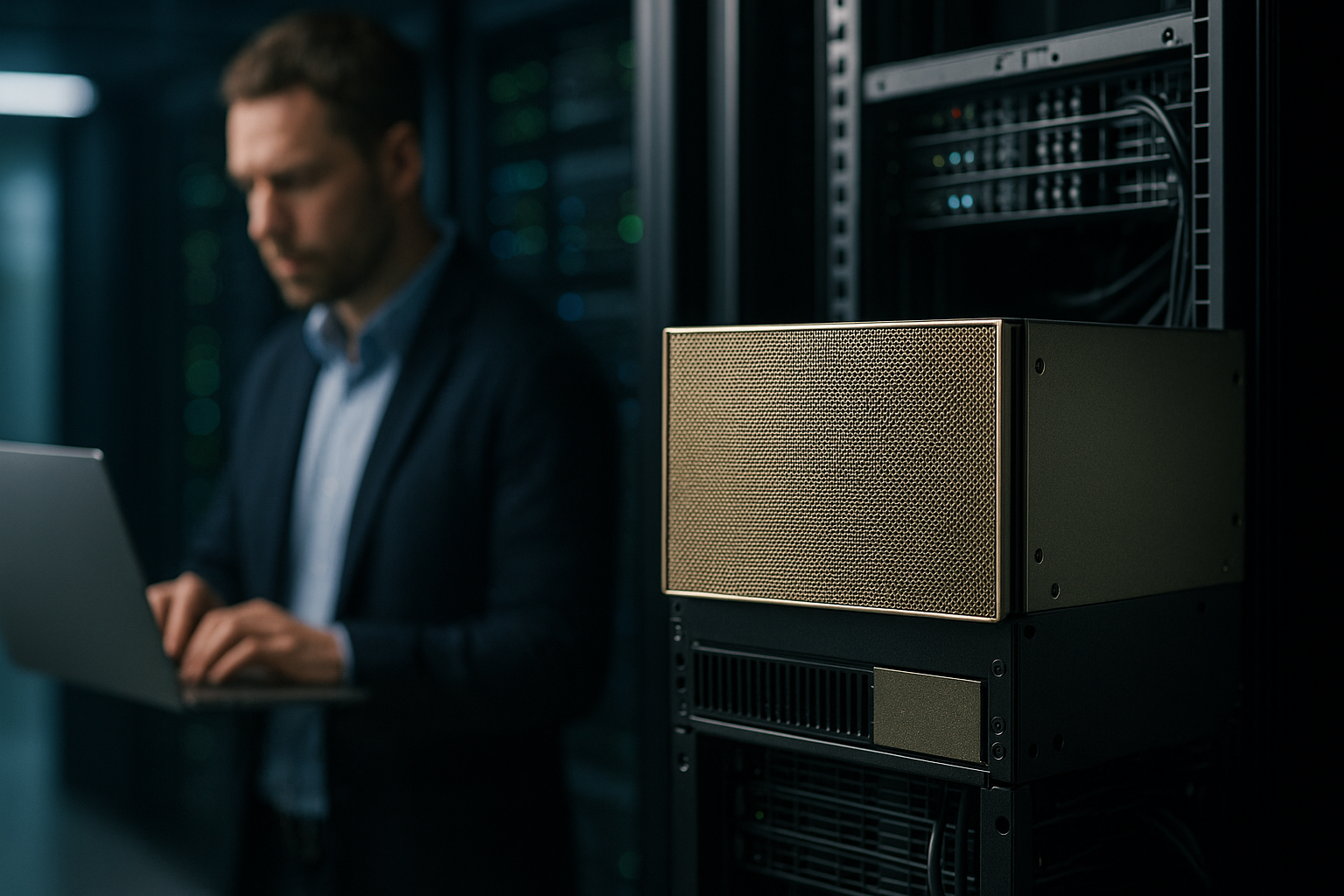
Hero image: NVIDIA Blackwell GB200 NVL72 systems powering open-source inference workloads.
NVIDIA’s latest Blackwell-generation accelerators are reshaping inference economics. Inference providers pairing open-source models with GB200 NVL72 systems report steep cost-per-token declines—part of broader Blackwell GPU inference cost reductions that are starting to reset ROI models for production-scale AI [1].
How Blackwell + Open Source Models Cut Inference Costs
- GB200 NVL72 enables up to 10x lower cost per token for Mixture-of-Experts (MoE) reasoning models compared to Hopper-class systems, driven by co-designed compute, networking, software, and partner stacks [1].
- DeepInfra cut costs per million tokens from roughly $0.20 on Hopper to ~$0.10 on Blackwell, and to ~$0.05 using NVFP4—while preserving accuracy—implying about a 4x improvement over its initial Hopper baseline [1].
- Decagon, using Together AI on Blackwell, serves demanding voice and multimodal customer-support workloads with sub-400 ms responses and thousands of tokens per query, achieving around 6x lower cost per query vs closed proprietary models by leaning on open-source and in-house models [1].
What is NVIDIA Blackwell and the GB200 NVL72?
NVIDIA positions Blackwell as the next major step beyond H100/H200 for inference throughput and efficiency. The GB200 NVL72 system is highlighted for enabling order-of-magnitude token-cost reductions on reasoning MoE models relative to Hopper, thanks to tight hardware–software co-design and integration with partner inference stacks [1].
These performance gains land alongside favorable GPU economics. Independent analyses indicate that higher utilization rates and competitive list pricing can roughly halve hourly compute costs in the cloud—before even accounting for architectural speedups—so real-world cost per token can fall faster than capital costs suggest [2][3].
NVFP4 and Low-Precision Inference: Accuracy vs Cost
Blackwell introduces the NVFP4 low-precision format, which providers report as maintaining accuracy while reducing memory and compute overheads—key to lowering cost per token at scale [1]. DeepInfra’s shift from FP8 on Hopper to NVFP4 on Blackwell correlates with a drop from about $0.20 to $0.05 per million tokens in its tests [1].
For teams evaluating NVFP4 inference accuracy, best practices include careful validation against production tasks, incremental rollout, and side-by-side quality checks with existing precisions to confirm parity before broad deployment (general guidance).
Case Studies: DeepInfra and Decagon on Blackwell
- DeepInfra Blackwell savings: The provider reports a stepwise reduction—~$0.20 (Hopper FP8) to ~$0.10 (Blackwell) to ~$0.05 (Blackwell NVFP4)—while maintaining accuracy [1].
- Decagon Together AI Blackwell case study: For high-throughput voice and multimodal support, Decagon achieves sub-400 ms responses and thousands of tokens per query, landing roughly 6x lower per-query cost than proprietary closed models by relying on open-source and custom models on Blackwell [1].
Together, these examples show how open source LLM cost comparison dynamics favor self-hosted or provider-optimized stacks when paired with Blackwell-class hardware [1][4].
Why Blackwell GPU inference cost reductions are accelerating
Open-source LLMs now approach proprietary quality on many tasks while averaging over 7x cheaper per token, and running them on Blackwell compounds the savings [4]. Meanwhile, cloud pricing dynamics—higher utilization and competitive rates—can independently slash hourly costs, magnifying Blackwell’s throughput advantages [2][3]. NVIDIA also signals a forward roadmap: the Rubin platform targets another 10x performance and token-cost reduction over Blackwell, suggesting continued downward pressure on inference pricing [1].
For a broader architectural view, see NVIDIA’s Blackwell platform page (external).
When to Self-Host vs Use API: Decision Framework
Self-hosted inference on modern GPUs can undercut API pricing, especially for large, steady workloads, but the decision depends on predictable volume, latency SLAs, and operational readiness [4][5]. Consider:
- Volume and utilization: Sustained, high token throughput that keeps GPUs highly utilized favors self-hosting [2][3].
- Model choice: Open-source or in-house models that meet quality targets unlock the largest savings [1][4].
- Precision strategy: NVFP4 can preserve accuracy while lowering costs; validate on target tasks before broad rollout [1].
- Operational scope: Engineering bandwidth for benchmarking, autoscaling, observability, and cost tracking (general guidance).
For hands-on frameworks and tool picks, Explore AI tools and playbooks.
Migration and Implementation Best Practices
Teams moving from H100/H200 to Blackwell should plan for:
- Benchmarking: Compare Blackwell vs Hopper baselines on end-to-end token cost and latency, including NVFP4 trials [1].
- Partner stacks: Evaluate inference providers or partner-optimized stacks that exploit GB200 NVL72 co-design benefits [1].
- Utilization tuning: Right-size batch, context, and concurrency to align with cloud pricing and maximize effective throughput [2][3].
- Model portfolio: Prioritize open-source models where quality meets requirements to capture compounding savings [1][4].
Projected Trends: Rubin and the Next Wave of Cost Declines
NVIDIA’s announced Rubin platform targets another 10x performance and cost-per-token reduction beyond Blackwell, pointing to a multi-year trend of falling inference prices—particularly for teams leaning into open-source models, NVFP4, and highly utilized deployments [1].
Quick ROI Worksheet and Actionable Next Steps
Start with a simple model:
- Inputs: monthly tokens, average context length, target latency, hardware/cloud pricing, expected utilization, and model precision (e.g., NVFP4) [1][2][3].
- Outputs: effective cost per million tokens vs proprietary API rates, breakeven utilization, and sensitivity to precision/throughput [1][4].
As Blackwell-era efficiencies spread, expect continued Blackwell GPU inference cost reductions—especially where open-source models and low-precision execution align with sustained, production-scale demand [1][4].
Sources
[1] Leading Inference Providers Cut AI Costs by up to 10x … – NVIDIA Blog
https://blogs.nvidia.com/blog/inference-open-source-models-blackwell-reduce-cost-per-token/
[2] NVIDIA AI GPU Pricing: A Guide to H100 & H200 Costs | IntuitionLabs
https://intuitionlabs.ai/articles/nvidia-ai-gpu-pricing-guide
[3] Blackwell GPUs and the New Economics of Cloud AI Pricing – Medium
https://medium.com/@Elongated_musk/blackwell-gpus-and-the-new-economics-of-cloud-ai-pricing-5e35ae42a78f
[4] Open Source vs Proprietary LLMs: Complete 2025 Benchmark …
https://whatllm.org/blog/open-source-vs-proprietary-llms-2025
[5] Private LLM Inference on Consumer Blackwell GPUs
https://arxiv.org/html/2601.09527v1
