
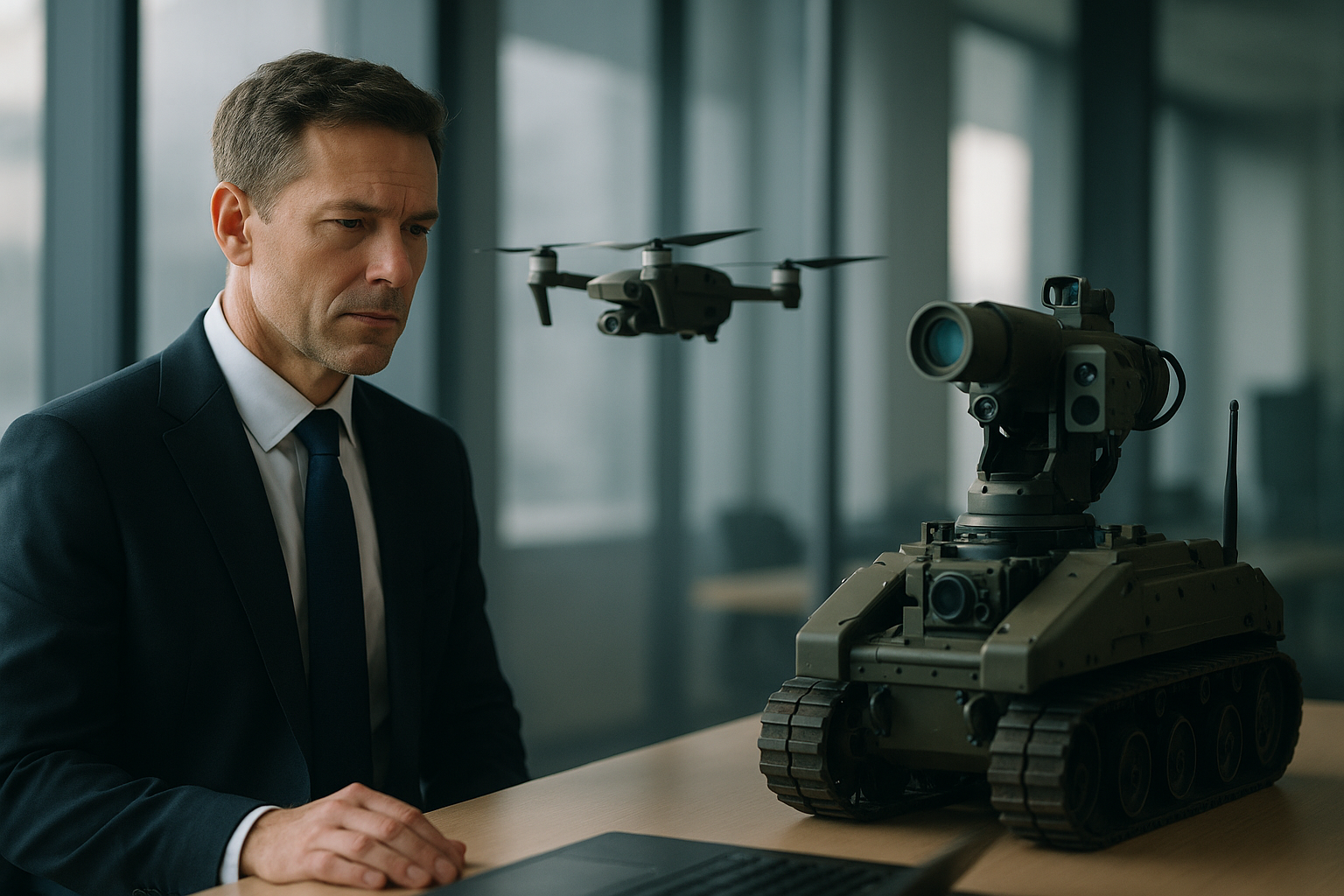
This Defense Company Made AI Agents That Blow Things Up: autonomous defense AI agents
Scout AI, a U.S. defense robotics startup, is developing a hierarchical stack of autonomous defense AI agents designed to interpret commanders’ instructions and control unmanned ground vehicles and drones with significant autonomy. The company argues that greater on-platform intelligence can improve safety, responsiveness, and mission success compared to pre‑scripted systems, even as experts warn of unresolved risks at the intersection of autonomy and lethality [1].
As profiled in a recent WIRED feature (external), Scout’s approach positions its models as planners and operators for armed platforms [1].
Where autonomous defense AI agents meet “physical AI”
Scout describes its core technology as “physical AI” anchored by FURY, a defense-specific Vision‑Language‑Action (VLA) foundation model that turns camera input and natural‑language commands into real‑time motor actions. Architecturally, the company runs a large, 100B+ parameter model in the cloud or on secure, air‑gapped hardware to interpret and plan from commander intent. That top‑level planner issues tasks to smaller, roughly 10B‑parameter edge models running directly on vehicles and drones; those in turn drive low‑level control software for mobility and weapons operations [1].
FURY is presented as lightweight, modular, and hardware‑agnostic, intended to retrofit existing air, ground, maritime, and potentially space platforms. Scout says its top‑level planning model is based on a modified open source system with safety guardrails relaxed relative to consumer AI, reflecting its defense context. The company frames its mission as building the world’s largest AI‑powered robotic force aligned with U.S. and allied interests [1].
This hierarchical design aims to keep decision loops tight: the planner interprets intent, the vehicle‑level agents handle execution, and the platform continues operating even with degraded connectivity. That redundancy is central to how Scout positions autonomous defense AI agents for contested environments [1].
Real‑world demos: GRUNT UGV, armed drones, and use cases
Scout has demonstrated multiple scenarios, including unmanned ground vehicles such as the GRUNT UGV equipped with gun systems, as well as threat detection, precision tracking, and autonomous homing when communications are lost or batteries are low. The GRUNT platform supports manned–unmanned teaming, heavy payloads, and vehicle‑to‑vehicle charging to extend operations. Lower‑tier edge models enable on‑vehicle replanning without constant human or cloud connectivity [1].
Contracts, investors, and industry signal
The company reports at least four U.S. Department of Defense contracts and is competing to manage UAV swarms, with fielded deployment projected to be a year or more away [1]. Draper Associates publicly disclosed its investment, citing Scout’s VLA model and defense robotics thesis [2]. Scout also announced its $15M seed round and the launch of FURY, positioning the company within a fast‑moving defense AI ecosystem [3]. Booz Allen Hamilton’s corporate venture arm invested as well, aligning with a broader portfolio in advanced defense, AI security, and space systems [4].
Operational readiness: from demos to deployment
While Scout emphasizes resilience via edge inference and hierarchical replanning, experts caution that polished demos often overstate readiness. Persistent issues include robustness to real‑world variability, cybersecurity hardening, rigorous testing and evaluation, and governance for systems interpreting ambiguous human commands while controlling lethal capabilities. Scout claims compliance with U.S. rules of engagement and international humanitarian law, but the distance between lab conditions and contested theaters remains a core question for acquisition timelines and risk management [1]. Military analyses further anticipate autonomous AI agents becoming central to future cyber and physical combat operations—heightening the urgency of verifiable performance and safety regimes [5].
For leaders evaluating edge AI for defense, the near‑term milestone is proving reliable vehicle‑level replanning without comms in diverse conditions, not just controlled trials. That’s foundational for any procurement decision involving autonomous defense AI agents [1][5].
Risks, ethics, and governance
Analysts warn that autonomy in lethal systems raises risks of misinterpretation, escalation, and accountability gaps if agents perform beyond intended scope or under unclear instructions. These concerns underscore the importance of transparent guardrails, auditability, and robust human‑on‑the‑loop controls, even as vendors cite adherence to international humanitarian law and rules of engagement [1][5].
Implications for defense contractors and businesses
- Interoperability and retrofits: FURY’s hardware‑agnostic posture targets existing platforms, which may accelerate pilots if integration paths and testing protocols are clear [1].
- Verification and validation: Independent red‑teaming, cybersecurity hardening, and scenario‑based stress testing should precede fielding when autonomous defense AI agents control mobility and weapons [1][5].
- Ecosystem signals: DoD contracts and backing from Draper Associates and Booz Allen suggest near‑term opportunities for trials and teaming agreements across the defense supply chain [1][2][4].
For implementation frameworks and operator checklists, you can explore AI tools and playbooks.
What to watch next
- Field trials that demonstrate resilient edge replanning and safe failure modes under jamming or degraded power [1].
- Progress on UAV swarm management competitions and any expansion of DoD AI contracts [1].
- Evidence of governance maturity: end‑to‑end audit trails, ROE/IHL alignment in practice, and adversarial robustness results [1][5].
Conclusion
Scout AI is attempting to make autonomous defense AI agents operational through a hierarchical VLA stack that links commander intent to robotic action. Early contracts and investor backing point to momentum, but procurement decisions will hinge on third‑party testing, cybersecurity posture, and demonstrable compliance with the laws of war under realistic conditions [1][2][3][4][5].
Sources
[1] This Defense Company Made AI Agents That Blow Things Up | WIRED
https://www.wired.com/story/ai-lab-scout-ai-is-using-ai-agents-to-blow-things-up/
[2] We invested in Scout AI, a defense robotics startup with a VLA model.
https://www.linkedin.com/posts/draper-associates_we-are-proud-to-announce-our-investment-activity-7318981676112429056-N7rL
[3] Scout launches with $15M seed, Fury AI model for defense robots
https://www.linkedin.com/posts/scout-ai-official_we-are-excited-to-announce-that-scout-has-activity-7318273808539287554-dX0Y
[4] Booz Allen Invests in Scout AI to Advance Physical AI for Defense Missions
https://www.businesswire.com/news/home/20250416486086/en/Booz-Allen-Invests-in-Scout-AI-to-Advance-Physical-AI-for-Defense-Missions
[5] A review of applications in Artificial Intelligence (AI) on the Security …
https://www.cmrsj-rmcsj.forces.gc.ca/cb-bk/art-art/2021/art-art-2021-2-eng.asp
