
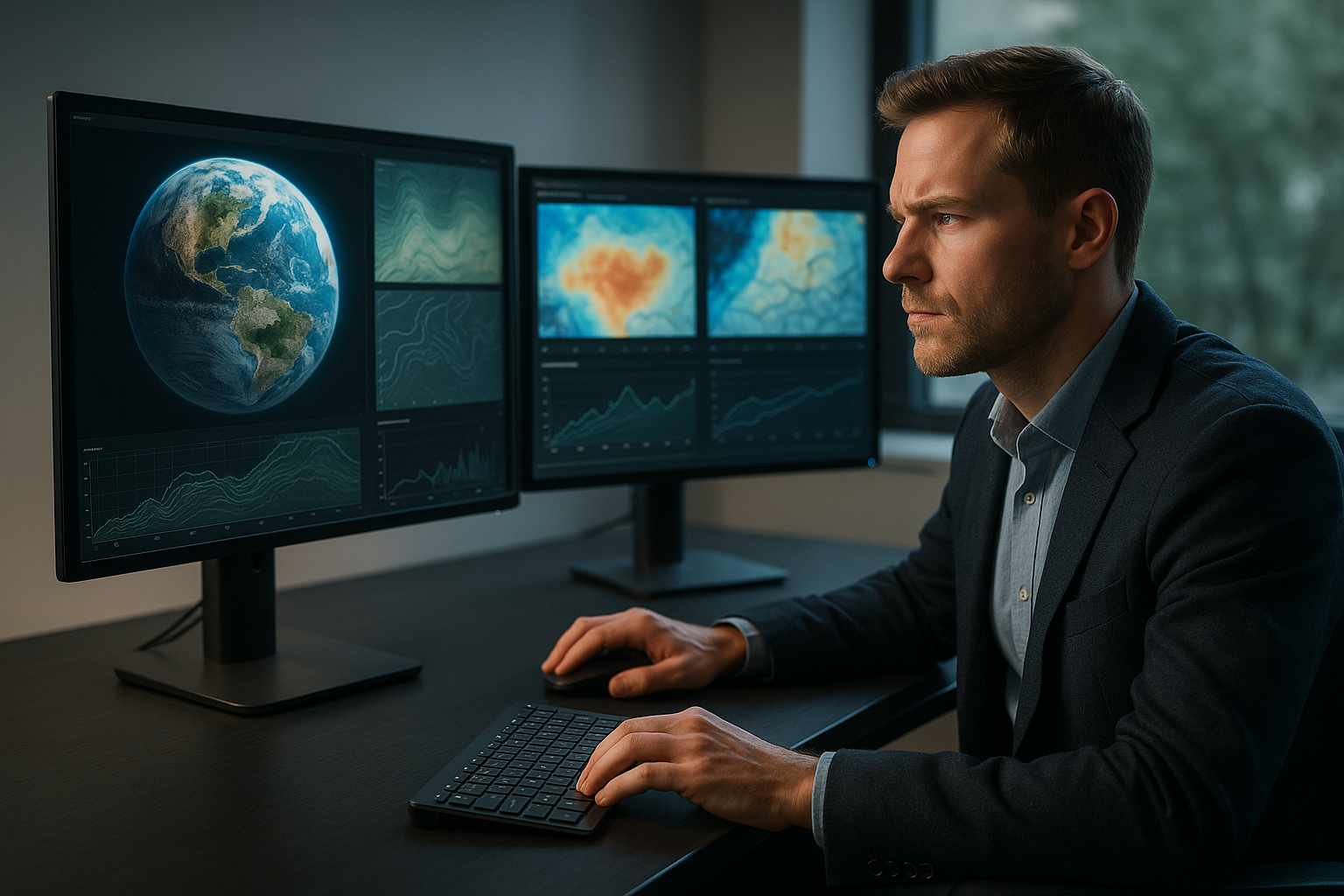
AI-powered climate downscaling: NVIDIA Earth-2 and CorrDiff for local risk and planning
Nations, cities, and businesses increasingly need local climate detail—kilometer-scale precipitation, winds, and temperature—to assess risk, plan infrastructure, and price exposure. NVIDIA Earth-2 is an AI-first climate and weather platform designed to translate coarse global projections into locally relevant information using AI-powered climate downscaling, making high-resolution scenarios more accessible to practitioners [1,6].
What is NVIDIA Earth-2 and the CorrDiff approach?
Earth-2 is a GPU-accelerated platform that brings AI to climate and weather workflows, aiming to deliver high-resolution outputs from inputs like CMIP6 scenarios or ERA5 reanalyses at a fraction of the time and energy used by traditional methods [1,6]. At its core is CorrDiff, a generative statistical downscaling method that learns a mapping from low-resolution inputs to high-resolution, physically consistent fields [1]. CorrDiff operates in two stages: a deterministic regression model predicts the conditional mean high-resolution state, then a diffusion model learns and corrects the residuals to refine small-scale structures that are missing from the original projections [1]. This AI-first approach aligns with broader advances in AI-accelerated physical modeling for weather and climate [2].
How the two-stage design improves local realism
Traditional global projections often resolve features at tens of kilometers, which is too coarse for local risk assessment and sectoral planning. CorrDiff’s regression step provides a stable baseline under distribution shifts between coarse and fine scales, while the diffusion stage stochastically refines patterns to capture localized precipitation, storms, and orographic effects [1]. Because the diffusion model samples residuals, it naturally produces ensembles of downscaled realizations, enabling probabilistic local climate risk analysis rather than a single deterministic view [1,3].
Data inputs and outputs: CMIP6, ERA5, Earth2Studio and xarray
For practitioners, Earth2Studio is the on-ramp: an open-source Python package that automates CMIP6 downloads from ESGF servers, configures model and scenario experiments (such as specific SSPs), and runs CorrDiff inference to produce high-resolution outputs as xarray DataArrays [1]. This workflow makes it feasible to systematize CMIP6 downscaling and feed bias-corrected, kilometer-scale fields directly into downstream impact models across insurance, infrastructure, and energy use cases [1]. These capabilities complement the growing ecosystem of ML-based tools in climate science and modeling [3].
AI-powered climate downscaling at enterprise speed
Compared with numerical dynamical downscaling, Earth-2 and CorrDiff report order-of-magnitude performance gains: 12.5x higher spatial resolution with roughly 500–1,000x speedups and large energy-efficiency improvements, making it practical to generate local projections at scale [1]. For production, Earth-2 exposes CorrDiff via cloud APIs and NVIDIA NIM microservices within CUDA-X, streamlining integration into existing data pipelines and applications [6]. NVIDIA has positioned Earth-2 as part of a broader digital twin initiative for the planet, emphasizing potential benefits while acknowledging the forward-looking nature of these claims in press materials [5]. For authoritative background on the platform’s goals and roadmap, see NVIDIA’s official announcement (external) [5].
Business use cases and ROI: insurance, energy, infrastructure planning
- Run ensemble downscaling for probabilistic local climate risk and stress tests across assets or portfolios [1,3].
- Generate locally relevant precipitation, temperature, and wind fields to inform infrastructure design and maintenance planning [1].
- Speed up scenario development cycles to support underwriting, pricing, and resilience strategies in climate-exposed sectors [1,6].
These capabilities align with industry interest in climate digital twins and AI-enabled decision support for extreme weather and long-term planning [4,5,6].
Limitations, uncertainties and research context
Vendor materials highlight performance and impact but also note that such claims are forward-looking and subject to uncertainty [4,5]. While CorrDiff has been benchmarked against simpler baselines and aims to improve stability under distribution shifts, users should validate outputs against high-resolution observations and consider multiple models where feasible [1,3]. Ongoing research compares alternative ML downscaling approaches, reflecting active progress in the field [3].
Getting started: practical adoption checklist
- Data access and setup: Use Earth2Studio to retrieve CMIP6 data from ESGF, configure desired model/SSP experiments, and prepare inputs for CorrDiff [1].
- Pilot runs and ensembles: Produce multiple downscaled realizations to assess spread and sensitivity for local risk analysis [1,3].
- Validation: Compare downscaled fields with high-resolution ground truth where available; assess bias and performance for your variables of interest [1].
- Integration: Deploy via NVIDIA NIM microservices and CUDA-X to connect APIs with internal data stores and downstream applications [6].
- Governance: Document assumptions, uncertainties, and model choices in line with your organization’s model risk standards [4,5].
For a strategic overview of tooling and adoption patterns, you can also Explore AI tools and playbooks.
Conclusion and next steps for practitioners
Earth-2 with the CorrDiff model demonstrates how AI-powered climate downscaling can convert coarse projections into kilometer-scale, application-ready data for local risk and planning [1,6]. Teams evaluating NVIDIA Earth-2 can start with Earth2Studio for experiments, validate ensembles against trusted references, and plan production integration via NIM microservices where speed and scale matter [1,6].
Sources
[1] How to Unlock Local Detail in Coarse Climate Projections with …
https://developer.nvidia.com/blog/how-to-unlock-local-detail-in-coarse-climate-projections-with-nvidia-earth-2/
[2] AI-Accelerated Physical Modelling for Weather, Climate, …
https://people.maths.ox.ac.uk/~gilesm/cuda/lecs/CUDA_workshop_Shokar.pdf
[3] Climate Science & Modeling
https://www.climatechange.ai/subject_areas/climate_science_modeling
[4] NVIDIA’s Earth Twin Might Save Us a Climate Emergency
https://blog.marketresearch.com/nvidias-earth-twin-might-save-us-a-climate-emergency
[5] NVIDIA Announces Earth Climate Digital Twin
https://nvidianews.nvidia.com/news/nvidia-announces-earth-climate-digital-twin
[6] AI-Powered Climate and Weather Simulation Platform | NVIDIA Earth-2
https://www.nvidia.com/en-us/high-performance-computing/earth-2/
