
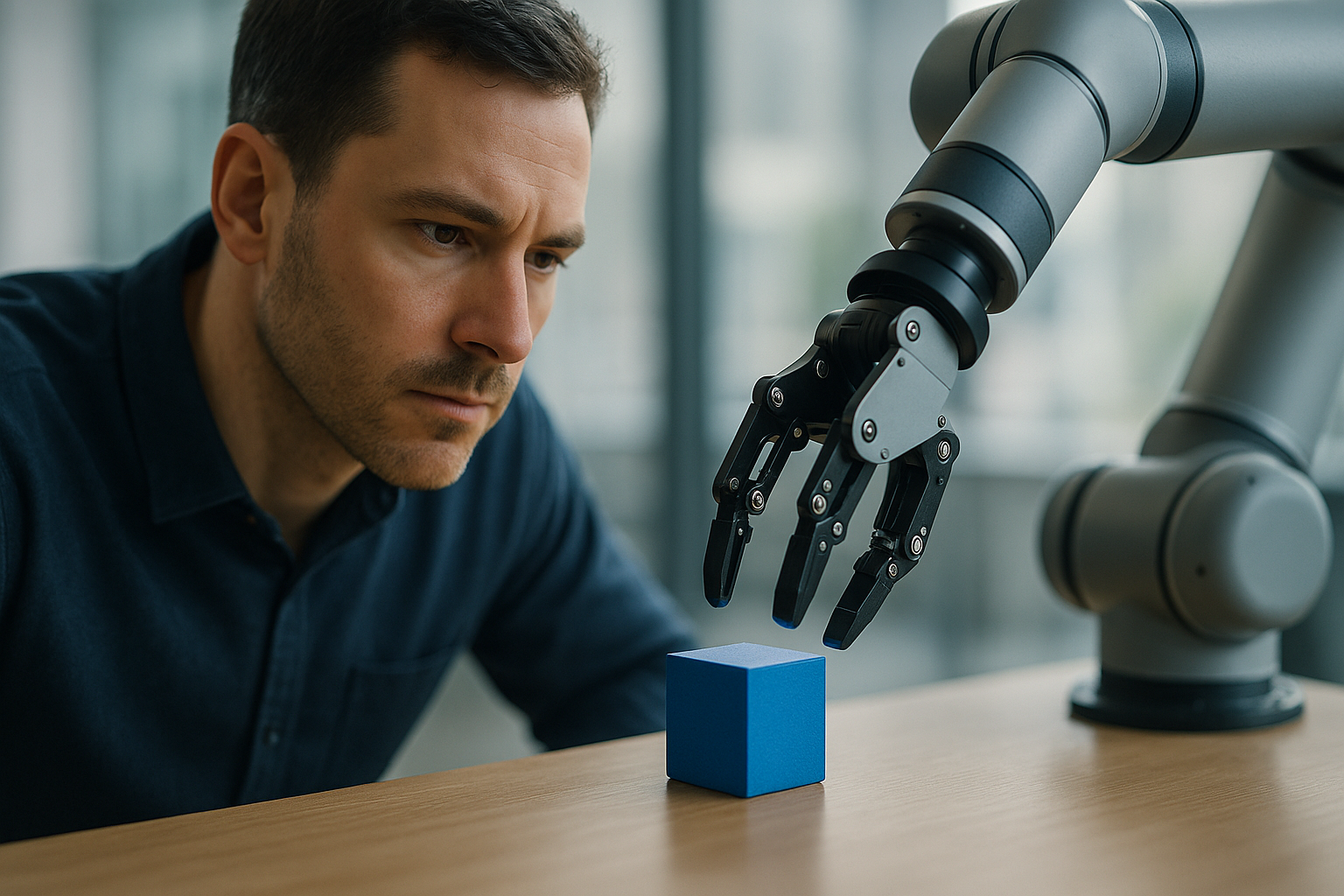
This AI Model Can Intuit How the Physical World Works
AI that “gets” how the physical world works may not need hand-crafted rules or explicit physics engines. Recent work on Meta’s Video-JEPA (V-JEPA) shows that intuitive physics can emerge from a simple objective: watch large amounts of natural video and predict how scenes evolve—at an abstract level rather than pixel by pixel [1][2][3]. The approach points to a broader movement toward world models and physical AI, where predictive models become internal simulators for forecasting and control in robots and agents [4][5][6].
From Pixels to Physics: How Video-JEPA Learns
Video-JEPA is trained self-supervised on natural videos by masking spatiotemporal regions and predicting the missing content in a learned latent space. By operating in representation space instead of reconstructing raw pixels, the model prioritizes higher-level structure—object identity, trajectories, and interactions—over fine appearance details [1][2]. This seemingly modest shift in training objective appears to unlock physical common sense from video alone [1][2].
What “Intuitive Physics” Means for AI
In cognitive science, intuitive physics refers to the everyday expectations humans hold about objects and motion. Video-JEPA is evaluated on specialized benchmarks probing classic concepts: object permanence, continuity of motion, solidity, support, gravity, and inertia. The model demonstrates competence across these areas without task-specific fine-tuning, suggesting it internalizes general constraints about how scenes should unfold [1][2].
Inside the Benchmarks: Permanence, Gravity—and Impossible Events
Across tests, V-JEPA variants—including smaller models and those trained with limited data—perform significantly above chance, indicating robust signal capture even under constrained regimes [1]. Strikingly, its prediction error spikes on videos depicting physically impossible events. This suggests the system “notices” violations of expected behavior, mirroring human sensitivity to broken physical rules observed in cognitive experiments [1][3].
Ablation studies further support the conclusion: a 115M-parameter version and a model trained on roughly a week of unique video still outperform chance on intuitive-physics evaluations, reinforcing that the effect is not confined to massive models or exhaustive data [1].
Why It Matters: Robustness Without Heavy Engineering
The headline result is not merely accuracy on narrow tests. It’s the emergence of physical common sense from a generic, scalable learning principle—predicting masked video regions in latent space—without hand-coded rules or explicitly hardwired physical laws [1][2]. Robust performance across sizes and training setups hints at more cost-efficient paths to deploy intuitive-physics AI in constrained environments, such as edge devices or embedded robotics, where compute and data are limited [1].
Physical AI and World Models: The Industry Shift
Video-JEPA lands amid a broader push toward physical AI and world models—architectures that learn spatiotemporal causality to simulate, predict, and plan future states. Academic groups and big tech players are racing to build these internal simulators for robotics, automation, and embodied agents, positioning them as a foundation for safer and more foresightful control [4][5]. Industrial initiatives like NVIDIA’s Cosmos highlight the market interest in world foundation models for the physical world, signaling a platform direction for simulation, planning, and digital twins at scale [6].
NVIDIA Cosmos and Industrial-Scale World Foundation Models
NVIDIA Cosmos is an example of a world foundation model aimed at physical AI—an infrastructure layer designed to power predictive capabilities across industries. Tying models like V-JEPA’s paradigm to systems such as Cosmos suggests a future where learned world models support complex forecasting, planning, and embodied decision-making across robotics and simulation workflows [4][5][6].
From Research to Operations: Where This Goes Next
For business and operations leaders, the near-term relevance centers on tasks that benefit from learned physical common sense and predictive foresight:
- Robotic manipulation and automation: More reliable grasping, stacking, and tool use in variable environments, guided by learned expectations of object behavior [4][5].
- Warehouse and logistics: Better path planning and incident avoidance through internal simulation of likely outcomes, not just reactive control [4][5].
- Industrial simulation and digital twins: Scenario planning and optimization grounded in models that learn how physical systems evolve over time [6].
- Safer autonomy: Systems that flag “physically impossible” sensor observations—useful for anomaly detection and safety overrides [1][3].
Key Takeaways
- Simple objective, rich behavior: Predicting masked video regions in latent space is enough to induce intuitive physics in AI [1][2].
- Robustness matters: Even smaller and limited-data variants beat chance on core physics concepts [1].
- Built-in guardrails: Error spikes on impossible events indicate internalized constraints that can improve safety monitoring [1][3].
- Industry alignment: The results fit a larger trend toward world models and physical AI platforms like NVIDIA Cosmos [4][5][6].
What to Watch
- Benchmark breadth and real-world transfer: Today’s results are benchmark-driven. The big test is whether these models generalize across domains and edge cases in the wild [1][2].
- Integration into tooling: Expect tighter coupling between learned world models and robotics stacks, simulation platforms, and enterprise planning tools [4][5][6].
- Cost and deployment: Continued gains from smaller models would accelerate adoption in embedded and on-prem environments [1].
If Video-JEPA is a signal, intuitive physics can emerge from general-purpose learning on video. That could reshape how businesses build, test, and deploy robots and automated systems—moving from brittle rules to models that learn how the world works [1][2][4][5][6].
Sources
[1] Intuitive physics understanding emerges from self-supervised video prediction in a joint-embedding architecture — https://arxiv.org/html/2502.11831v1
[2] How AI learns intuitive physics from watching videos — https://bdtechtalks.com/2025/04/28/v-jepa-intuitive-physics/
[3] “Video-JEPA model learns physical intuition, predicts impossible events” — https://www.linkedin.com/posts/yann-lecun_how-one-ai-model-creates-a-physical-intuition-activity-7379970909102825473-3RUI
[4] Scholars and Big Tech Race to Develop Physical AI World Models — https://www.chosun.com/english/industry-en/2025/11/24/KSKAJSRIMFDJFDELIQD5HBMUNA/
[5] Physical AI Deep Dive | Part I: Market Timing – Dream Machines — https://www.dreammachines.ai/p/physical-ai-deep-dive-part-i-market
[6] NVIDIA Cosmos – Physical AI with World Foundation Models — https://www.nvidia.com/en-us/ai/cosmos/
