
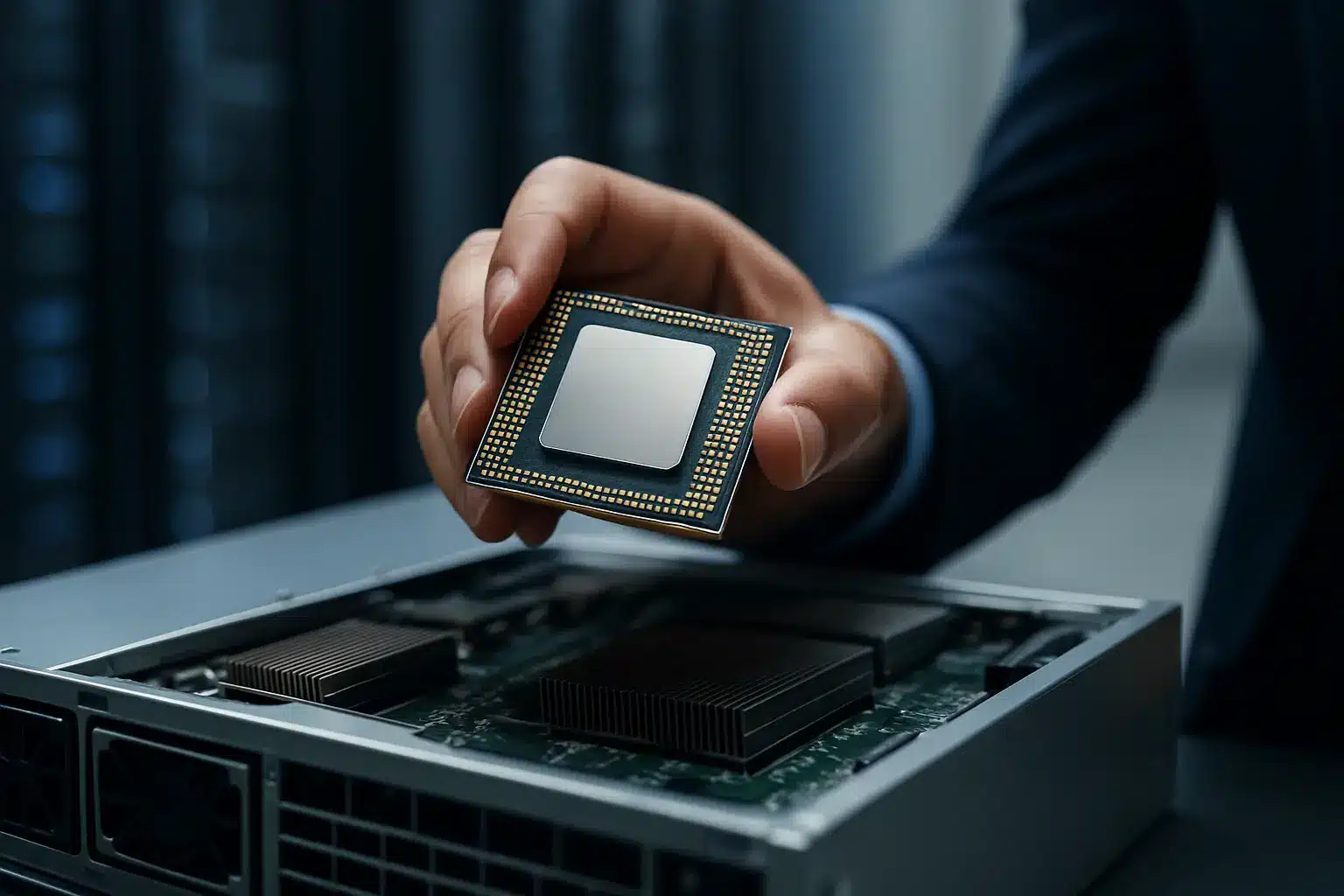
NVIDIA Vera CPU Performance: Impact on AI Data Centers
NVIDIA’s Vera CPU targets agentic AI, reinforcement learning, and memory‑bound analytics with a design that prioritizes bandwidth and fabric efficiency over raw core count. For readers evaluating NVIDIA Vera CPU performance, the key story is per-core memory bandwidth and coherency fabric behavior under multi-tenant AI loads, not just socket totals [1][4][6].
Quick take: What NVIDIA Vera promises for AI data centers
Vera combines 88 custom Armv9.2 Olympus cores with Spatial Multithreading for 176 threads, FP8‑capable SVE2 vectors, and a second‑generation Scalable Coherency Fabric aimed at deterministic latency under heavy load [1][4][6]. The memory subsystem offers up to 1.2 TB/s of LPDDR5X bandwidth and roughly 1.5 TB capacity via an extra‑wide 1,024‑bit interface and eight SOCAMM modules, with the LPDDR5X memory configuration using under 30 W in typical operation [1][4][5]. NVIDIA positions Vera as a direct alternative to x86 server processors and claims 4x agentic sandbox density and 2x performance per watt versus racks built on Intel and AMD platforms [1][4][6].
Architecture at a glance: Olympus cores, SMT and SVE2
At the core level, Vera introduces the Olympus microarchitecture with a very wide 10‑wide front end and high single‑thread IPC, targeting about 1.5x the IPC of NVIDIA’s prior Grace core according to company guidance [1][6]. Spatial Multithreading enables 176 threads per socket, and SVE2 vectors support FP8 for AI workloads [1][4][6]. NVIDIA’s second‑generation Scalable Coherency Fabric is designed to sustain deterministic latency and throughput across all 88 cores under full‑socket, multi‑tenant AI load, a critical requirement for agentic pipelines and mixed service orchestration [1][4][6].
Memory and fabric: LPDDR5X SOCAMM and per-core bandwidth
Vera’s memory architecture is its defining feature. The CPU connects to eight LPDDR5X SOCAMM modules across a 1,024‑bit interface, enabling up to 1.2 TB/s of bandwidth and around 1.5 TB of capacity, while using less than half the power of comparable DDR5 setups [1][4][5]. That design yields roughly 14 GB/s of per-core bandwidth, estimated at 2–4x what contemporary Intel Xeon and AMD EPYC CPUs offer on a per-core basis for memory‑bound workloads [3][5]. For operators comparing LPDDR5X SOCAMM bandwidth to traditional server memory, the efficiency profile and width of the interface are central to Vera’s advantage [1][5].
Benchmarks and evidence: NVIDIA Vera CPU performance in context
Phoronix’s STREAM TRIAD testing, as reported by NVIDIA, shows Vera sustaining about 90% of its theoretical peak memory bandwidth. NVIDIA notes this is the highest sustained-to-peak ratio seen in the CPU tests it referenced and translates to more than 4x the bandwidth per core compared to mainstream x86 chips in that context [2]. These results focus on bandwidth and do not replace application-level evaluations, but they align with the platform’s goal to elevate throughput for memory‑bound AI and analytics [1][2][5].
System integration: NVLink‑C2C, PCIe Gen6, CXL 3.1, Rubin GPUs
Vera connects to Rubin GPUs via NVLink‑C2C at up to 1.8 TB/s, a level that helps reduce CPU‑GPU bottlenecks in tightly coupled AI pipelines [1][4][6]. The platform also supports PCIe Gen6 and CXL 3.1, expanding composability options for accelerators and memory tiers [1][4][6]. For broader context on CXL’s industry goals, see the CXL Consortium overview (external). Crucially, Vera can operate as a standalone CPU for deployments that do not require accelerator pairing [4][6].
Performance per rack: density, throughput and energy claims
NVIDIA claims 4x agentic sandbox density and 2x performance per watt versus x86‑based racks in AI factory use, attributing gains to per-core bandwidth, fabric behavior, and memory power characteristics [1][4][6]. For buyers comparing Vera vs Intel Xeon for AI, the practical lens is rack‑level throughput on agentic and memory‑bound workloads, along with TCO expectations tied to energy, cooling, and space efficiency [1][4][6]. Some industry analysis suggests Vera could challenge or even surpass Intel and AMD data center CPU revenues if NVIDIA meets its sales goals, underscoring the competitive stakes [7].
Who should consider Vera now
Shortlist Vera for pilots if your stacks emphasize agentic AI, reinforcement learning, or analytics pipelines that are constrained by memory throughput rather than peak scalar compute. The platform’s integration with Rubin via NVLink‑C2C, plus PCIe Gen6 and CXL 3.1, provides flexibility for building GPU‑accelerated clusters or CPU‑centric nodes [1][4][6]. Teams evaluating NVIDIA Vera CPU performance should design proofs of concept that measure end‑to‑end task throughput and queueing behavior under multi‑tenant load, not only microbenchmarks [1][2].
Risks, unknowns and what to validate during pilots
- Validate multi‑tenant latency under full-socket load despite the fabric’s deterministic design goals [1][4][6].
- Confirm rack‑level density and perf‑per‑watt claims on real agentic sandboxes and memory‑bound analytics [1][4][6].
- Check software and ecosystem readiness for Olympus cores, SVE2 features, and memory topology at your scale [1][4][6].
For additional tooling and playbooks, Explore AI tools and playbooks.
FAQ (quick answers for busy decision-makers)
- What is Vera’s per-core bandwidth? Approximately 14 GB/s per core, enabled by a 1,024‑bit LPDDR5X interface and eight SOCAMM modules [1][3][5].
- How does Vera’s per-core bandwidth compare to x86? NVIDIA and industry write‑ups estimate about 2–4x the per-core bandwidth of contemporary Intel Xeon and AMD EPYC CPUs for memory‑bound scenarios [3][5].
- What enables tight GPU‑CPU coupling? NVLink‑C2C provides up to 1.8 TB/s for Rubin GPU integration, with PCIe Gen6 and CXL 3.1 also supported [1][4][6].
- What are the headline efficiency and density claims? NVIDIA cites 4x agentic sandbox density and 2x performance per watt versus x86‑based racks for AI factories [1][4][6].
Sources
[1] NVIDIA Vera CPU Delivers High Performance, Bandwidth, and …
https://developer.nvidia.com/blog/nvidia-vera-cpu-delivers-high-performance-bandwidth-and-efficiency-for-ai-factories
[2] NVIDIA Vera CPU Is ‘Packing a Heavy-Hitting Punch’ Against Competition | NVIDIA Blog
https://blogs.nvidia.com/blog/vera-cpu-phoronix
[3] The NVIDIA Vera CPU: A Practical Guide to the Chip Built for the Age of Agentic AI – Kingy AI
https://kingy.ai/ai/the-nvidia-vera-cpu-a-practical-guide-to-the-chip-built-for-the-age-of-agentic-ai
[4] Next Gen Data Center CPU | NVIDIA Vera CPU
https://www.nvidia.com/en-us/data-center/vera-cpu
[5] NVIDIA’s Vera CPU in Detail: High Perf Chip Takes Aim at Broader AI Server Market – ServeTheHome
https://www.servethehome.com/nvidias-vera-cpu-in-detail-high-perf-chip-takes-aim-at-broader-ai-server-market
[6] NVIDIA Corporation – NVIDIA Launches Vera CPU, Purpose-Built for Agentic AI
https://investor.nvidia.com/news/press-release-details/2026/NVIDIA-Launches-Vera-CPU-Purpose-Built-for-Agentic-AI/default.aspx
[7] NVIDIA’s ‘Vera’ CPUs could outperform and outsell competing x86 offerings from Intel and AMD
https://www.tweaktown.com/news/111785/nvidias-vera-cpus-could-outperform-and-outsell-competing-x86-offerings-from-intel-and-amd/index.html
[8] NVIDIA Rubin GPU vs. NVIDIA Vera CPU – Civo
https://www.civo.com/blog/nvidia-rubin-gpu-vs-vera-cpu
