
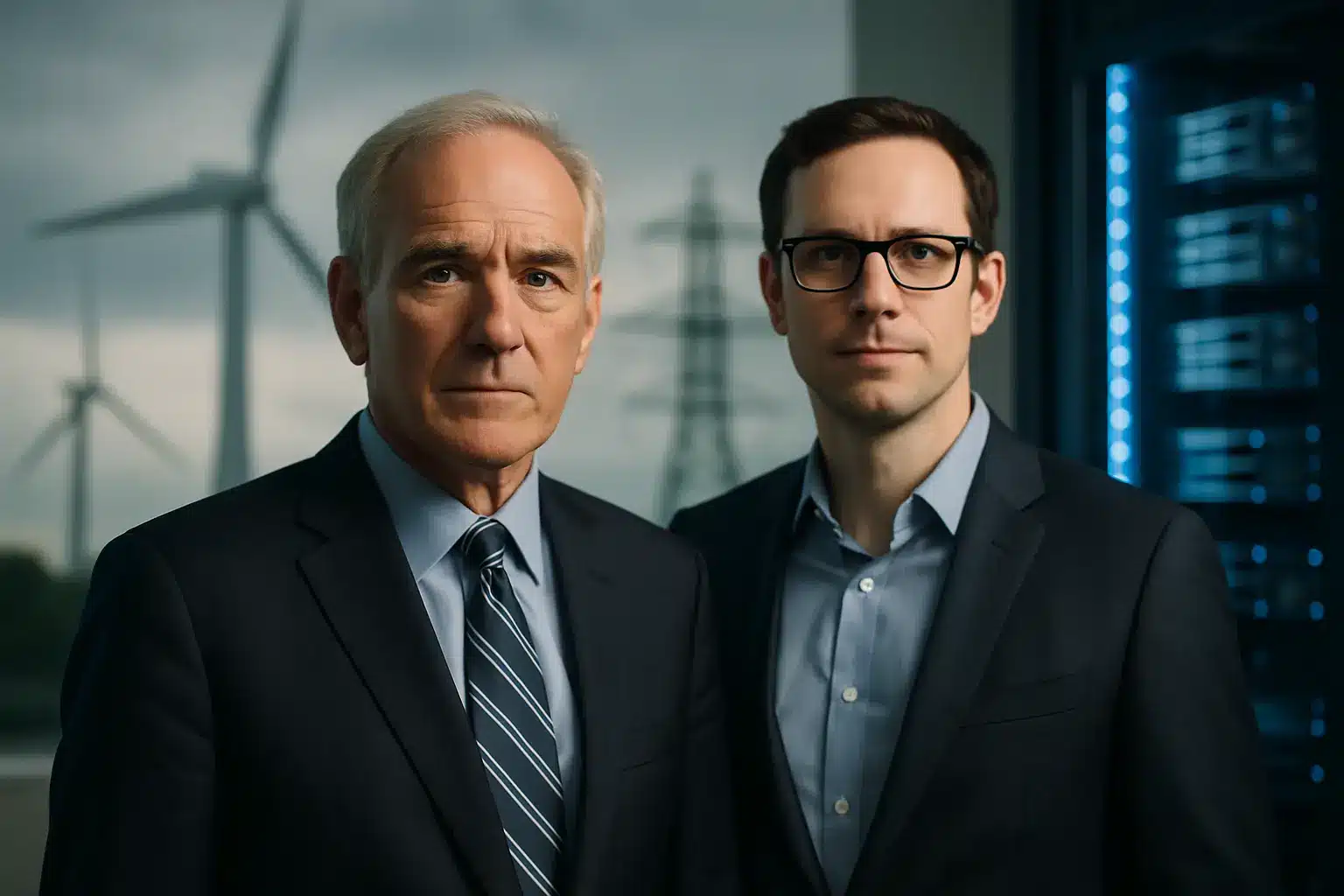
Powering the Next American Century: US Energy Secretary Chris Wright and NVIDIA’s Ian Buck on the Genesis Mission AI energy strategy
AI has moved to the center of U.S. competitiveness planning. At the AI+ Expo in Washington, D.C., organizers and speakers framed the technology as strategic infrastructure and tied it to a long-horizon push on power systems, national security, and economic resilience. That conversation now has a label: the Genesis Mission AI energy strategy, which links grid reliability with leadership in accelerated computing [1][2].
The Genesis Mission AI energy strategy in Washington
The AI+ Expo convened government, industry, and academic leaders in the capital to connect AI with security, education, and the broader U.S.–China–Taiwan strategic context. The event’s framing placed AI alongside the internet and the power grid as foundational infrastructure for national competitiveness [1][2].
What Energy Secretary Chris Wright said: risks, rewards, and the grid
U.S. Energy Secretary Chris Wright described AI as disruptive but ultimately a net positive for productivity and scientific progress. He acknowledged public anxiety around job displacement and the environmental footprint of rapidly expanding data centers, noting protests that surfaced around the event. The policy through-line: modernize and harden the U.S. grid to reliably power AI infrastructure while addressing public concerns about AI data center energy use [3].
In practice, that means grid resilience for AI infrastructure is no longer a niche facility issue. It sits inside a larger policy conversation about reliable generation, transmission, and regional capacity planning as AI workloads scale [3].
NVIDIA and Ian Buck: the hardware side of the Genesis Mission
On the systems front, NVIDIA’s Ian Buck bridges product leadership and national-scale deployments. Buck helped create CUDA, which enabled generalized GPU computing and opened the path to today’s generative AI systems. He now oversees hyperscale and high-performance computing products that sit behind major AI services and research platforms [4]. In recent briefings, he outlined priorities across hyperscale and HPC that align with accelerating generative AI deployments [6].
These roles place Buck and NVIDIA at the intersection of industrial capability and public policy. The work spans commercial hyperscalers and collaborations with U.S. national laboratories, where accelerated computing underpins cutting-edge simulation and model training [4][6].
Los Alamos and national supercomputers: capability and purpose
The Department of Energy’s National Nuclear Security Administration announced two new supercomputers at Los Alamos National Laboratory. The systems are intended to propel U.S. leadership in science, advancing both large-scale simulation and emerging generative intelligence workloads. The announcement highlights accelerated computing as the performance backbone for this research portfolio [5].
For enterprises tracking Ian Buck NVIDIA supercomputing efforts, Los Alamos provides a clear example of how national initiatives leverage GPU acceleration to expand capability and throughput for mission-driven science [4][5].
The energy challenge: data centers, emissions, and grid impacts
Public debate around AI has sharpened on two fronts: jobs and power. Wright’s remarks acknowledged concerns about displacement risk and the rising energy demands of AI data centers, which featured prominently in discussions and protests around the Expo. These worries heighten pressure for near-term transparency on power sourcing and longer-term plans to scale sustainable capacity [3].
From a planning perspective, operators building AI-scale facilities will face tighter coordination with utilities and regulators as regional grids adapt to new load profiles. The policy signal from Washington is that energy and AI policy are now intertwined, with reliability and capacity central to competitiveness [1][2][3].
How AI can help the grid — a two-way relationship
Expo programming also emphasized a reciprocal dynamic: AI is expected to optimize grid operations and industrial processes, improving reliability and efficiency as systems scale. That positions AI as both a new source of demand and a practical tool for operational resilience [1][2]. For broader context on federal energy initiatives, see the U.S. Department of Energy’s overview page DOE (external).
Business and policy implications: what leaders should plan for
For executives and planners, three themes stand out:
- Map AI workloads to power availability. Align model scale, training cadence, and siting with regional capacity and grid upgrade timelines [1][2][3].
- Treat energy as a procurement pillar. Build partnerships with utilities and factor transmission constraints and redundancy into contracts and SLAs [1][3].
- Track national supercomputing roadmaps. They signal architecture trends and component availability that will influence commercial buildouts [4][5][6].
Leaders building long-term roadmaps can find practical tooling and vendor context in our reference guides. For deeper planning support, explore our AI tools and playbooks.
Conclusion: the strategic arc — powering American AI leadership
The Expo’s message was consistent: AI leadership and energy resilience rise together. Wright’s focus on grid modernization meets Buck’s accelerated computing roadmap in a single strategic lane, with national labs like Los Alamos showing how policy and capability translate into deployed systems. The path forward requires public-private coordination, clear communication on data center impacts, and sustained investment in compute and power to keep the U.S. on the front foot [1][2][3][4][5][6].
Sources
[1] The Countdown to the AI+ Expo is On. – by SCSP
https://scsp222.substack.com/p/the-countdown-to-the-ai-expo-is-on
[2] The AI+ Expo Takes Over DC This Week – by SCSP
https://scsp222.substack.com/p/the-ai-expo-takes-over-dc-this-week
[3] AI will be ‘disruptive’ but promises larger positives, US energy secretary says | The National
https://www.thenationalnews.com/future/technology/2026/05/07/ai-plus-scsp-chris-wright-protester/
[4] Ian Buck Author Page | NVIDIA Blog
https://blogs.nvidia.com/blog/author/ian-buck/
[5] NNSA Announces Two New Supercomputers at Los Alamos National Laboratory, Propelling America’s Leadership in Science | Department of Energy
https://www.energy.gov/nnsa/articles/nnsa-announces-two-new-supercomputers-los-alamos-national-laboratory-propelling
[6] GTC 2026: Ian Buck press Q&A transcript — VP of Hyperscale and HPC speaks out on shelving CPX and shipping LPU decode this year | Tom’s Hardware
https://www.tomshardware.com/tech-industry/gc-2026-press-q-and-a-transcript
