
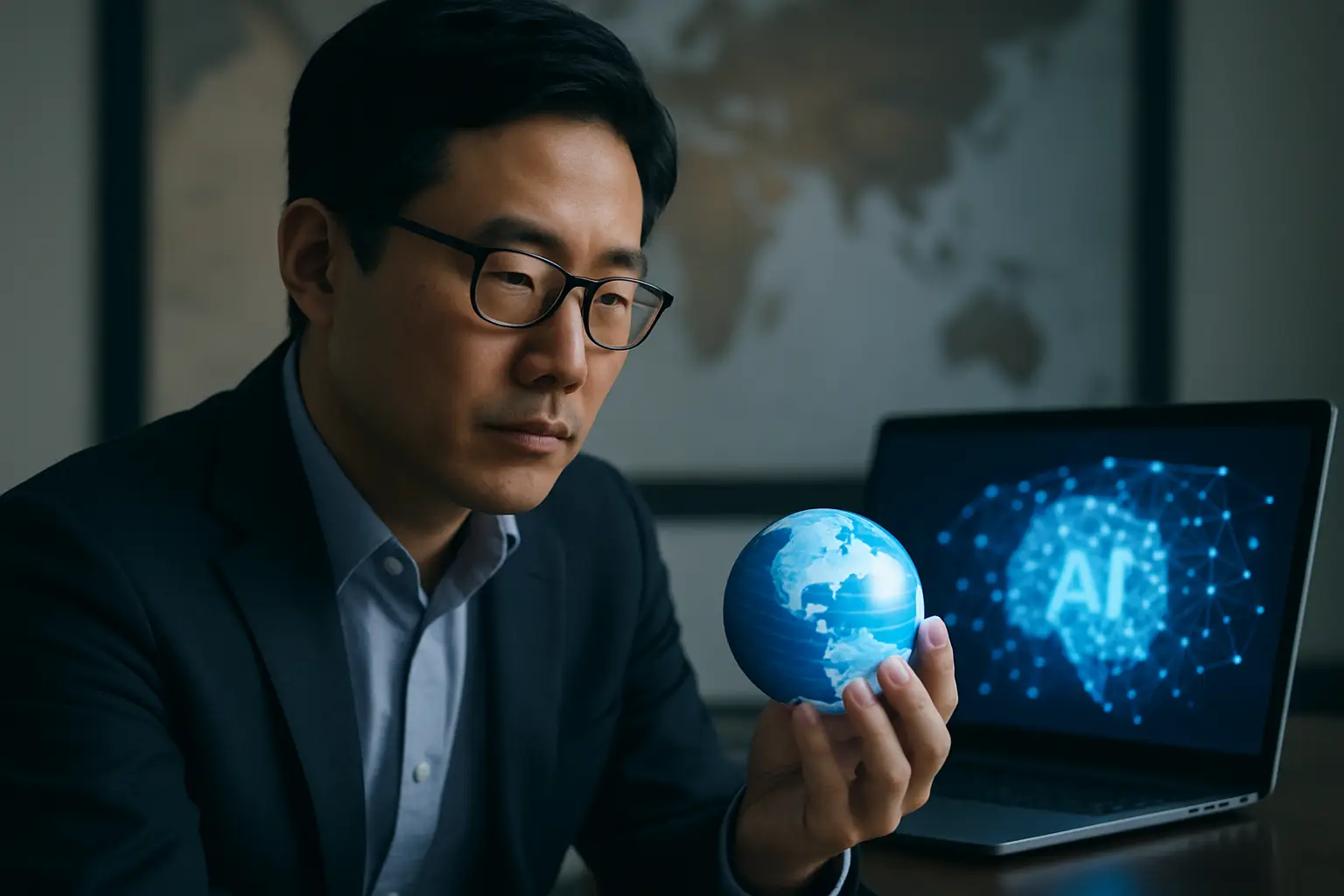
Advancing international trade research and finding community: an international trade and AI research profile
Sojun Park is a political scientist whose work connects trade, intellectual property, and technological change to inform today’s policy debates and firm strategies. This international trade and AI research profile outlines how his findings on product lifecycles, innovation diffusion, and governance can guide decisions in markets shaped by IP and geopolitics [5][2].
Background and career path
Park trained at Korea University and Princeton, completing his MA and PhD and receiving a Fulbright scholarship [5]. He has held pre- and postdoctoral fellowships at Georgetown’s Mortara Center, Princeton’s Niehaus Center, and MIT’s Center for International Studies, which provided protected research time, collaboration, and mentoring that helped refine his quantitative approaches and broaden his agenda to include security dimensions in AI [5][1][6]. He will join the Lee Kuan Yew School of Public Policy at the National University of Singapore as an assistant professor, continuing his research and a community-oriented teaching style [5][2].
Core research themes: trade, patents, and political economy
Park’s research sits at the intersection of international political economy, trade agreements, intellectual property rights, and the politics of innovation and diffusion [5][2]. He analyzes how firms’ product lifecycles and fears of imitation translate into lobbying for more restrictive trade rules and stronger global patent protections. This work shows how declining technological leadership can fuel support for more exclusionary international IP rules [5]. He uses patent citations and lobbying data to examine these dynamics, with a forthcoming coauthored article focused on rapidly innovating firms, patent lifecycles, and support for trade and IP enforcement [5][3].
AI diffusion project: trade in data-processing machines and patent patterns
At MIT CIS, Park extends this agenda to AI, linking trade data and patent filings to study how exports of data-processing machines shape where AI innovations emerge. The project connects hardware trade to the geography of AI patenting and examines how gaps between geopolitical alignments and trade patterns among allies structure diffusion beyond formal security coalitions [4][5]. For firms and policymakers, this framing underscores how supply chain decisions and export ties can influence local AI capability formation and R&D location choices [4][5].
Geopolitical misalignments: allies, trade patterns, and AI capability formation
Park argues that misalignments between security alliances and trade patterns among allies can shape where AI capabilities develop, pointing to diffusion channels that do not always track formal coalitions. This perspective emphasizes the need to match geopolitical assumptions with empirical trade and patent signals when assessing AI exposure and opportunity [4][5].
WTO TRIPS and transparency: what the research reveals for IP governance
Another thread of Park’s work examines transparency and international bureaucrats in the WTO TRIPS Council, focusing on information flows that influence IP governance and enforcement expectations [5][2]. For context on the legal framework, see the WTO TRIPS Agreement (external). Park’s analysis highlights how institutional settings and bureaucratic processes can shape how firms perceive the clarity and stability of global IP rules [5][2].
An international trade and AI research profile for practitioners
Park’s work offers several takeaways for business and policy readers:
- Track patent lifecycles and product obsolescence when evaluating lobbying posture and market entry. Declining technological leadership can correlate with support for more exclusionary international rules [5].
- Map hardware export channels to AI patenting footprints. Trade in data-processing machines can inform where AI capabilities emerge and scale [4][5].
- Stress-test geopolitical assumptions. Misalignments between alliances and trade ties can redirect diffusion pathways beyond formal security groupings [4][5].
- Monitor transparency processes in IP forums. Information dynamics in bodies like the TRIPS Council affect how firms interpret enforcement landscapes across markets [5][2].
The role of community in advancing research
Park emphasizes how institutional communities shaped his work. Fellowships at the Mortara Center, the Niehaus Center, and MIT CIS provided time, mentorship, and interdisciplinary networks that advanced his trade–IP–AI agenda and helped integrate security questions into research on innovation and diffusion [5][1][6]. The MIT CIS environment, in particular, supported the expansion of AI-focused projects tied to trade and governance [5][6][7].
What’s next
Park will continue this program as he moves to the Lee Kuan Yew School of Public Policy at the National University of Singapore, carrying forward research on trade, patents, and AI diffusion, and applying a collaborative, community-oriented teaching approach [5][2]. For readers seeking applied frameworks and tools connected to these themes, Explore AI tools and playbooks.
International trade and AI research profile: where to follow the work
Park’s institutional and personal pages offer updates on publications, talks, and projects, including forthcoming work on rapidly innovating firms and TRIPS transparency. See profiles at MIT CIS, Mortara, and his personal site for details and event listings [6][1][2][3][4][5].
Sources
[1] Sojun Park – Mortara Center – Georgetown University
https://mortara.georgetown.edu/profiles/sojun-park/
[2] Sojun Park
https://www.sojunpark.com/
[3] Sojun Park (MIT), “Innovation, Imitation, and Political Cleavages in …
https://gripe.polisci.ucla.edu/event/park-2026-01-21/
[4] The Global Diffusion of AI Technologies and Its Political Drivers
https://cis.mit.edu/events-seminars/event/global-diffusion-ai-technologies-and-its-political-drivers
[5] Advancing international trade research and finding community
https://news.mit.edu/2026/sojun-park-advancing-international-trade-research-finding-community-0323
[6] Sojun Park | Center for International Studies – MIT
https://cis.mit.edu/our-people/sojun-park
[7] Center for International Studies | MIT News | Massachusetts Institute …
https://news.mit.edu/topic/center-international-studies-0
