
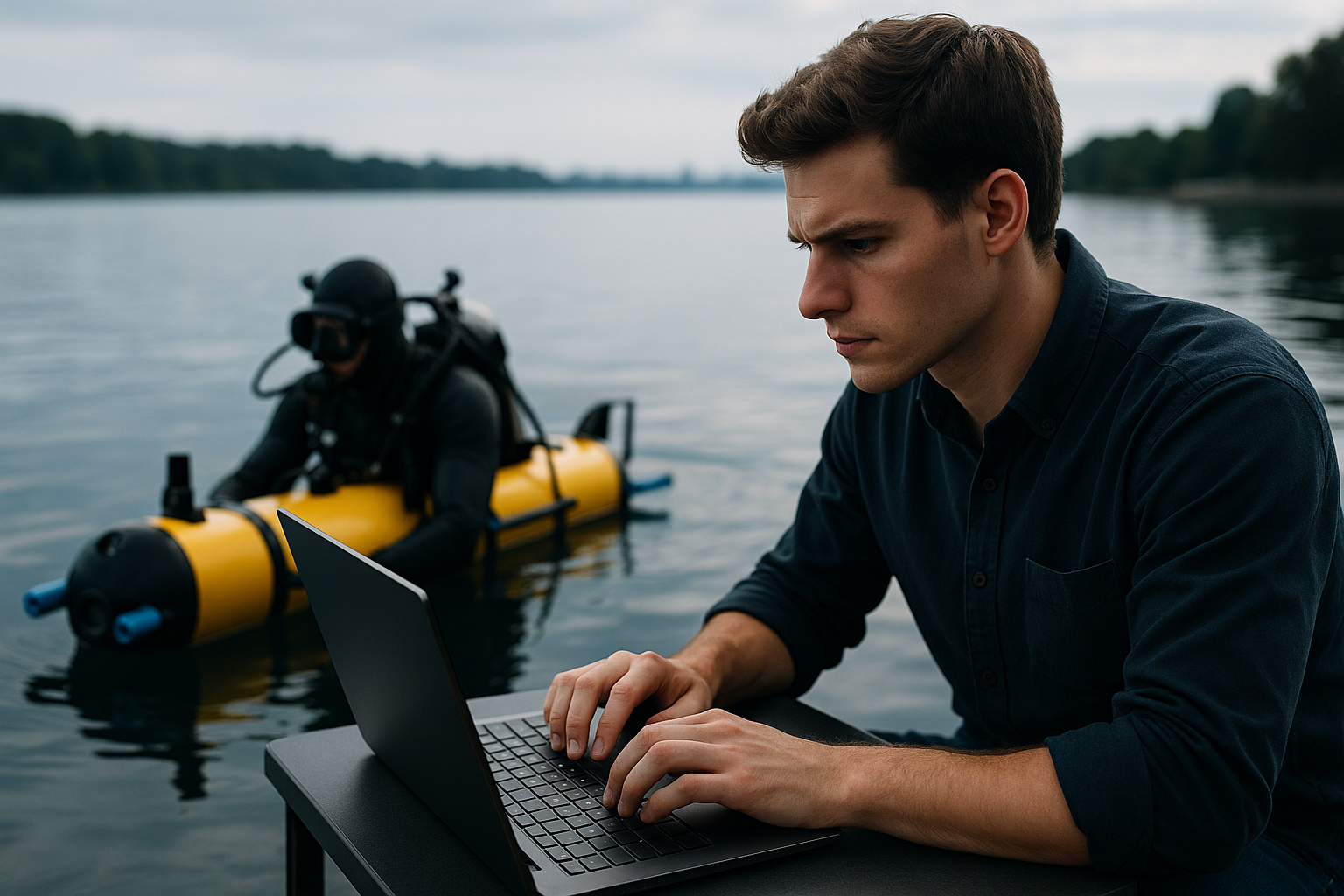
Coding Underwater Navigation Algorithms: Inside MIT Lincoln Lab’s Diver–AUV Project
In a featured MIT News video, Olin College undergraduate Ivy Mahncke details how she coded, refined, and deployed an algorithm that lets a human diver and an autonomous underwater vehicle coordinate their positions in environments where GPS does not work. The project, part of her 2025 internship at MIT Lincoln Laboratory’s Advanced Undersea Systems and Technology Group, underscores why robust underwater navigation algorithms are foundational to real-world undersea autonomy [1][2][3].
The technical challenge: GPS doesn’t reach underwater
Conventional localization methods like GPS fail underwater. Mahncke’s effort focused on alternative sensing and navigation strategies that enable a diver and robot to share information and maintain situational awareness in GPS-denied conditions. The goal: reliable, real-time coordination that operators can trust during demanding undersea missions [1][2][3].
How underwater navigation algorithms enable diver–AUV collaboration
The approach showcased in the video centers on collaborative navigation between a human diver and a robotic vehicle. Mahncke contributed to algorithm development, iterative refinement, and troubleshooting, culminating in software deployment on an operational underwater robot. By letting the diver and vehicle exchange navigation cues, the system aims to keep both assets coordinated when external signals are unavailable—a practical pathway for diver-robot collaboration in the field [1][2].
Real-world deployment and field testing across diverse sites
After lab development, the team took the code into the water. Field trials in the Atlantic Ocean, the Charles River, and Lake Superior stressed the algorithm under varied conditions—an essential step for validating robustness beyond controlled tests. Notably, Mahncke served as one of the lead field testers, an uncommon role for an intern and a reflection of the hands-on, mission-oriented culture around operational undersea autonomy at the Laboratory [1][2].
These multi-site trials illustrate the operational bar for deploying autonomous underwater vehicle software. Testing in distinct environments helps surface edge cases early, guides iteration, and builds confidence that the system will hold up when it matters [1][2].
Program and people: the internship pipeline powering undersea R&D
The project sits within Lincoln Laboratory’s Advanced Undersea Systems and Technology portfolio, which focuses on autonomous vehicles, ocean sensing, and AI-enabled undersea missions. The Laboratory’s summer research program brings interns into teams working on undersea sensors, autonomy, simulation tools, and AI and machine learning applications—creating a pipeline where students can contribute to deployable systems. The featured video is part of Lincoln Laboratory’s broader autonomy-focused content on its YouTube channel [1][3][4][5].
For readers exploring how interns build undersea robotics algorithms at MIT Lincoln Laboratory—or considering internship undersea robotics opportunities—these programs provide direct exposure to field validation and operational constraints that shape production-grade solutions [1][3][4].
Applications and industry implications
Technical progress in GPS-denied navigation underwater ties directly to mission outcomes. Undersea work referenced by the Laboratory includes ocean sensing, underwater target classification, and mine identification—domains where dependable localization and coordination can unlock safer, more efficient operations. For program managers and buyers, this strengthens the case for partnering with teams that link algorithm development to rigorous, environment-spanning trials [1][3].
Prospective collaborators can also consider the Laboratory’s broader emphasis on AI-enabled undersea missions, which aligns with sensor-rich, autonomy-first workflows in maritime technology. For broader institutional context, see MIT Lincoln Laboratory (external) for research themes and partnerships [3](https://www.ll.mit.edu/).
Practical takeaways for CTOs and program managers
- Demand evidence from real-world trials that span multiple environments, not just pools or single-site demos.
- Evaluate how diver–robot collaboration is operationalized: user workflows, safety, and recoverability when sensors degrade.
- Prioritize platforms where software can be iterated, deployed, and measured quickly—closing the loop between lab work and field validation.
- Ask vendors for performance metrics collected during trials and the process used to debug and update software between test campaigns.
As you assess autonomous underwater vehicle software, align pilots to environments that mirror your operational conditions and ensure your teams can instrument, log, and analyze outcomes across repeated trials [1][2].
Watch the video and learn more
- Watch the featured story on MIT News: [Featured video: Coding for underwater robotics][1]
- Explore the Laboratory’s undersea portfolio: [Advanced Undersea Systems and Technology][3]
- Learn about internship pathways: [Group 03-37 Summer Research Program listing][4]
- See more autonomy-focused clips: [MIT Lincoln Laboratory YouTube channel][5]
For additional context on AI practices that translate from lab to deployment, you can also Explore AI tools and playbooks.
Sources
[1] Featured video: Coding for underwater robotics | MIT News
https://news.mit.edu/2026/featured-video-coding-underwater-robotics-0227
[2] Ivy Mahncke develops algorithms for underwater robotics
https://www.ll.mit.edu/news/intern-spotlight-ivy-mahncke-develops-algorithms-underwater-robotics
[3] Advanced Undersea Systems and Technology
https://www.ll.mit.edu/r-d/air-missile-and-maritime-defense-technology/advanced-undersea-systems-and-technology
[4] Group 03-37 | Advanced Undersea Systems and Technology
https://careers.ll.mit.edu/job/Lexington-Group-03-37-SRP-Intern-Advanced-Undersea-Systems-and-Technology-Summer-2026-MA-02420/1326711100/
[5] MIT Lincoln Laboratory – YouTube
https://www.youtube.com/@MITLL/videos
