
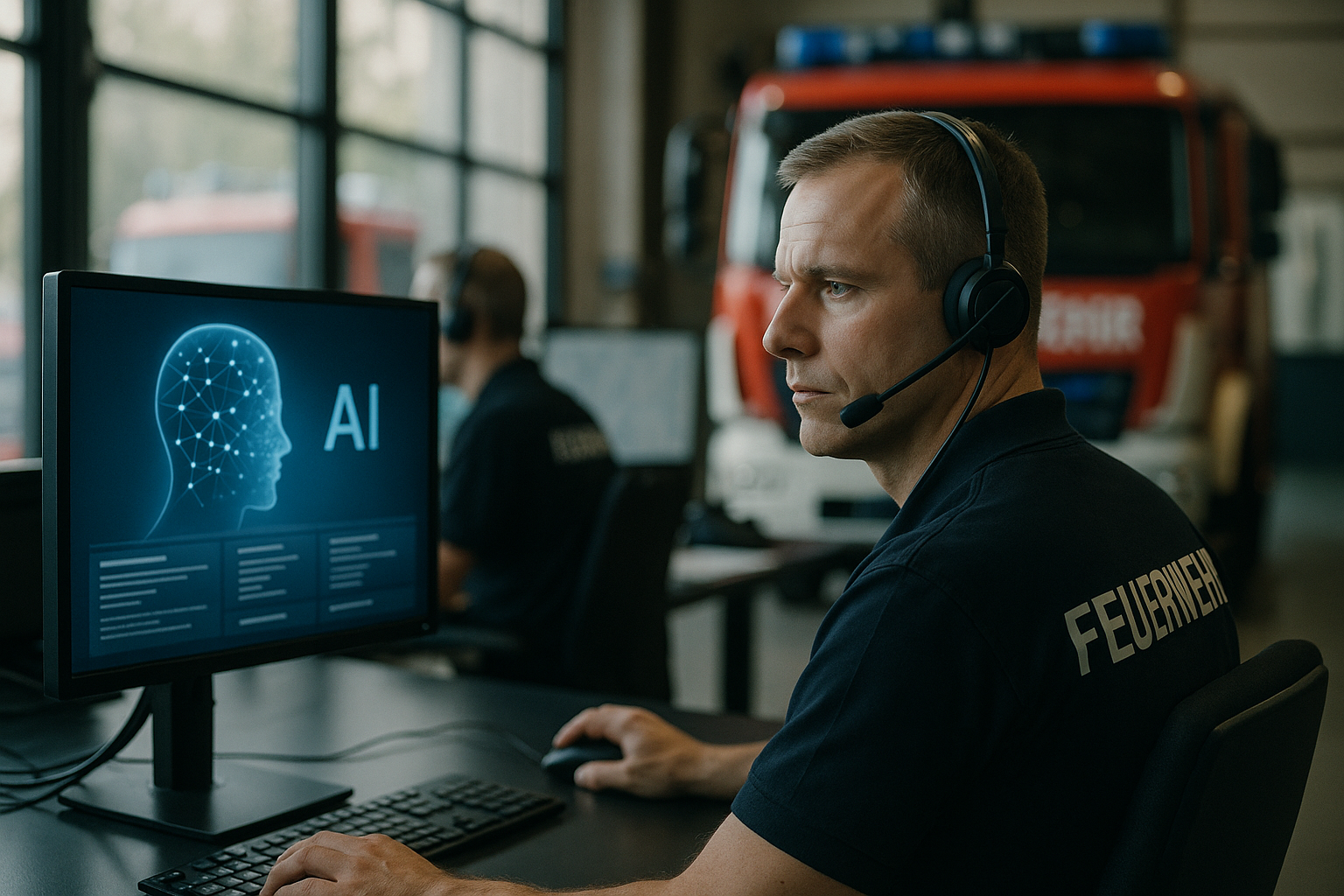
Inside Munich’s AI non-emergency dispatch system: Governance-first augmentation for public safety
City call centers are straining under rising volumes, routine inquiries, and multilingual needs. Munich’s fire service is piloting an AI operator that answers non-emergency calls in natural language, routes requests, and gathers structured information—an approach designed to modernize communications while keeping humans at the helm. The AI non-emergency dispatch system matters because it offloads low-risk tasks, so trained staff can stay focused on cardiac arrests, CPR coaching, mental health crises, and other high-stakes situations that demand judgment and empathy [1][2].
Case study: Munich Fire Department’s AI operator – what it does
Developed in partnership with Microsoft, Munich’s AI operator speaks naturally across multiple languages and manages routine questions and low-risk service requests. It captures details in a structured format, routes callers to the right services, and escalates to human operators when needed. Crucially, life-critical guidance remains with dispatchers, ensuring that sensitive interactions—from distressed callers to pediatric scenarios—are handled by people, not automation [1][2].
Technology stack: Microsoft Foundry, Azure Speech and Azure AI Search
The deployment hinges on three layers:
- Microsoft Foundry: Defines the AI’s role, governs behavior, and integrates with back-end systems so the virtual operator stays within tightly scoped, non-emergency boundaries [1].
- Azure Speech (HD Voice): Provides a natural-sounding, adaptive voice experience that supports clear, context-sensitive interactions for callers [1].
- Azure AI Search: Interfaces with municipal address databases to automatically verify locations, entrances, and access details before information reaches dispatchers, improving accuracy and speed [1].
This stack reflects Microsoft’s broader public safety strategy: use AI and cloud services to integrate data, enhance situational awareness, and streamline workflows—augmenting rather than replacing frontline personnel [2].
How the AI non-emergency dispatch system is scoped in Munich
Scope is the safety rail. Munich’s AI operator is expressly limited to non-emergency interactions and governed so it cannot drift into clinical advice or life-critical decision-making. Human dispatchers remain responsible for CPR instructions, pediatric guidance, and support for mentally ill or distressed callers. That separation protects public trust while letting AI handle repetitive intake and routing tasks that slow response operations [1][2].
Operational benefits: speed, accuracy, and dispatcher augmentation
Early outcomes in comparable deployments suggest clear advantages: lower call burden for human operators, faster handoffs, and better-structured information at the point of dispatch. As agencies modernize toward next-generation communications, AI-driven call intake and smart routing are helping reduce administrative drag and shorten time-to-action on routine incidents [3][4]. In Munich’s model, the system acts as dispatcher augmentation with AI—accelerating non-emergency workflows while preserving human control where it matters most [1][2][4].
Governance, human oversight, and scope limits
Governance is the backbone of safe adoption. With Microsoft Foundry, system designers can define allowed behaviors, confine the assistant to non-emergency protocols, and control integrations. Human-in-the-loop oversight ensures escalations when complexity rises, and that operators review AI-collected data before critical decisions. This approach mirrors best-practice guidance for governance for AI in emergency communications: constrain models to well-defined roles, maintain transparency, and keep trained professionals in charge of outcomes [1][2][5][6].
Risks, limitations, and areas requiring further research
Academic research underscores both promise and caution. Tools that prioritize calls, extract key details, and automate documentation can improve speed and accuracy; however, reliability, explainability, multilingual performance, and user-centric design require continuous attention. Agencies should plan for robust testing, ongoing monitoring, and iterative improvements to mitigate errors and maintain trust—especially in high-variability edge cases [5][6]. Pilots focused on non-emergency lines, like Munich’s, reflect a risk-conscious path that aligns with these recommendations while advancing next-generation public safety communications [1][3][5][6].
Implementation checklist for cities and agencies
- Define scope tightly: Start with non-emergency lines (e.g., routine requests) and pre-authorized tasks.
- Establish governance: Use role constraints, auditability, and escalation rules to keep humans in control [1][2].
- Prioritize integrations: Implement Azure AI Search address validation for accurate location data; link to municipal records for entrances and access details [1].
- Design for voice UX: Select natural, adaptive speech (e.g., Azure Speech HD Voice) and test with local dialects and languages [1].
- Train staff and workflows: Prepare dispatchers for AI-assisted handoffs and data review.
- Monitor KPIs: Track call duration, routing accuracy, escalation rates, and caller satisfaction, and iterate.
For technical teams formalizing patterns and controls, see Microsoft’s official documentation (external) on Azure services and governance frameworks in the cloud: Azure documentation. For additional playbooks and practitioner guides, you can Explore AI tools and playbooks.
Conclusion: Augmentation over replacement and next steps
Munich’s initiative exemplifies a pragmatic route to modernization: a governed, multilingual virtual operator for non-emergency lines that validates addresses, structures information, and routes calls effectively—while leaving life-critical decisions to trained professionals. As more jurisdictions evaluate similar models, the lesson is clear: start narrow, instrument for safety, and scale what works. An AI non-emergency dispatch system that is scoped, governed, and human-supervised can meaningfully reduce workload and improve responsiveness without compromising public trust [1][2][4][5][6].
Sources
[1] How the Munich Fire Department’s AI operator is modernizing non …
https://news.microsoft.com/source/emea/features/ai-dispatch-system-munich/
[2] Public Safety and Justice | Microsoft AI
https://www.microsoft.com/en/ai/government/public-safety-and-justice
[3] EMERGENCY CALL: THE NEXT GENERATION MOBILE … – Eurofunk
https://www.eurofunk.com/wp-content/uploads/eurofunk_NEWS_issue_05_EN-1.pdf
[4] AI-based dispatch: A game changer in public safety agencies
https://www.police1.com/artificial-intelligence/ai-based-dispatch-a-game-changer-in-public-safety-agencies
[5] AI-powered smart emergency services support for 9-1-1 call …
https://pmc.ncbi.nlm.nih.gov/articles/PMC12277377/
[6] Enhancing Emergency Response through Artificial Intelligence in …
https://pmc.ncbi.nlm.nih.gov/articles/PMC10475749/
