
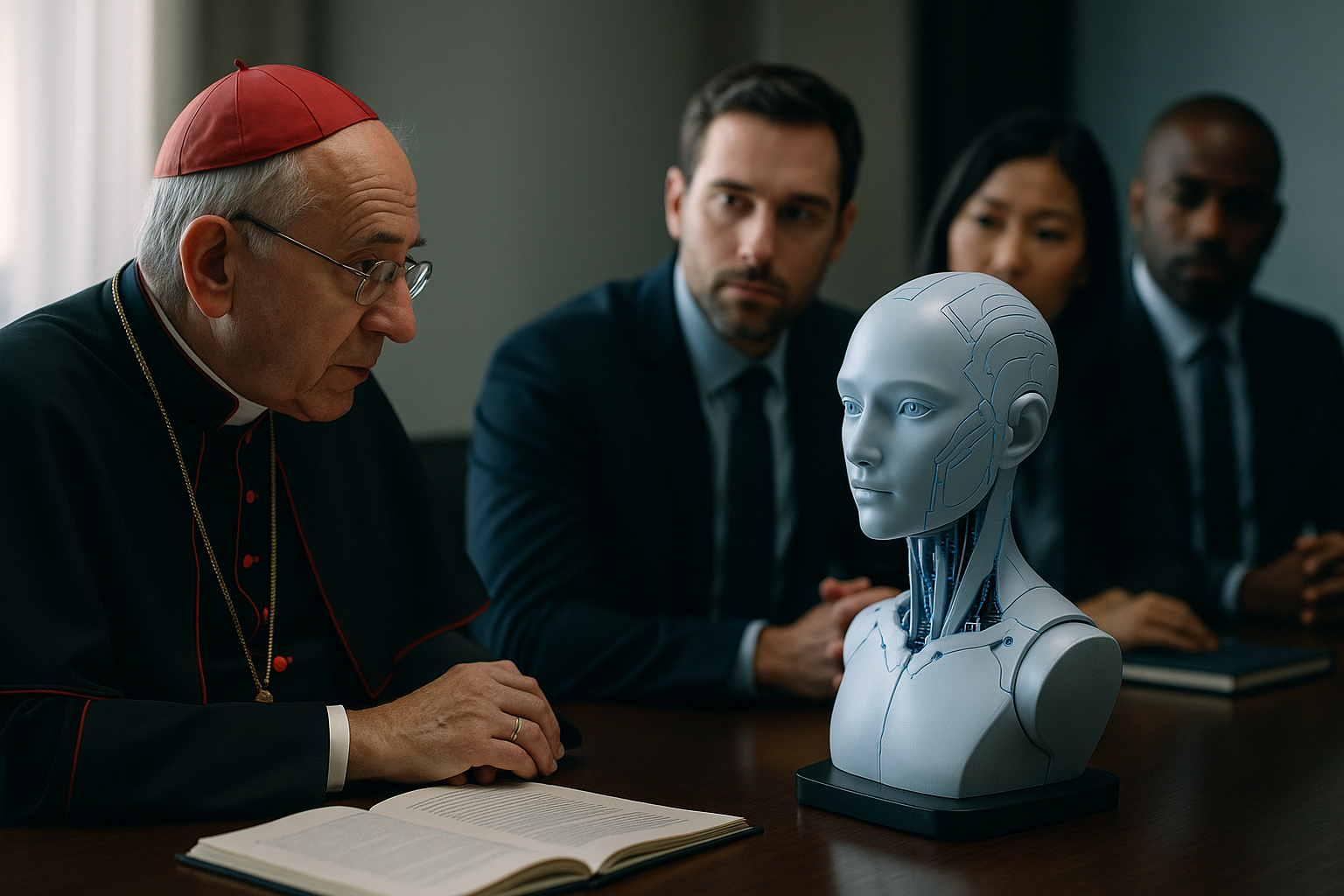
Vatican AI Ethics: What Business and Policy Leaders Should Know
Artificial intelligence is now a boardroom and policy priority, and the Vatican’s voice carries weight in those arenas. Recent coverage highlights how the Church frames AI’s societal stakes, situating ethics alongside innovation — a perspective that resonates with leaders navigating risk, trust, and compliance in emerging tech [1][2]. For organizations evaluating AI investments, Vatican AI ethics offers a values-based lens anchored in global governance and human dignity [1][2].
From Leo XIII to Leo XIV: A throughline on technology and society
The current papacy presents AI as the next social–ethical frontier, extending the Church’s tradition of engaging industrial and digital transformations. Under Pope Leo XIV, official communications and addresses connect technological change with the human good and the responsibilities of institutions [5]. The Vatican’s continuity on digital culture is evident in pastoral texts such as “Towards Full Presence,” which examine how digital media reshape relationships, community, and mission — now informing debates about AI’s social impact [4].
Profile: Paolo Benanti — engineer, theologian, adviser
Franciscan priest Paolo Benanti, trained first as an engineer and now a moral theologian, has emerged as a central advisor to the Holy See on AI. He teaches ethics of technology and a course on “Theology and AI” at the Pontifical Gregorian University, and also advises the Italian government — bridging technical literacy with ethical analysis across church and state. Benanti helped launch the Rome Call for AI Ethics, a multi-stakeholder initiative that seeks alliances across religious, academic, corporate, and governmental actors to steer AI toward the common good [3].
The Rome Call for AI Ethics: Coalition-building for the common good
The Rome Call aims to convene diverse stakeholders around shared commitments for responsible AI. Its coalition strategy reflects the Vatican’s preference for norms, dialogue, and accountability mechanisms that guide how societies integrate AI, rather than prescribing technical specifications or legislation from the church itself [3].
Vatican AI ethics in practice: core principles
Official messages to AI gatherings set a high bar for evaluation: the inviolable dignity of every person; integral human development — material, intellectual, and spiritual; and respect for cultural and religious diversity. These principles function as a north star for AI governance, pushing organizations and policymakers to vet systems for societal benefit, not just performance or efficiency [5].
Practical concerns: authorship, accountability, and risks to minors
Benanti argues that content mediated by AI should be traceable to identifiable human authors. The goal is to preserve responsibility and reputation in public discourse — a safeguard against anonymity that can erode trust and accountability online. For content teams, platforms, and communicators, this view supports transparent provenance practices and human-in-the-loop oversight [3].
The Vatican also centers vulnerable populations, especially children and adolescents. Beyond abstract codes, it calls for daily educational and protective measures that address online risks and the influence of AI systems on behavior. This agenda translates to practical steps: child-centric safety features, age-appropriate design, and curricula that build digital literacy and resilience [6].
What this means for businesses and marketers
- Align product and policy reviews with dignity-forward benchmarks and cultural sensitivity. This helps anticipate regulatory trends and enhances brand trust in diverse markets [5].
- Operationalize traceable authorship: adopt provenance labels, document human oversight in content lifecycles, and maintain auditable workflows for AI-assisted outputs — aligning with emerging expectations around accountability [3].
- Prioritize protections for minors: integrate safety-by-design, strengthen parental controls, and invest in ongoing education programs for youth and caregivers [6].
- Engage in cross-sector governance: consider participating in initiatives like the Rome Call for AI Ethics to shape standards collaboratively alongside peers and civil society [3].
For additional playbooks on implementing responsible AI practices, Explore AI tools and playbooks.
Limits of the approach — and where details live
The Church does not focus on technical design specifics or draft legal codes. Instead, it champions governance, accountability, and inclusive dialogue, encouraging states, firms, and civil society to translate principles into concrete rules and systems. Businesses should expect to operationalize these norms through existing policy frameworks and sector standards while tracking broader regulatory developments [3][5]. As a reference point for international standard-setting beyond the Church, see the UNESCO Recommendation on the Ethics of AI (external).
Conclusion: Dialogue as a strategic asset
The Vatican’s evolving stance — informed by advisors like Paolo Benanti and articulated through initiatives such as the Rome Call — offers a pragmatic pathway: elevate human dignity, ensure accountable authorship, and protect minors, while participating in broad governance coalitions [3][5][6]. For leaders navigating AI strategy, adopting these norms can de-risk deployments, strengthen stakeholder trust, and align innovation with the common good — the enduring objective of Vatican AI ethics [3][5].
Sources
[1] Issues Archive | Signal Magazine – Microsoft Source
https://news.microsoft.com/signalmagazine/issue/
[2] Issue 03 | Signal Magazine – Microsoft Source
https://news.microsoft.com/signalmagazine/issue/issue-03/
[3] How the Vatican Is Shaping the Ethics of Artificial Intelligence
https://ctse.aei.org/how-the-vatican-is-shaping-the-ethics-of-artificial-intelligence/
[4] Towards Full Presence – A Pastoral Reflection on Engagement with …
https://www.vatican.va/roman_curia/dpc/documents/20230528_dpc-verso-piena-presenza_en.html
[5] Message of the Holy Father to participants in the Second Annual …
http://www.vatican.va/content/leo-xiv/en/messages/pont-messages/2025/documents/20250617-messaggio-ia.html
[6] Clementine Hall Thursday, 13 November 2025 – The Holy See
http://www.vatican.va/content/leo-xiv/en/speeches/2025/november/documents/20251113-fondazione-infanzia-adolescenza.html
