
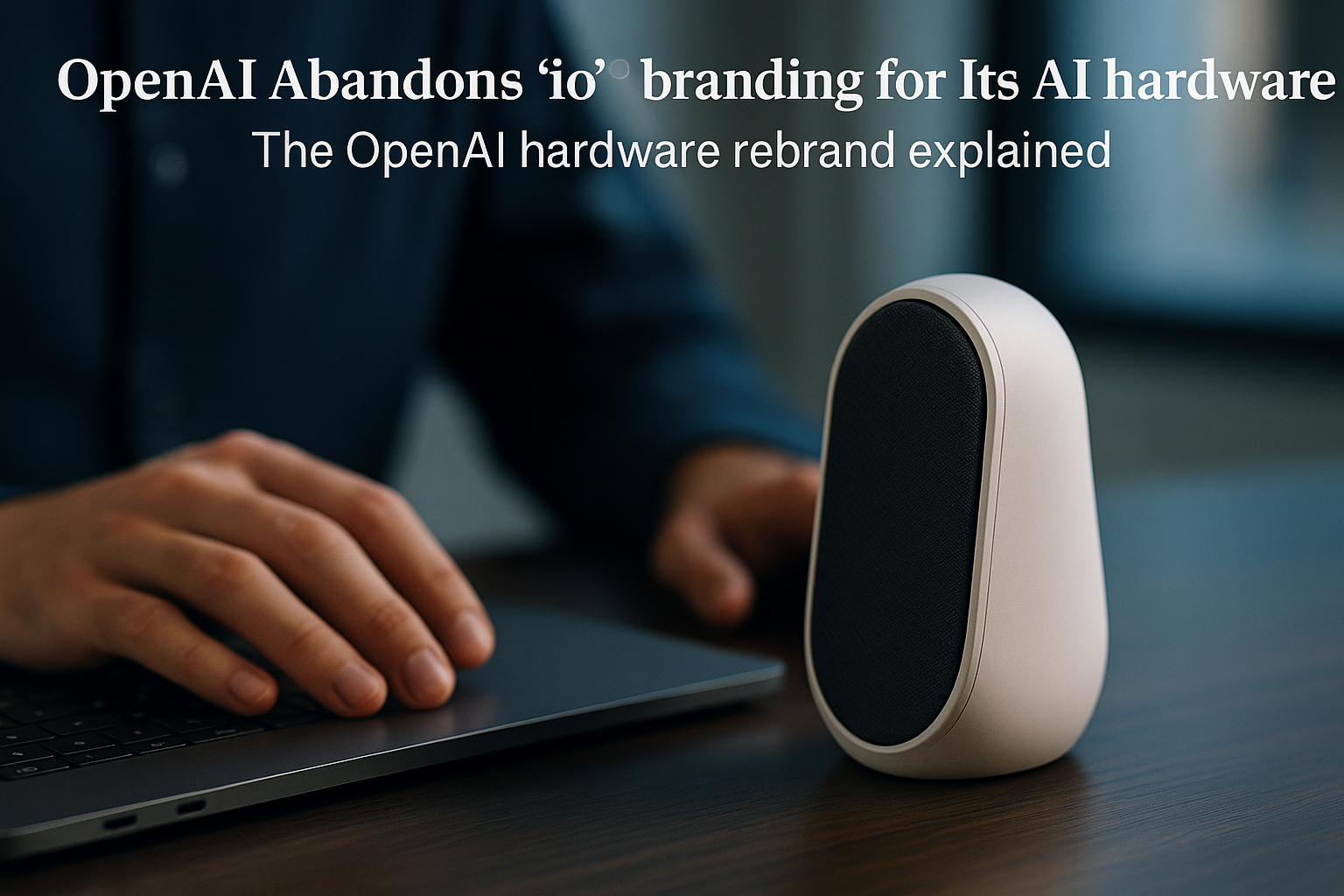
OpenAI Abandons ‘io’ Branding for Its AI Hardware: The OpenAI hardware rebrand explained
OpenAI will change course on branding for its first consumer hardware after a US federal court barred the company from using the “io” name, which it inherited through an acquisition. The OpenAI hardware rebrand matters because litigation could stretch on, making the contested mark an expensive distraction during product definition, developer outreach, and go‑to‑market planning [1].
What the Court Ruling Says—and Why It Matters
A preliminary ruling bars OpenAI from using “io” for its forthcoming device after a trademark lawsuit by Google Ventures–backed startup iyO, which argued that OpenAI’s “io” branding would create market confusion. While the order is preliminary, the court’s move is significant enough that OpenAI is unlikely to keep investing in the disputed name while litigation continues [1]. For teams planning launches and retail partnerships, a contested identity can complicate channel commitments and packaging long before final judgment.
For legal and brand leaders, it’s a reminder that trademark conflicts can shape product strategy early. For general context on trademark processes, see the USPTO trademark basics (external).
What the OpenAI hardware rebrand changes now
- Expect new naming and identity workstreams to kick off immediately, running in parallel with hardware and software development [1].
- Marketing and partner plans tied to “io” will be unwound or frozen until updated guidance is issued [1].
- The dispute underscores the risk surface around naming in emerging AI categories, especially where short, generic-sounding marks collide in adjacent markets [1].
Who Is iyO—and What Was at Stake
iyO, backed by Google Ventures, filed suit in June, claiming OpenAI’s planned use of “io” would be confusingly similar to its own brand. The court agreed enough to restrict OpenAI’s use during proceedings, which could drag on, making a steady rebrand path the pragmatic choice [1].
Background: OpenAI’s Acquisition of Jony Ive’s io Products
In 2024, OpenAI acquired Jony Ive’s hardware venture, io Products, in a deal widely reported as a strategic bet to pair Ive’s industrial design DNA with OpenAI’s models for a dedicated consumer device. Estimates placed the acquisition around $6.5 billion, underscoring the company’s high-stakes commitment to a new product category [2][3]. The plan: build a purpose-designed device that goes beyond phone apps and laptops to showcase natural, voice-led interaction [2][3].
How the Ruling Affects the Device Roadmap and Launch Timeline
The court’s decision is preliminary, but trademark litigation can be slow. Rather than fight for a risky name, OpenAI is expected to proceed under a new identity while continuing development [1]. Public reporting points to a first device in late 2026 or 2027, so branding decisions made now must scale through industrial design, packaging, developer kits, and retail signage on a tight runway [2][3][4].
For teams evaluating the path forward, an OpenAI hardware rebrand should be treated as a parallel track to maintain schedule integrity: lock a replacement name, validate freedom to operate, and coordinate brand assets for pilots, FCC/CE labeling, and paid media plans [1][2][4].
What We Know About the Device: Audio‑First, Mostly Screenless Companion
Reports describe a compact, mostly screenless, voice‑driven “third device” designed to complement phones and laptops. Expect heavy emphasis on audio interaction, with microphones and cameras to perceive context, and deep integration with users’ existing devices [2][3][4]. The concept aims to reduce screen time while maintaining access to AI assistance, potentially appealing to professionals seeking hands‑free productivity and ambient intelligence [2][3][4]. Media coverage spans news and explainers, including a video overview of the device’s concept and implications [6].
OpenAI has reorganized internal teams to focus on audio-based hardware and new voice models, signaling sustained investment despite the brand setback—another reason to keep the schedule moving while names and trademarks are reworked [4].
Privacy, Regulatory, and Public Backlash Risks
An “always on” AI device can trigger strong consumer reaction and regulatory scrutiny, especially around continuous data collection through microphones and cameras. Commentators warn that an OpenAI-branded, always-listening device could court reputational risk if privacy expectations aren’t met or clearly communicated [5]. That makes transparent data policies, opt‑in defaults, and on‑device processing claims central to launch messaging and compliance planning [5].
Branding and Go‑to‑Market Implications for OpenAI and Partners
A forced renaming compresses timelines for trademark clearance, packaging updates, and channel enablement—work that must proceed while hardware sprints continue. For partners and retailers, clarity on final naming and ship windows will be critical to merchandising and ad buys as the OpenAI hardware rebrand takes effect [1][2][4].
Practical steps for brand and legal teams:
- Run accelerated clearance and filing on 2–3 viable names as hedges [1].
- Align ID, UI, and packaging with neutral placeholders until the mark is locked [1][4].
- Pre‑brief strategic partners under NDA to avoid downstream relabeling costs [1][2].
What Competitors and Investors Should Watch Next
Key signals include a new brand announcement, early hardware prototypes, hiring updates, and any settlement movement. Watch for progress on audio model releases in early 2026 and hardware milestones into 2027, which would validate OpenAI’s long‑term device thesis in spite of branding friction [3][4]. For deeper tactical guidance on AI adoption and deployment, explore AI tools and playbooks.
Sources
[1] OpenAI Can’t Use the ‘io’ Name for Its AI Hardware Device, Court …
https://www.pcmag.com/news/openai-cant-name-new-hardware-device-io-court-rules
[2] OpenAI’s New Device: What We Know So Far | Built In
https://builtin.com/articles/openai-device
[3] OpenAI plans late-2026 launch of first AI hardware device, designed …
https://m.economictimes.com/us/science-tech/openai-plans-late-2026-launch-of-first-ai-hardware-device-designed-with-jony-ive-will-it-survive-where-others-struggled/articleshow/126769816.cms
[4] OpenAI reorganizes some teams to build audio-based AI hardware …
https://arstechnica.com/ai/2026/01/openai-plans-new-voice-model-in-early-2026-audio-based-hardware-in-2027/
[5] An ‘always on’ OpenAI device is a massive backlash waiting to happen
https://www.bloodinthemachine.com/p/an-always-on-openai-device-is-a-massive
[6] OpenAI’s New Device Will Change AI Forever (OpenAI’s IO Device …)
https://www.youtube.com/watch?v=RJnyN6HTSxs
