
How Painkiller RTX Uses AI-driven game asset modernization to Scale Remasters
A small team’s overhaul of the 2004 gothic horror shooter Painkiller shows how AI-driven game asset modernization can turn decades-old content into a ray-traced showcase without ballooning production time. Built with NVIDIA RTX Remix and generative AI texture tools, Painkiller RTX upgrades thousands of legacy assets by automating texture upscaling and PBR material creation, then layering modern lighting and effects on top [1][2][3].
What RTX Remix brings to legacy game pipelines
RTX Remix captures DirectX 8/9 content and converts it into USD, transforming in-game scenes into editable sandboxes for artists and tools outside the running title. This capture-to-USD process enables deep inspection, material swapping, mesh fixes, and lighting adjustments that were previously impractical in legacy engines [1][3]. For teams planning an RTX Remix workflow, an official overview is available via NVIDIA’s site: see the RTX Remix documentation (external).
Generative AI texture tools: how they upscale and infer PBR
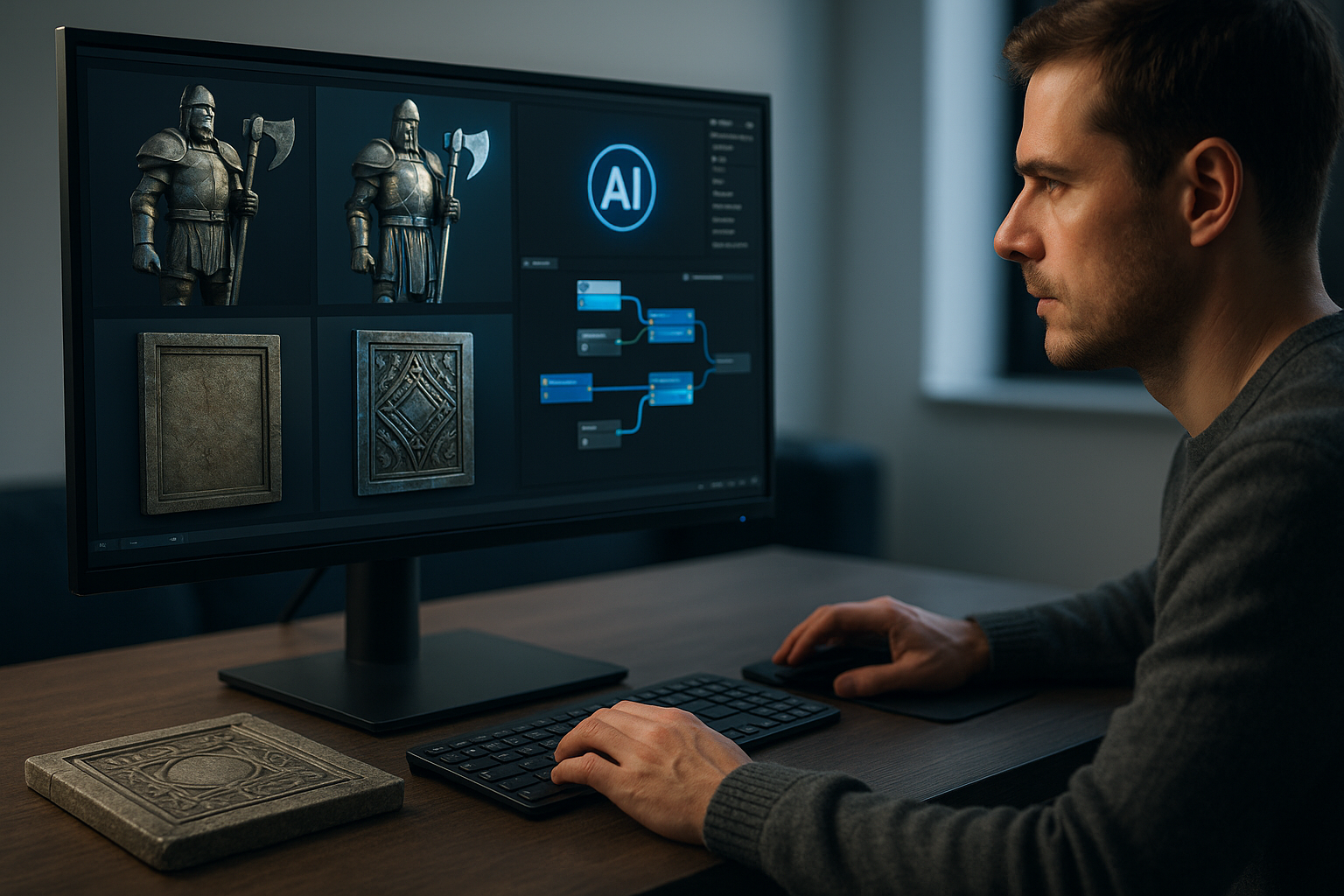
Generative AI models trained on large corpora of game textures scan legacy assets, automatically upscaling low-resolution textures—often up to 4x—and inferring physically based rendering properties. From diffuse-only sources, the tools can generate albedo, normal, and roughness maps, effectively transforming flat materials into modern, lighting-aware surfaces. Neural networks also assist with material classification, helping convert broad sets of textures at scale with minimal manual intervention [1].
This approach jumpstarts PBR conversion for legacy games while keeping the door open for artistic control. Artists can review outputs, replace any weak results, and address edge cases—such as correcting opacity on fences—before finalizing assets for a ray tracing remaster pipeline [1].
AI-driven game asset modernization in practice
Painkiller RTX applies AI-driven conversions broadly: stone, wood, metal, leather, armor, weapons, and gothic architecture are upgraded to higher-quality PBR materials, then rendered with full ray-traced global illumination, shadows, and reflections. Volumetrics and improved meshes further elevate the presentation. The result is a modern look that respects original art direction while responding accurately to physically based lighting. AI accelerates the repetitive work, and artists step in where fidelity, style, or gameplay readability demand a human touch [1][2].
Artist workflow: AI as an assistant, not a replacement
- Reviewing AI-generated albedo, normal, and roughness maps for consistency and style [1].
- Fixing edge cases like material opacity (e.g., fences) and reworking any misclassified surfaces [1].
- Handcrafting key hero assets and set pieces where quality and storytelling stakes are highest [1].
- Validating results under ray tracing and path tracing to catch lighting artifacts or materials that need additional tuning [1].
This division of labor trims repetitive production while preserving creative control—precisely the promise of generative AI texture tools in modern remasters [1].
Performance and engineering: reparenting lights and mesh fixes
Modern lighting can expose shortcuts from the original game. Painkiller RTX addresses this by reparenting roughly 3,000 lights to nearby geometry for better culling—a pragmatic optimization that sustains performance under ray-traced and path-traced lighting. The team also replaced problematic high-cost meshes to reduce overhead while maintaining the visual bar [1]. Together, these steps stabilize frame times as new effects, volumetrics, and refined meshes come online [1].
Business case: costs, timelines, and team sizing for AI-assisted remasters
The project highlights how a small team can scale texture upscaling for game remasters and PBR conversion when RTX Remix and AI are combined. By converting legacy assets to USD and running batch AI passes first, teams front-load the heavy lifting to automation and reserve human effort for polish. In practice, that means a higher-fidelity end product—ray-traced GI, accurate reflections, modern materials—without a proportional increase in manual production hours [1][2].
Tooling recommendations and next steps for studios
- Capture with RTX Remix to turn DirectX 8/9 content into USD scenes for asset-level control [1][3].
- Run batch AI passes to upscale textures up to 4x and infer PBR maps (albedo, normal, roughness) across broad material sets [1].
- Prioritize an artist pass for edge cases, hero assets, and stylistic alignment; fix opacity issues and reclassify as needed [1].
- Execute a performance pass: reparent lights for culling and replace high-cost meshes before final tuning [1].
- Validate under ray-traced and path-traced lighting as the final integration step [1].
For related playbooks and tooling roundups, you can Explore AI tools and playbooks.
Conclusion and resources
Painkiller RTX demonstrates that a practical RTX Remix workflow can modernize legacy games at scale, pairing generative AI texture tools with a targeted artist pass and performance-minded engineering. The approach turns flat, diffuse-only surfaces into PBR materials and brings them to life under contemporary ray tracing—without starting from scratch [1][2][3].
Sources
[1] How Painkiller RTX Uses Generative AI to Modernize Game Assets …
https://forums.developer.nvidia.com/t/how-painkiller-rtx-uses-generative-ai-to-modernize-game-assets-at-scale/359779
[2] Painkiller RTX mod – ModDB
https://www.moddb.com/mods/painkiller-rtx-remix
[3] Easily Remaster Classic Games with NVIDIA RTX Remix
https://www.youtube.com/watch?v=Vg52-HZhrFc
