
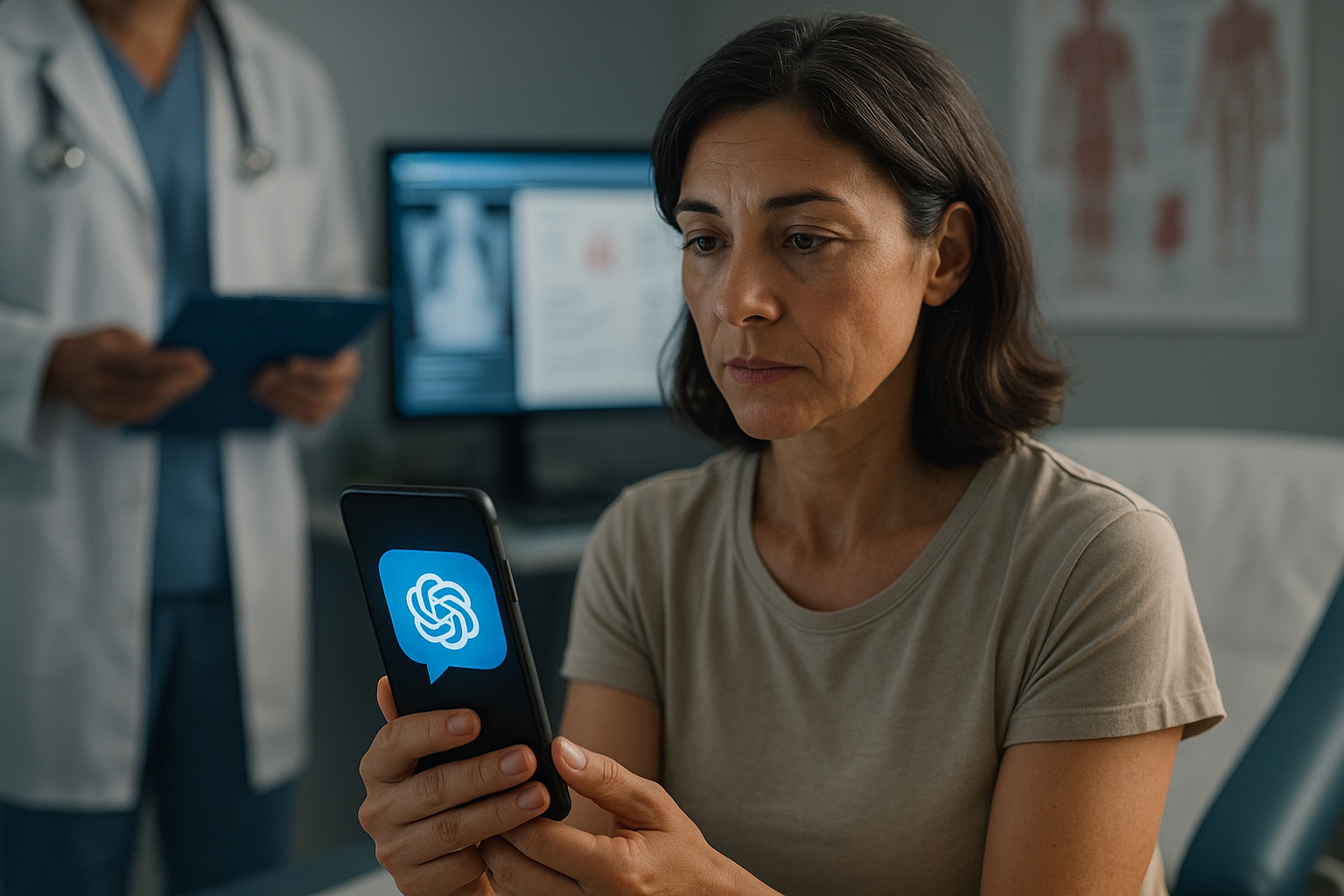
How ChatGPT Health for patients Helps People Navigate Care
Patients are adopting generative AI between visits to translate medical jargon, organize next-step questions, and manage uncertainty—trends now formalized by ChatGPT Health for patients. Early oncology examples show people using chatbots to interpret scan results and frame conversations, while emerging tools aim to centralize health understanding without replacing professional judgment [1][2][3].
What is ChatGPT Health for patients
OpenAI’s product sets up a dedicated health workspace that can connect to patient portals, medical records, and consumer health apps in limited regions. The stated purpose is to help users understand everyday health information, track patterns, and get ready for clinical conversations—not to diagnose, prescribe, or substitute for care [3]. For clinics and health IT teams, this positions the tool as a patient-facing navigation and education layer that lives alongside existing portals and communications workflows, rather than a clinician decision aid [3].
Real-world oncology and personalized medicine use cases
Oncology remains a time-pressured setting where patients leave with unresolved questions and complex documentation. Case examples and research show patients turning to AI to clarify terminology, summarize highlights from reports, and draft concise question lists for specialists—work that can improve preparation and reduce anxiety before appointments [1][2][5]. In parallel, studies in personalized medicine and care planning suggest large language models can produce generally accurate, empathetic explanations and decision-support narratives, even though they should not be treated as authoritative guidance [4][5][6].
- Organizing questions for clinicians based on reports or scan notes [1][2][5]
- Translating complex genetics or oncology terminology into plain language [4][5]
- Building simple timelines of tests and treatments to orient upcoming decisions [1][5]
Still, researchers emphasize variability in quality and readability, as well as the need to confirm any AI-generated explanation against clinical judgment and local standards of care [2][4][5][6].
Benefits for patients and clinic workflows
Studies report that patients sometimes rate the clarity and empathy of AI-generated explanations favorably, which may help with emotional support and understanding of next steps. Structured use—such as asking for key terms, options to discuss, and trade-offs to consider—can yield focused outputs that make clinic time more productive [2][5]. For care teams, receiving a patient’s AI-generated question list or summary ahead of a visit can streamline agenda-setting and documentation, provided clinicians review and correct any inaccuracies [5][6].
Limitations, safety risks, and quality concerns
Despite promising results, critical limitations are well documented:
- Variable quality and readability; evaluation frameworks like DISCERN, JAMA benchmarks, and PEMAT are difficult to apply systematically to LLM output [2][5].
- Incomplete domain knowledge and lack of real-time clinical context, leading to plausible but incorrect or incomplete answers [4][5][6].
- Risk of confident errors; all recommendations must be verified by clinicians and aligned with local standards of care [4][5][6].
- Broader ethical and mental health considerations argue for cautious deployment and clear oversight [4][5].
Given these risks, guidance across reviews is consistent: treat AI as an adjunct for education and question-framing, and keep final interpretation and decisions with licensed professionals [4][5][6].
Implementation considerations for health systems and vendors
For health IT leaders evaluating generative AI in patient portals, integration details matter. ChatGPT Health’s data connections are region-limited, and its remit is explicitly educational and preparatory rather than diagnostic. Clear labeling, patient safeguards, and verification workflows are essential [3][5][6]. Clinics should anticipate patients arriving with AI-generated summaries, letters, or question lists and plan for clinician review, documentation, and communication norms that reinforce what is—and isn’t—medical advice [5][6]. Product and operations teams can pilot with defined cohorts (e.g., oncology navigation) and measure impact on preparation quality, message volume, and visit efficiency, with regular audits for accuracy and readability [5][6].
For broader context on the evolution of conversational AI in healthcare, see OpenAI’s announcement (external).
FAQs
- How can patients use AI to prepare for oncology appointments? Ask for a plain-language summary of key terms in your report, a short list of questions to clarify risks, benefits, and next steps, and a simple timeline of tests and treatments to date—then bring it to your clinician for confirmation [1][2][5].
- What are the main limitations of AI for medical advice and triage? LLMs can omit critical context, make confident errors, and vary in readability; they are not a substitute for clinician judgment or local standards of care [4][5][6].
- How should clinics respond to AI-generated patient questions? Set expectations that summaries are starting points, review and correct inaccuracies, and reinforce that clinical decisions come from licensed professionals [5][6].
If you’re building patient-facing workflows, you can adapt these insights into prompt patterns and review loops, then pilot within a narrow use case before scaling. To operationalize this in your roadmap, Explore AI tools and playbooks.
Sources
[1] ChatGPT aids cancer patient Burt with medical navigation – LinkedIn
https://www.linkedin.com/posts/openai_understanding-your-scan-results-with-chatgpt-activity-7414712765376004097-DZ_x
[2] Artificial Intelligence Chatbot as a Companion for Cancer Patients about Most Common Questions
https://actaoncologicaturcica.com/articles/artificial-intelligence-chatbot-as-a-companion-for-cancer-patients-about-most-common-questions-analysis-of-readability-and-quality/ahot.galenos.2024.2024-8-2
[3] OpenAI launches ChatGPT Health, directly linking patient portals to the AI chatbot
https://www.medicaleconomics.com/view/openai-launches-chatgpt-health-directly-linking-patient-portals-to-the-ai-chatbot
[4] Revolutionizing personalized medicine with generative AI
https://link.springer.com/article/10.1007/s10462-024-10768-5
[5] Generative AI for patient education in cancer care: A scoping review
https://pmc.ncbi.nlm.nih.gov/articles/PMC12804003/
[6] Generative AI in Improving Personalized Patient Care Plans
https://www.mdpi.com/2076-3417/14/23/10899
