
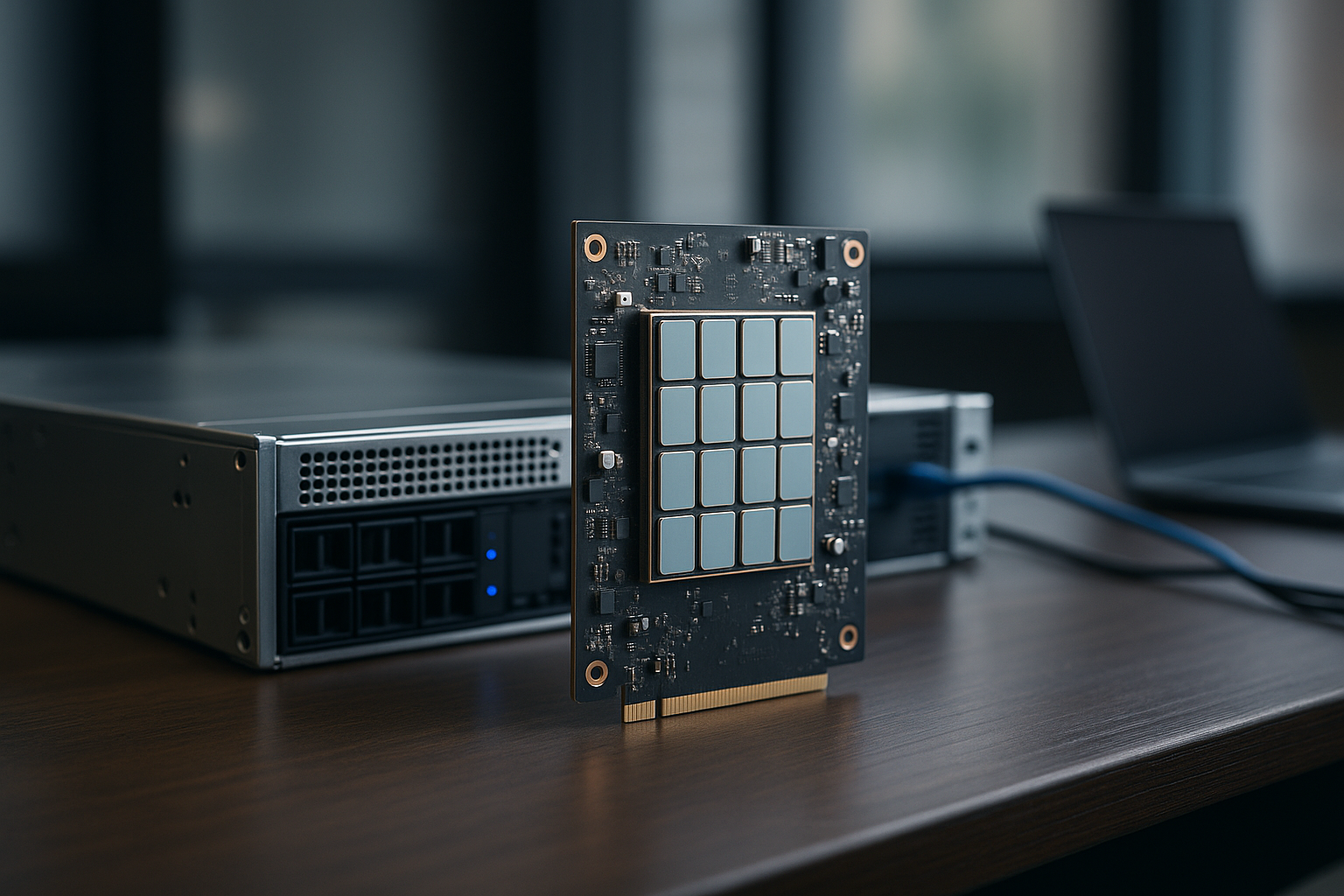
Establishing a Scalable Sparse Ecosystem with the Universal Sparse Tensor Abstraction
A wave of model deployments is moving from dense to sparse computation to lower cost, boost throughput, and cut power. The near-term path runs through structured sparsity on modern GPUs and a universal sparse tensor abstraction that keeps models portable as hardware evolves [1][2][4].
What is Structured Sparsity (2:4) and How GPUs Exploit It
Ampere introduced 2:4 structured sparsity and Sparse Tensor Cores that skip zero weights and operate on stored nonzeros plus lightweight metadata. This enables roughly 2× effective math throughput for GEMM and convolution across several precisions and typically yields >30% performance-per-watt gains on pruned models [1][3]. The hardware acceleration targets the known 2:4 pattern, exposing predictable dataflow for optimized execution [1][3].
Toolchain: TensorRT and cuSPARSELt — How Structured Sparse GEMM Is Exposed
In deployment, TensorRT integrates structured sparse GEMM through plugins that orchestrate cuSPARSELt’s sparse descriptors and algorithm plans. This path compiles pruned-and-quantized networks into Sparse Tensor Core kernels, managing format details while keeping application integration straightforward. Teams can invoke the plugin flow to target 2:4 sparsity and achieve Ampere’s throughput and efficiency benefits in production [1]. For reference implementations and APIs, consult the NVIDIA CUDA Toolkit documentation (external) alongside the TensorRT and cuSPARSELt guides [1].
Building a Practical Compression Pipeline: Pruning, INT8 Quant, and Distillation
A pragmatic recipe to realize structured sparsity in shipping models combines:
- Pruning weights into the 2:4 pattern.
- INT8 quantization via post-training quantization (PTQ) or quantization-aware training (QAT).
- Knowledge distillation to preserve accuracy.
This pipeline produces sparse-int8 models that map cleanly to TensorRT plugins and cuSPARSELt plans for deployment. The typical result is competitive accuracy with materially higher throughput and performance-per-watt versus dense baselines on Ampere hardware [1].
Why Storage Format and Layout Matter: Kernel Generators vs Generic Libraries
Sparse tensor performance depends strongly on storage format, nonzero ordering, and how the layout drives data reuse and locality. Research on structured sparse tensor kernels shows that specialized kernel generators for known block patterns can unlock instruction-level parallelism and outperform generic libraries by large margins when the pattern is exploitable [2]. For practitioners, this means two things: choose formats that maximize reuse on your target hardware, and consider structured sparse kernel generators when generic routines underutilize the processor [2].
Looking Ahead: Hopper and Blackwell — New Hardware Primitives for Sparse Models
The roadmap extends beyond Ampere. Hopper expands support for higher-throughput sparse low-precision modes aimed at large-scale AI and HPC workloads [4]. Blackwell adds 5th-generation Tensor Cores, hardware decompression, and a Tensor Memory subsystem optimized for compressed, tile-based tensor access—features designed to elevate compressed and sparse weights to first-class status and improve overlap between data movement and compute [4][5][6]. Collectively, these advances indicate that compressed and structured sparse models will gain even more efficiency as hardware evolves [4][5][6].
Designing a Universal Sparse Tensor Abstraction
A universal sparse tensor abstraction should encode both the tensor values and the layout constraints that define structured patterns such as 2:4, while providing compiler paths to lower into hardware-specific formats. This approach aligns with Ampere’s structured sparsity model today and positions teams to map to next-generation decompression and Tensor Core formats as Hopper and Blackwell mature [1][2][4]. Such an abstraction improves portability across GPU generations and software stacks, allowing the same high-level model to target evolving Sparse Tensor Core capabilities and on-chip decompression [1][4].
To operationalize the universal sparse tensor abstraction:
- Keep layout constraints explicit so compilers can choose hardware-native formats.
- Integrate with TensorRT and cuSPARSELt to materialize 2:4 kernels on Ampere-class devices.
- Anticipate decompression-aware lowering for Blackwell’s Tensor Memory and hardware-assisted paths [1][4].
Practical Recommendations and ROI Checklist for Teams
- Start with 2:4 pruning on candidate layers and measure accuracy deltas before full-model pruning [1][3].
- Apply INT8 PTQ or QAT, then distill to close accuracy gaps; validate with end-to-end workloads, not just microbenchmarks [1].
- Compile with TensorRT plugins using cuSPARSELt descriptors and plans; profile GEMMs to confirm Sparse Tensor Core utilization [1].
- Evaluate storage format choices and consider structured sparse kernel generators if generic kernels stall on utilization [2].
- For forward compatibility, design around a universal sparse tensor abstraction to simplify migration to Hopper and Blackwell features like hardware decompression and Tensor Memory [4][5][6].
For more implementation playbooks and comparative guidance, explore AI tools and playbooks.
Universal Sparse Tensor Abstraction: What It Enables
By cleanly separating values from layout constraints and providing robust lowering to device-native sparse formats, the universal sparse tensor abstraction helps teams standardize compression workflows, target Ampere’s 2:4 acceleration, and prepare for Hopper and Blackwell’s compressed-weight primitives. The result is a scalable, portable sparse inference pipeline that aligns performance, power, and cost objectives across GPU generations [1][2][4].
Sources
[1] Accelerating Inference with Sparsity Using the NVIDIA Ampere …
https://developer.nvidia.com/blog/accelerating-inference-with-sparsity-using-ampere-and-tensorrt/
[2] Accelerating Multilinear Maps and Structured Sparse Tensor Kernels
https://escholarship.org/content/qt5kg904mq/qt5kg904mq.pdf
[3] Structured Sparsity: NVIDIA Ampere – Search Engines
https://developer.nvidia.com/blog/structured-sparsity-in-the-nvidia-ampere-architecture-and-applications-in-search-engines/
[4] Blackwell vs Hopper: A Deep Dive GPU Architecture Comparison
https://intuitionlabs.ai/articles/blackwell-vs-hopper-gpu-architecture-comparison
[5] Microbenchmarking NVIDIA’s Blackwell Architecture: An in-depth …
https://arxiv.org/html/2512.02189v1
[6] Blackwell vs. Hopper: Performance Showdown – NeevCloud
https://blog.neevcloud.com/blackwell-vs-hopper-in-depth-comparison-of-architecture-performance
