
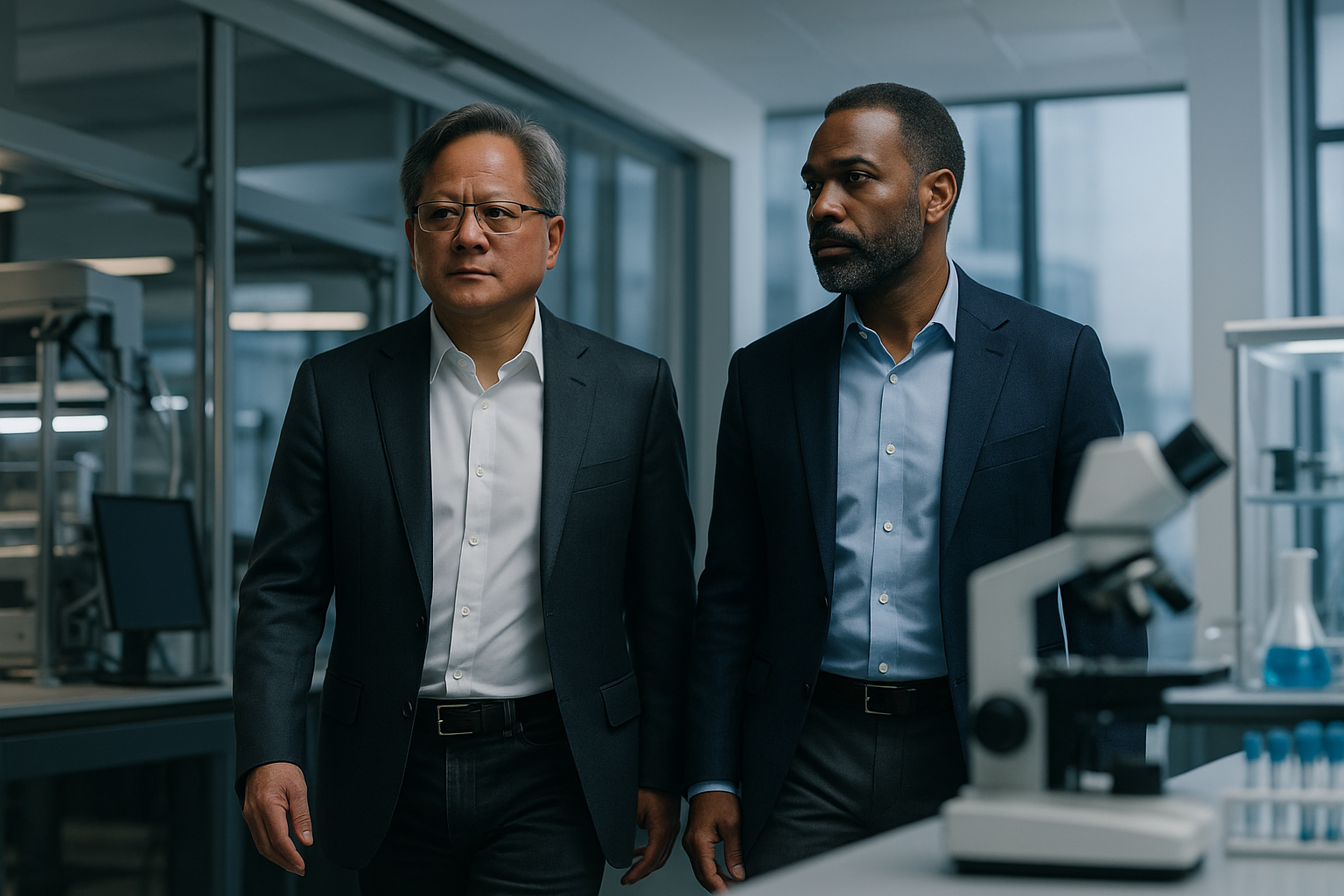
CEOs of NVIDIA and Lilly Share ‘Blueprint for What Is Possible’ in AI and Drug Discovery: NVIDIA Lilly AI lab for drug discovery
NVIDIA and Eli Lilly unveiled a co‑innovation AI lab in the San Francisco Bay Area, framed by their CEOs as a “blueprint for what is possible” in AI‑enabled drug discovery. The NVIDIA Lilly AI lab for drug discovery will bring together Lilly’s biology and development expertise with NVIDIA’s accelerated computing platforms, backed by up to $1 billion invested over five years in talent, infrastructure, and compute resources [1][2][4][5].
Quick summary: What NVIDIA and Lilly announced
The companies will co‑locate Lilly scientists and NVIDIA AI researchers to generate large‑scale biomedical data and develop models on NVIDIA’s BioNeMo platform. The lab will run on next‑generation architectures such as NVIDIA Vera Rubin alongside Lilly’s previously announced AI supercomputer [1][2][3][4]. The aim is to re‑engineer discovery into an engineering‑like, iterative process where billions of molecules are explored in silico, filtered, and optimized before physical experiments, tightly coupling automated “wet labs” with computational “dry labs” [1][3][4].
What the NVIDIA Lilly AI lab for drug discovery means
For pharma leaders, the headline is speed and scale. By treating discovery as a continuous loop—models propose candidates, automated labs test them, results feed back to models—the lab targets faster iteration, better filtering, and more systematic optimization. This approach promises to reduce costly dead ends and shift more work to software and simulation before committing to bench time and materials [1][3][4].
The collaboration also signals a strategic move toward enterprise‑grade AI stacks in biopharma, pairing domain expertise with purpose‑built compute. That pairing is designed to accelerate molecule identification, optimization, and validation—and support adjacent workloads from manufacturing to medical imaging [1][2][3].
The technical stack: BioNeMo, Lilly’s supercomputer and Vera Rubin
NVIDIA’s BioNeMo is the backbone for building and deploying biological foundation models at scale. By running on next‑generation architectures, including Vera Rubin, and tapping Lilly’s AI supercomputer, the partners aim to train and serve large models for tasks across sequence, structure, and property prediction, with enterprise‑class throughput and reliability [1][2][3][4].
Lilly’s AI “factory” will focus on training biomedical foundation and frontier models to accelerate key R&D steps. The stack is intended to support discovery workloads initially and then extend to operations across clinical development, manufacturing, and beyond [1][2][3].
From bits to biology: coupling dry labs and automated wet labs
The lab’s “continuous learning” design integrates computational dry labs with automated wet labs. In practice, teams will use models to generate hypotheses, route them to automated experiments, and feed results back to retrain and refine models—tightening the loop over time. Co‑locating biologists and AI engineers is meant to increase throughput, reproducibility, and cross‑disciplinary problem‑solving while cutting cycle times and costs [1][3][4].
This is where the NVIDIA Lilly AI lab for drug discovery could change operating rhythms: standardizing iterative experiments and data capture so that both the biology and the models improve with each cycle [1][3][4].
Tooling and models: Clara RNA, BioNeMo Recipes, nvMolKit
NVIDIA is expanding the BioNeMo ecosystem with Clara open models for RNA prediction, tools to assess synthesis feasibility, BioNeMo Recipes for scalable training and deployment of biological foundation models, and GPU‑accelerated cheminformatics libraries like nvMolKit. These additions target practical needs across ML engineering and computational chemistry, from data processing to model training and inference [1][4].
Together, these tools are intended to support Lilly’s AI factory and the lab’s goal of using foundation models to accelerate discovery while maintaining an enterprise‑ready pipeline into development and manufacturing workflows [1][2][4].
Business and operational use cases beyond discovery
Beyond molecule design, the collaboration will explore multimodal models, agentic AI, robotics, and digital twins across clinical development, manufacturing, and commercial operations. The ambition is end‑to‑end impact: optimizing trial design and execution, improving production quality and yield, and enabling more responsive commercial processes [1][2][3][4].
As the lab matures, leaders evaluating similar stacks can track how capabilities extend from discovery into regulated operations.
Ecosystem context: Lilly’s other AI partnerships
Lilly complements the co‑innovation lab with partnerships across the AI R&D ecosystem, including Insilico Medicine, Schrödinger, and Chai Discovery. The lab strengthens its position by combining internal compute and data pipelines with external innovation channels [1][2][3][4].
Risks, timelines, and forward‑looking caveats
While the investment and technical roadmap are ambitious, all parties emphasize that statements about performance, timelines, and impact are forward‑looking and not guarantees of future results. Outcomes will depend on scientific, technical, regulatory, and operational factors over time [1][2][4].
What operators and executives should watch next
- Integration milestones: evidence that wet and dry lab loops are shortening discovery cycles and improving hit quality [1][3][4].
- Model portfolio: progress on BioNeMo‑based foundation models and their transfer into development and manufacturing [1][2][4].
- Compute scaling: how the Lilly AI supercomputer and Vera Rubin enable throughput, latency, and cost improvements for production workloads [1][2][3][4].
- Ecosystem effects: how external partnerships and tooling (e.g., BioNeMo Recipes, nvMolKit) diffuse into broader pipelines [1][4].
For a deeper dive into practical adoption patterns, you can Explore AI tools and playbooks. For the official details, see NVIDIA’s investor release, which provides the most complete overview of the lab’s scope and roadmap [4], and the NVIDIA blog announcement as an additional reference via NVIDIA’s blog (external).
Sources
[1] NVIDIA and Lilly Announce Co-Innovation AI Lab to Reinvent Drug Discovery in the Age of AI
http://nvidianews.nvidia.com/news/nvidia-and-lilly-announce-co-innovation-lab-to-reinvent-drug-discovery-in-the-age-of-ai
[2] NVIDIA and Lilly Announce Co-Innovation AI Lab to Reinvent Drug Discovery in the Age of AI
https://investor.lilly.com/news-releases/news-release-details/nvidia-and-lilly-announce-co-innovation-ai-lab-reinvent-drug
[3] CEOs of NVIDIA and Lilly Share ‘Blueprint for What Is Possible’ in AI and Drug Discovery
https://blogs.nvidia.com/blog/jpmorgan-healthcare-nvidia-lilly/
[4] NVIDIA and Lilly Announce Co-Innovation AI Lab to Reinvent Drug Discovery in the Age of AI
https://investor.nvidia.com/news/press-release-details/2026/NVIDIA-and-Lilly-Announce-Co-Innovation-AI-Lab-to-Reinvent-Drug-Discovery-in-the-Age-of-AI/default.aspx
[5] NVIDIA and Lilly Launch $1B AI Co-Innovation Hub for Drug Discovery in South San Francisco
https://www.biopharmatrend.com/news/nvidia-and-lilly-launch-1b-ai-co-innovation-hub-for-drug-discovery-in-south-san-francisco-1457/
