
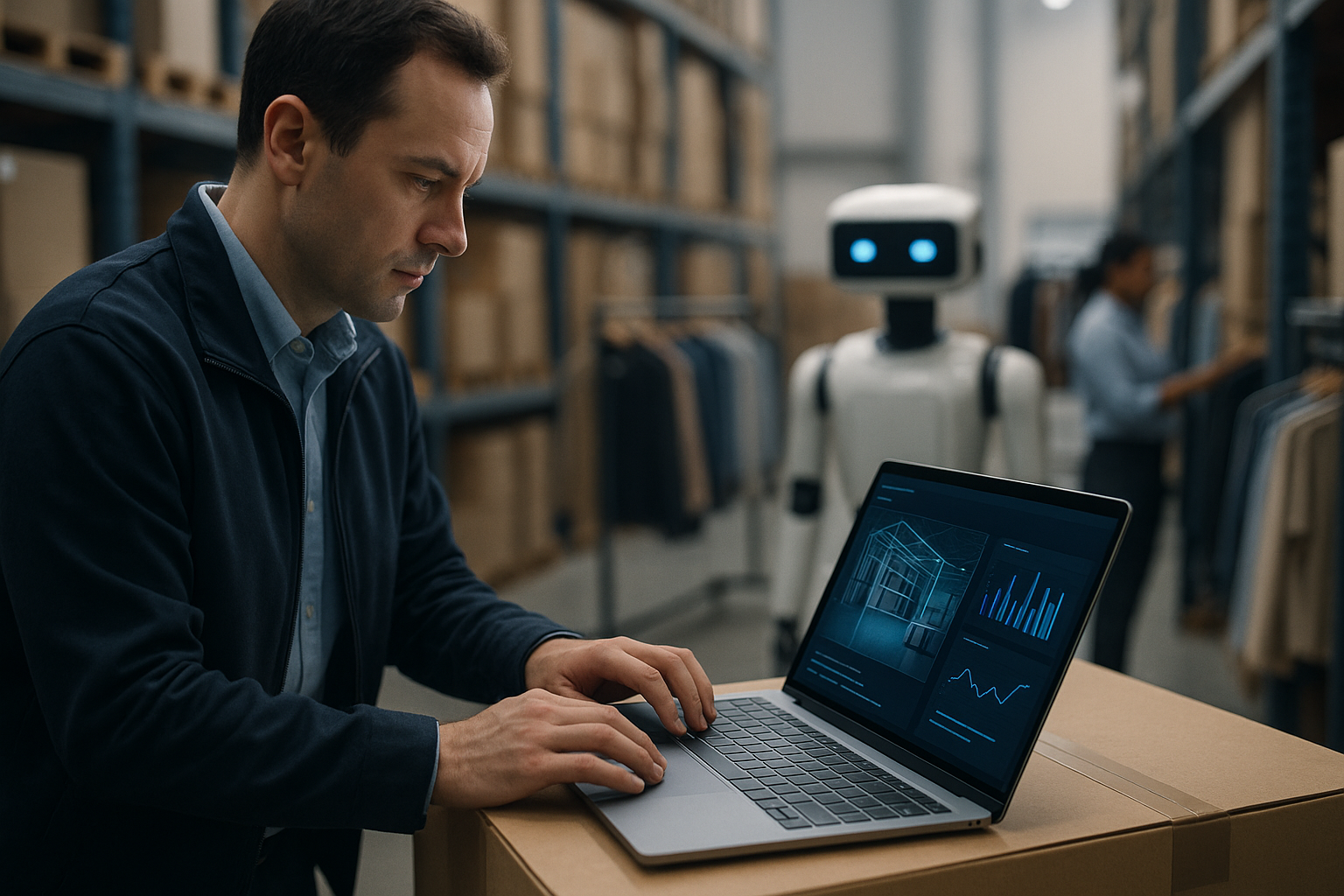
NVIDIA retail AI blueprints: Intelligent Warehouses and Catalog Enrichment Move from Pilot to Production
Retailers are accelerating AI adoption across operations and customer experience, and NVIDIA is pushing that shift with an end-to-end stack spanning customer assistants, intelligent warehouses, and catalog enrichment. The NVIDIA retail AI blueprints tie together reference workflows and partner solutions to speed deployment while keeping systems grounded in enterprise data and safety policies [1][3][4].
Where the NVIDIA retail AI blueprints fit
NVIDIA’s push centers on three pillars: a Retail Shopping Assistant Blueprint for always-on, domain-grounded support; Omniverse digital twins for multi-agent intralogistics; and generative AI for product catalog enrichment. The goal is to improve search, recommendations, support, throughput, and resilience across the retail pipeline [1][3][4].
The company and partners emphasize production-ready patterns that sit atop enterprise data and integrate safety controls, reflecting survey findings that retailers are graduating AI initiatives from pilots to live deployments [1][3].
What is the Retail Shopping Assistant Blueprint?
The Retail Shopping Assistant Blueprint is a generative AI reference workflow built on NVIDIA AI Enterprise and NIM microservices for retail. It uses large language models such as Meta Llama 3.3 70B, Retrieval-Augmented Generation via NeMo Retriever for grounded search and reranking, and NeMo Guardrails for safety and policy control. Designed to sit on enterprise data, it powers search, recommendations, and customer support across digital and physical channels [1].
This blueprint targets retailers seeking domain-aware assistants that scale across touchpoints while maintaining compliance and consistency. Its microservices approach aligns with integration into existing systems and data stores [1].
Safety, compliance, and governance with NeMo Guardrails
NeMo Guardrails provides policy enforcement, safety filtering, and compliance controls for retail conversational agents. By constraining responses and aligning behavior with enterprise rules, it supports risk-aware deployments in regulated and brand-sensitive environments [1].
Intelligent warehouses: Omniverse digital twins and multi-agent simulation
On the physical operations side, Omniverse-based digital twins let teams design warehouse layouts, simulate multi-robot fleets, optimize routing, and validate multi-agent workflows before deployment. Omniverse Blueprints are used to test and tune intralogistics in a virtual environment, aiming for higher throughput, lower costs, and better resilience once systems go live [4].
These capabilities are part of a broader “physical AI” strategy that extends from intelligent warehouses to in-store operations, connecting simulation, robotics, and analytics to operational KPIs [4]. This is where the NVIDIA retail AI blueprints also emphasize simulation-first validation to reduce deployment risk [4].
Video analytics and robotics: NVIDIA Metropolis and intralogistics stacks
NVIDIA Metropolis powers intelligent video analytics for warehouses and stores, enabling automated tracking, inventory visibility, and operational analytics designed to reduce shrink and improve throughput. It complements robotics stacks for smart warehouses and intelligent stores, creating a feedback loop between perception, planning, and performance monitoring [4].
AI catalog enrichment: turning raw data into discovery-ready content
Generative AI is also being applied to catalog enrichment, converting raw product data into structured attributes and high-quality copy to improve search relevance, discovery, personalization, and merchandising. Partners like Grid Dynamics are highlighting production deployments and intralogistics optimization in collaboration with NVIDIA and Dell at NRF 2026, signaling growing maturity across both content and operations workflows [5][6].
For retailers evaluating AI catalog enrichment, the approach supports cleaner data pipelines and faster time-to-market on product content — critical inputs for recommendation quality and conversion [6]. This content pillar further strengthens the NVIDIA retail AI blueprints by linking upstream product data to downstream customer experiences [1][6].
From pilot to production: signals from the field
NVIDIA’s State of AI in Retail and CPG survey indicates that agentic and physical AI are moving from pilots into production, with goals centered on process speed, personalization, and data-driven decision-making. The company also notes that forward-looking benefits are subject to execution risks and market uncertainties — a reminder to pair ambition with governance and staged rollouts [3].
Implementation notes and next steps
- Start with data readiness: clean product catalogs, standardized attributes, and policies for conversational agents [1][6].
- Use NIM microservices for retail to integrate assistants with enterprise systems and orchestrate retrieval, generation, and safety layers [1].
- Leverage Omniverse Blueprints to simulate multi-robot workflows before deployment; refine layouts, routing, and resilience strategies virtually [4].
- Apply NVIDIA Metropolis warehouse analytics to connect video insights with inventory visibility and shrink reduction programs [4].
- Validate with controlled pilots and measurable KPIs aligned to throughput, conversion, and time-to-content, then scale to production [3][4][6].
For official details, see NVIDIA’s announcement on the Retail Shopping Assistant Blueprint in the company newsroom (official announcement, external) and review broader retail solution pages for Omniverse and Metropolis alignment [1][4]. For hands-on guidance and solution patterns, you can also Explore AI tools and playbooks.
Sources
[1] NVIDIA Announces Blueprint for AI Retail Shopping Assistants
https://nvidianews.nvidia.com/news/nvidia-announces-blueprint-for-ai-retail-shopping-assistants
[2] AI Successes from L’Oréal, Lowe’s, Walmart: AI Conversation
https://www.retailtouchpoints.com/topics/retail-innovation/ai-successes-from-loreal-lowes-and-walmart-bring-context-to-the-ai-conversation
[3] From Warehouse to Wallet: New State of AI in Retail and CPG
https://blogs.nvidia.com/blog/ai-in-retail-cpg-survey-2026/
[4] Retail Industry Solutions Powered by AI – NVIDIA
https://www.nvidia.com/en-us/industries/retail/
[5] Meet Grid Dynamics with NVIDIA & Dell at NRF 2026
https://www.griddynamics.com/events/meet-grid-dynamics-with-nvidia-dell-at-nrf-2026
[6] AI Catalog Enrichment for Retail: Transforming Raw Product Data
https://www.linkedin.com/pulse/ai-catalog-enrichment-retail-transforming-raw-product-data-revenue-7lsif
